Thank you for visiting SNEWPapers!
Sign up free
Editorial
August 7, 1801
The National Intelligencer And Washington Advertiser
Washington, District Of Columbia
What is this article about?
This editorial argues for a more precise definition of powers in the U.S. Federal Constitution to prevent government usurpation, departmental conflicts, and loss of liberties, without radical changes. It emphasizes the harmony between people and government in a republic, signed by SOLON.
Clipping
OCR Quality
98%
Excellent
Full Text
FOR THE NATIONAL INTELLIGENCER.
No. II.
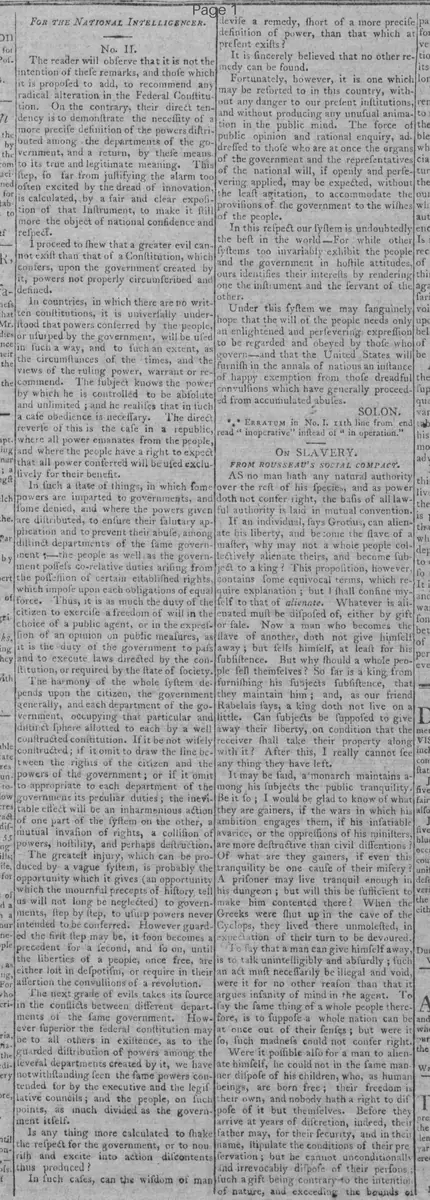
The reader will observe that it is not the intention of these remarks, and those which it is proposed to add, to recommend any radical alteration in the Federal Constitution. On the contrary, their direct tendency is to demonstrate the necessity of a more precise definition of the powers distributed among the departments of the government, and a return, by these means, to its true and legitimate meaning. This step, so far from justifying the alarm too often excited by the dread of innovation, is calculated, by a fair and clear exposition of that Instrument, to make it still more the object of national confidence and respect.
I proceed to show that a greater evil cannot exist than that of a Constitution, which confers, upon the government created by it, powers not properly circumscribed and defined.
In countries, in which there are no written constitutions, it is universally understood that powers conferred by the people, or usurped by the government, will be used in such a way, and to such an extent, as the circumstances of the times, and the views of the ruling power, warrant or recommend. The subject knows the power by which he is controlled to be absolute and unlimited; and he realizes that in such a case obedience is necessary. The direct reverse of this is the case in a republic, where all power emanates from the people, and where the people have a right to expect that all power conferred will be used exclusively for their benefit.
In such a state of things, in which some powers are imparted to governments, and some denied, and where the powers given are distributed, to ensure their salutary application and to prevent their abuse, among distinct departments of the same government;—the people as well as the government possess co-relative duties arising from the possession of certain established rights, which impose upon each obligations of equal force. Thus, it is as much the duty of the citizen to exercise a freedom of will in the choice of a public agent, or in the expression of an opinion on public measures, as it is the duty of the government to pass and to execute laws directed by the constitution, or required by the state of society. The harmony of the whole system depends upon the citizen, the government generally, and each department of the government, occupying that particular and distinct sphere allotted to each by a well constructed constitution. If it be not wisely constructed; if it omit to draw the line between the rights of the citizen and the powers of the government; or if it omit to appropriate to each department of the government its peculiar duties; the inevitable effect will be an inharmonious action of one part of the system on the other, a mutual invasion of rights, a collision of powers, hostility, and perhaps destruction.
The greatest injury, which can be produced by a vague system, is probably the opportunity which it gives (an opportunity which the mournful precepts of history tell us will not long be neglected) to governments, step by step, to usurp powers never intended to be conferred. However guarded the first step may be, it soon becomes a precedent for a second, and so on, until the liberties of a people, once free, are either lost in despotism, or require in their assertion the convulsions of a revolution.
The next grade of evils takes its source in the conflicts between different departments of the same government. However superior the federal constitution may be to all others in existence, as to the guarded distribution of powers among the several departments created by it, we have notwithstanding seen the same powers contended for by the executive and the legislative councils; and the people, on such points, as much divided as the government itself.
Is any thing more calculated to shake the respect for the government, or to nourish and excite into action discontents thus produced?
In such cases, can the wisdom of man devise a remedy, short of a more precise definition of power, than that which at present exists?
It is sincerely believed that no other remedy can be found.
Fortunately, however, it is one which may be resorted to in this country, without any danger to our present institutions, and without producing any unusual animation in the public mind. The force of public opinion and rational enquiry, addressed to those who are at once the organs of the government and the representatives of the national will, if openly and persevering applied, may be expected, without the least agitation, to accommodate the provisions of the government to the wishes of the people.
In this respect our system is undoubtedly the best in the world For while other systems too invariably exhibit the people and the government in hostile attitudes, ours identifies their interests by rendering one the instrument and the servant of the other.
Under this system we may sanguinely hope that the will of the people needs only an enlightened and persevering expression to be regarded and obeyed by those who govern and that the United States will furnish in the annals of nations an instance of happy exemption from those dreadful convulsions which have generally proceeded from accumulated abuses.
SOLON.
No. II.
The reader will observe that it is not the intention of these remarks, and those which it is proposed to add, to recommend any radical alteration in the Federal Constitution. On the contrary, their direct tendency is to demonstrate the necessity of a more precise definition of the powers distributed among the departments of the government, and a return, by these means, to its true and legitimate meaning. This step, so far from justifying the alarm too often excited by the dread of innovation, is calculated, by a fair and clear exposition of that Instrument, to make it still more the object of national confidence and respect.
I proceed to show that a greater evil cannot exist than that of a Constitution, which confers, upon the government created by it, powers not properly circumscribed and defined.
In countries, in which there are no written constitutions, it is universally understood that powers conferred by the people, or usurped by the government, will be used in such a way, and to such an extent, as the circumstances of the times, and the views of the ruling power, warrant or recommend. The subject knows the power by which he is controlled to be absolute and unlimited; and he realizes that in such a case obedience is necessary. The direct reverse of this is the case in a republic, where all power emanates from the people, and where the people have a right to expect that all power conferred will be used exclusively for their benefit.
In such a state of things, in which some powers are imparted to governments, and some denied, and where the powers given are distributed, to ensure their salutary application and to prevent their abuse, among distinct departments of the same government;—the people as well as the government possess co-relative duties arising from the possession of certain established rights, which impose upon each obligations of equal force. Thus, it is as much the duty of the citizen to exercise a freedom of will in the choice of a public agent, or in the expression of an opinion on public measures, as it is the duty of the government to pass and to execute laws directed by the constitution, or required by the state of society. The harmony of the whole system depends upon the citizen, the government generally, and each department of the government, occupying that particular and distinct sphere allotted to each by a well constructed constitution. If it be not wisely constructed; if it omit to draw the line between the rights of the citizen and the powers of the government; or if it omit to appropriate to each department of the government its peculiar duties; the inevitable effect will be an inharmonious action of one part of the system on the other, a mutual invasion of rights, a collision of powers, hostility, and perhaps destruction.
The greatest injury, which can be produced by a vague system, is probably the opportunity which it gives (an opportunity which the mournful precepts of history tell us will not long be neglected) to governments, step by step, to usurp powers never intended to be conferred. However guarded the first step may be, it soon becomes a precedent for a second, and so on, until the liberties of a people, once free, are either lost in despotism, or require in their assertion the convulsions of a revolution.
The next grade of evils takes its source in the conflicts between different departments of the same government. However superior the federal constitution may be to all others in existence, as to the guarded distribution of powers among the several departments created by it, we have notwithstanding seen the same powers contended for by the executive and the legislative councils; and the people, on such points, as much divided as the government itself.
Is any thing more calculated to shake the respect for the government, or to nourish and excite into action discontents thus produced?
In such cases, can the wisdom of man devise a remedy, short of a more precise definition of power, than that which at present exists?
It is sincerely believed that no other remedy can be found.
Fortunately, however, it is one which may be resorted to in this country, without any danger to our present institutions, and without producing any unusual animation in the public mind. The force of public opinion and rational enquiry, addressed to those who are at once the organs of the government and the representatives of the national will, if openly and persevering applied, may be expected, without the least agitation, to accommodate the provisions of the government to the wishes of the people.
In this respect our system is undoubtedly the best in the world For while other systems too invariably exhibit the people and the government in hostile attitudes, ours identifies their interests by rendering one the instrument and the servant of the other.
Under this system we may sanguinely hope that the will of the people needs only an enlightened and persevering expression to be regarded and obeyed by those who govern and that the United States will furnish in the annals of nations an instance of happy exemption from those dreadful convulsions which have generally proceeded from accumulated abuses.
SOLON.
What sub-type of article is it?
Constitutional
Legal Reform
What keywords are associated?
Constitutional Powers
Government Usurpation
Federal Constitution
Departmental Conflicts
Public Opinion
Republican Harmony
What entities or persons were involved?
Federal Constitution
Executive
Legislative Councils
The People
Editorial Details
Primary Topic
Necessity Of Precise Definition Of Constitutional Powers
Stance / Tone
Advocating Clearer Constitutional Definitions To Prevent Abuse Without Radical Alteration
Key Figures
Federal Constitution
Executive
Legislative Councils
The People
Key Arguments
Vague Constitutions Enable Gradual Usurpation Of Powers Leading To Despotism Or Revolution.
Conflicts Between Government Departments Undermine Respect And Cause Division.
Precise Definition Of Powers Ensures Harmony Between Citizens And Government.
Public Opinion Can Reform The Constitution Peacefully Without Agitation.
The U.S. System Identifies People's And Government's Interests, Preventing Convulsions.