Thank you for visiting SNEWPapers!
Sign up free
Story
February 9, 1912
Rural Retreat Times
Rural Retreat, Wythe County, Virginia
What is this article about?
T. E. Schreiner of Kansas State Agricultural College explains profitable small-scale goose farming: low costs, forage-based feeding, valuable eggs/meat/feathers, market goslings at 12 weeks, Toulouse/Embden breeds, natural hatching, protections needed.
Clipping
OCR Quality
98%
Excellent
Full Text
BIG PROFIT IN GEESE
Eggs, Alone, Bring Good Prices For Hatching.
Then There Is the Meat and Feathers to Sell on Ready Markets-There Is But Little Waste in These Foraging Fowls.
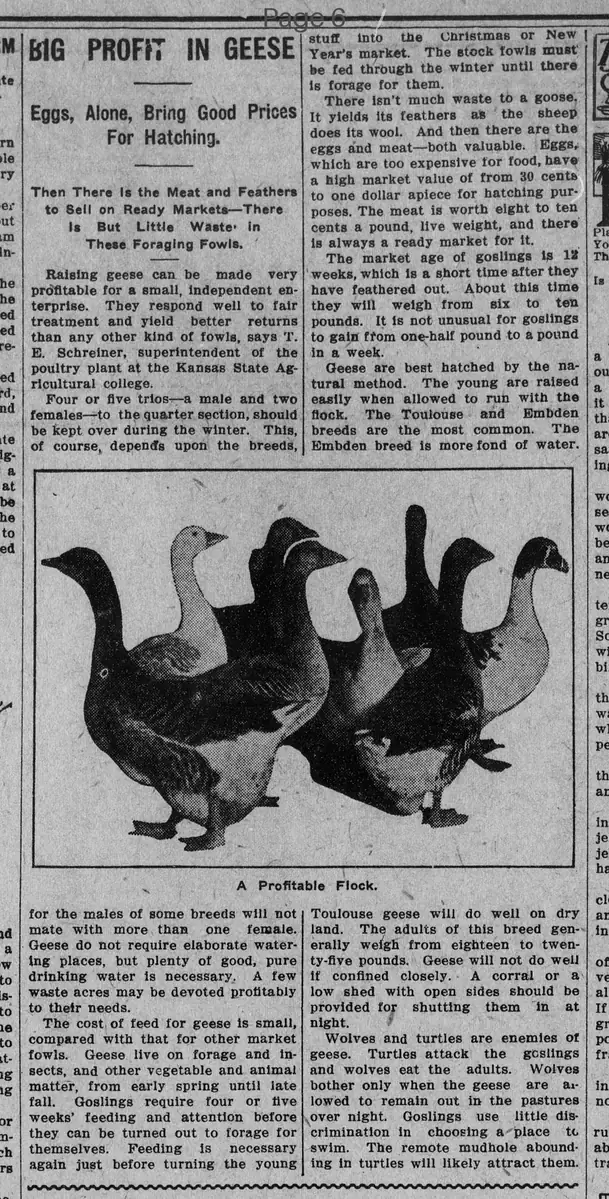
Raising geese can be made very profitable for a small, independent enterprise. They respond well to fair treatment and yield better returns than any other kind of fowls, says T. E. Schreiner, superintendent of the poultry plant at the Kansas State Agricultural college.
Four or five trios--a male and two females--to the quarter section, should be kept over during the winter. This, of course, depends upon the breeds, for the males of some breeds will not mate with more than one female.
Geese do not require elaborate watering places, but plenty of good, pure drinking water is necessary. A few waste acres may be devoted profitably to their needs.
The cost of feed for geese is small, compared with that for other market fowls. Geese live on forage and insects, and other vegetable and animal matter, from early spring until late fall. Goslings require four or five weeks' feeding and attention before they can be turned out to forage for themselves. Feeding is necessary again just before turning the young stuff into the Christmas or New Year's market. The stock fowls must be fed through the winter until there is forage for them.
There isn't much waste to a goose. It yields its feathers as the sheep does its wool. And then there are the eggs and meat-both valuable. Eggs, which are too expensive for food, have a high market value of from 30 cents to one dollar apiece for hatching purposes. The meat is worth eight to ten cents a pound, live weight, and there is always a ready market for it.
The market age of goslings is 12 weeks, which is a short time after they have feathered out. About this time they will weigh from six to ten pounds. It is not unusual for goslings to gain from one-half pound to a pound in a week.
Geese are best hatched by the natural method. The young are raised easily when allowed to run with the flock. The Toulouse and Embden breeds are the most common. The Embden breed is more fond of water. Toulouse geese will do well on dry land. The adults of this breed generally weigh from eighteen to twenty-five pounds. Geese will not do well if confined closely. A corral or a low shed with open sides should be provided for shutting them in at night.
Wolves and turtles are enemies of geese. Turtles attack the goslings and wolves eat the adults. Wolves bother only when the geese are allowed to remain out in the pastures over night. Goslings use little discrimination in choosing a place to swim. The remote mudhole abounding in turtles will likely attract them.
Eggs, Alone, Bring Good Prices For Hatching.
Then There Is the Meat and Feathers to Sell on Ready Markets-There Is But Little Waste in These Foraging Fowls.
Raising geese can be made very profitable for a small, independent enterprise. They respond well to fair treatment and yield better returns than any other kind of fowls, says T. E. Schreiner, superintendent of the poultry plant at the Kansas State Agricultural college.
Four or five trios--a male and two females--to the quarter section, should be kept over during the winter. This, of course, depends upon the breeds, for the males of some breeds will not mate with more than one female.
Geese do not require elaborate watering places, but plenty of good, pure drinking water is necessary. A few waste acres may be devoted profitably to their needs.
The cost of feed for geese is small, compared with that for other market fowls. Geese live on forage and insects, and other vegetable and animal matter, from early spring until late fall. Goslings require four or five weeks' feeding and attention before they can be turned out to forage for themselves. Feeding is necessary again just before turning the young stuff into the Christmas or New Year's market. The stock fowls must be fed through the winter until there is forage for them.
There isn't much waste to a goose. It yields its feathers as the sheep does its wool. And then there are the eggs and meat-both valuable. Eggs, which are too expensive for food, have a high market value of from 30 cents to one dollar apiece for hatching purposes. The meat is worth eight to ten cents a pound, live weight, and there is always a ready market for it.
The market age of goslings is 12 weeks, which is a short time after they have feathered out. About this time they will weigh from six to ten pounds. It is not unusual for goslings to gain from one-half pound to a pound in a week.
Geese are best hatched by the natural method. The young are raised easily when allowed to run with the flock. The Toulouse and Embden breeds are the most common. The Embden breed is more fond of water. Toulouse geese will do well on dry land. The adults of this breed generally weigh from eighteen to twenty-five pounds. Geese will not do well if confined closely. A corral or a low shed with open sides should be provided for shutting them in at night.
Wolves and turtles are enemies of geese. Turtles attack the goslings and wolves eat the adults. Wolves bother only when the geese are allowed to remain out in the pastures over night. Goslings use little discrimination in choosing a place to swim. The remote mudhole abounding in turtles will likely attract them.
What sub-type of article is it?
Agricultural Guide
What keywords are associated?
Geese Raising
Goslings Market
Poultry Profit
Forage Feeding
Hatching Eggs
What entities or persons were involved?
T. E. Schreiner
Where did it happen?
Kansas
Story Details
Key Persons
T. E. Schreiner
Location
Kansas
Story Details
Article on profitable goose raising: keep 4-5 trios per quarter section, low feed costs on forage, sell eggs (30c-$1 for hatching), meat (8-10c/lb), feathers; market goslings at 12 weeks (6-10lbs); best breeds Toulouse and Embden; natural hatching; protect from wolves and turtles.