Thank you for visiting SNEWPapers!
Sign up free
New York Tribune
New York, New York County, New York
What is this article about?
In Allegheny City on Aug. 14, the National Convention of United Presbyterian Church's anti-music faction convened with 200 attendees, elected officers, discussed history of instruments in worship, and proposed resolutions challenging the 1882 authorization of instrumental music.
Clipping
OCR Quality
Full Text
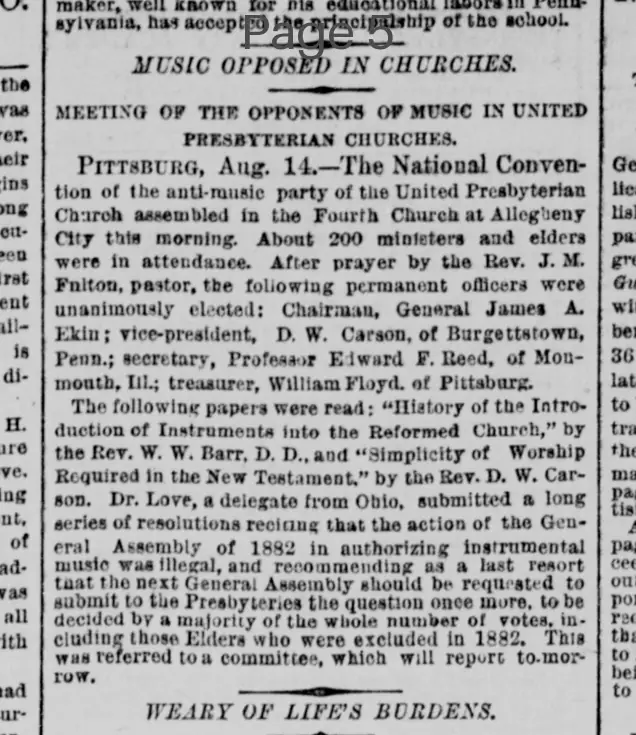
MEETING OF THE OPPONENTS OF MUSIC IN UNITED PRESBYTERIAN CHURCHES.
Pittsburg, Aug. 14.—The National Convention of the anti-music party of the United Presbyterian Church assembled in the Fourth Church at Allegheny City this morning. About 200 ministers and elders were in attendance. After prayer by the Rev. J. M. Fulton, pastor, the following permanent officers were unanimously elected: Chairman, General James A. Ekin; vice-president, D. W. Carson, of Burgettstown, Penn.; secretary, Professor Edward F. Reed, of Monmouth, Ill.; treasurer, William Floyd, of Pittsburg
The following papers were read: "History of the Introduction of Instruments into the Reformed Church," by the Rev. W. W. Barr, D. D., and "Simplicity of Worship Required in the New Testament " by the Rev. D. W. Carson. Dr. Love, a delegate from Ohio, submitted a long series of resolutions reciting that the action of the General Assembly of 1882 in authorizing instrumental music was illegal, and recommending as a last resort that the next General Assembly should be requested to submit to the Presbyteries the question once more, to be decided by a majority of the whole number of votes, including those Elders who were excluded in 1882. This was referred to a committee, which will report to-morrow.
What sub-type of article is it?
What themes does it cover?
What keywords are associated?
What entities or persons were involved?
Where did it happen?
Story Details
Key Persons
Location
Allegheny City, Fourth Church, Near Pittsburg
Event Date
Aug. 14
Story Details
The National Convention of the anti-music party of the United Presbyterian Church met in Allegheny City with about 200 ministers and elders. Officers were elected, papers on history and worship simplicity were read, and resolutions against the 1882 General Assembly's authorization of instrumental music were submitted for committee review.