Thank you for visiting SNEWPapers!
Sign up free
The Organizer
Oxford, Lafayette County, Mississippi
What is this article about?
The U.S. steamship Alabama arrived from Chagres on March 22, bringing Pacific intelligence to March 21, passengers including officials, reports of Isthmus population, transportation shortages to California, and positive conditions at Chagres with healthy crew.
Clipping
OCR Quality
Full Text
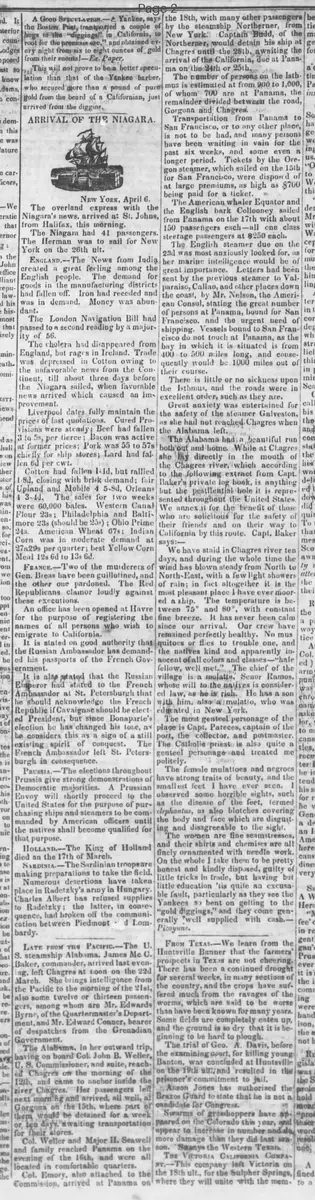
She brings intelligence from the Pacific to the morning of the 21st, also some twelve or thirteen passengers, among whom are Mr. Edwards Byrne, of the Quartermaster's Department, and Mr. Edward Conner, bearer of despatches from the Grenadian Government.
The Alabama, in her outward trip, having on board Col. John B. Weller, U. S. Commissioner, and suite, reached Chagres the morning of the 12th, and came to anchor inside the river Chagres.
Her passengers left next morning and arrived all well, at Gorgona on the 15th, where part of them would be detained for a week or ten days, awaiting transportation for their stores.
Col. Weller and Major H. Seawell and Family reached Panama on the evening of the 16th, and were all located in comfortable quarters.
Col. Emory, also attached to the Commission, arrived at Panama on the 18th, with many other passengers by the steamship Northerner, from New York. Captain Budd, of the Northerner, would detain his ship at Chagres until the 28th, awaiting the arrival of the California, due at Panama on the 24th or 25th.
The number of persons on the Isthmus is estimated at from 900 to 1,000, of whom 700 are at Panama, the remainder divided between the road, Gorgona and Chagres.
Transportation from Panama to San Francisco, or to any other place, is not to be had, and many persons have been waiting in vain for the past six weeks, and some even a longer period. Tickets by the Oregon steamer, which sailed on the 15th for San Francisco, were disposed of at large premiums, as high as $700 being paid for a ticket.
The American whaler Equator and the English bark Collooney sailed from Panama on the 17th with about 150 passengers each—all one class steerage passengers at $250 each.
The English steamer due on the 23d was most anxiously looked for, as her marine intelligence would be of great importance. Letters had been sent by the previous steamer to Valparaiso, Callao, and other places down the coast, by Mr. Nelson, the American Consul, stating the great number of persons at Panama, bound for San Francisco, and the urgent need of shipping. Vessels bound to San Francisco do not touch at Panama, as the bay in which it is situated is from 400 to 500 miles long, and consequently would be 1000 miles out of their course.
There is little or no sickness upon the Isthmus, and the roads were in excellent order, such as they are.
Great anxiety was entertained for the safety of the steamer Galveston, as she had not reached Chagres when the Alabama left.
The Alabama had a beautiful run both out and home. While at Chagres she lay directly in the mouth of the Chagres river, which according to the following extract from Capt. Baker's private log book, is anything but the pestilential hole it is represented throughout the United States. We annex it for the benefit of those who are solicitous for the safety of their friends and on their way to California by this route. Capt. Baker says:
We have staid in Chagres river ten days, and during the whole time the wind has blown steady from North to North-East, with a few light showers of rain; in fact altogether it is the most pleasant place I have ever moored a ship.
The temperature is between 75 and 80, with constant fine breeze. It has never been calm since our arrival. Our crew have remained perfectly healthy. No mosquitoes or flies to trouble one, and the natives kind and apparently innocent of all colors and classes—“hale fellow, well met.” The chief of the village is a mulatto, Senor Ramos, whose will to the natives is considered law, as he is rich. He has a son with him, also a mulatto, who was educated in New York.
The most genteel personage of the place is Capt. Pareces, captain of the port, the collector, and postmaster. The Catholic priest is also quite a genteel personage and treated me politely.
The female mulattoes and negroes have strong traits of beauty, and the smallest feet I have ever seen. I observed some horrible sights, such as the disease of the feet, termed elephantiasis, as also blotches covering the body and face which are disgusting and disagreeable to the sight.
The women are fine seamstresses, and their shirts and chemises are all finely ornamented with needle work.
On the whole I take them to be pretty honest and kindly disposed, guilty of little tricks in trade, but having but little education 'tis quite an excusable fault, particularly as they see the Yankees so bent on getting to the "gold diggings," and they come generally well supplied with cash.—Picayune.
What sub-type of article is it?
What keywords are associated?
What entities or persons were involved?
Where did it happen?
Domestic News Details
Primary Location
Chagres, Panama Isthmus
Event Date
22d March
Key Persons
Outcome
no sickness on isthmus; healthy crew; transportation shortages with high ticket premiums; anxiety for steamer galveston; favorable conditions at chagres.
Event Details
U.S. steamship Alabama arrived with intelligence from Pacific to 21st March, carrying passengers including officials; reports on outward trip delivering commissioners to Panama; estimated 900-1000 persons on Isthmus awaiting transport to San Francisco amid shortages; ships Equator and Collooney sailed with passengers; Captain Baker's log praises Chagres conditions and locals.