Thank you for visiting SNEWPapers!
Sign up free
Ellsworth American
Ellsworth, Hancock County, Maine
What is this article about?
German occupation during World War I has ruined Courtrai, Belgium's vital flax production district: barges sold cheaply, machinery seized, factories used for quarters, and fields repurposed or battle-scarred, delaying recovery for years.
Clipping
OCR Quality
Full Text
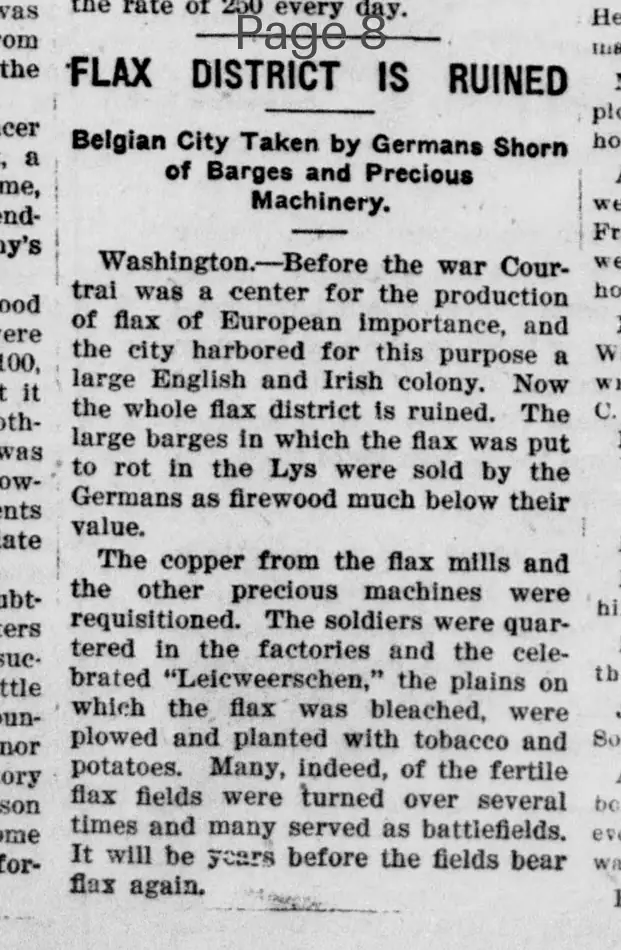
Belgian City Taken by Germans Shorn of Barges and Precious Machinery.
Washington. Before the war Courtrai was a center for the production of flax of European importance, and the city harbored for this purpose a large English and Irish colony. Now the whole flax district is ruined. The large barges in which the flax was put to rot in the Lys were sold by the Germans as firewood much below their value.
The copper from the flax mills and the other precious machines were requisitioned. The soldiers were quartered in the factories and the celebrated "Leie weerschen," the plains on which the flax was bleached, were plowed and planted with tobacco and potatoes. Many, indeed, of the fertile flax fields were turned over several times and many served as battlefields.
It will be years before the fields bear flax again.
What sub-type of article is it?
What keywords are associated?
Where did it happen?
Foreign News Details
Primary Location
Courtrai, Belgium
Outcome
the whole flax district is ruined. the large barges were sold by the germans as firewood much below their value. the copper from the flax mills and the other precious machines were requisitioned. it will be years before the fields bear flax again.
Event Details
Before the war Courtrai was a center for the production of flax of European importance, and the city harbored for this purpose a large English and Irish colony. Now the whole flax district is ruined. The large barges in which the flax was put to rot in the Lys were sold by the Germans as firewood much below their value. The copper from the flax mills and the other precious machines were requisitioned. The soldiers were quartered in the factories and the celebrated "Leie weerschen," the plains on which the flax was bleached, were plowed and planted with tobacco and potatoes. Many, indeed, of the fertile flax fields were turned over several times and many served as battlefields.