Thank you for visiting SNEWPapers!
Sign up free
The Daily Worker
Chicago, Cook County, Illinois
What is this article about?
Article exposes Tammany Hall's 1927-1933 graft scheme in NYC's East Side, where city bought $16M slum land at Christie-Forsythe Streets under Walker, displacing tenants, with Rockefeller ties and secret 1933 rebuilding plans for high-rent housing to benefit insiders before elections.
Clipping
OCR Quality
Full Text
IN GRAFT SCHEME AS ELECTIONS LOOM
ROCKEFELLER LOT
WAS SOLD TO CITY
IN BIG 1927 STEAL
To Charge Exorbitant
Rent for Rooms
By PHILIP SHORT
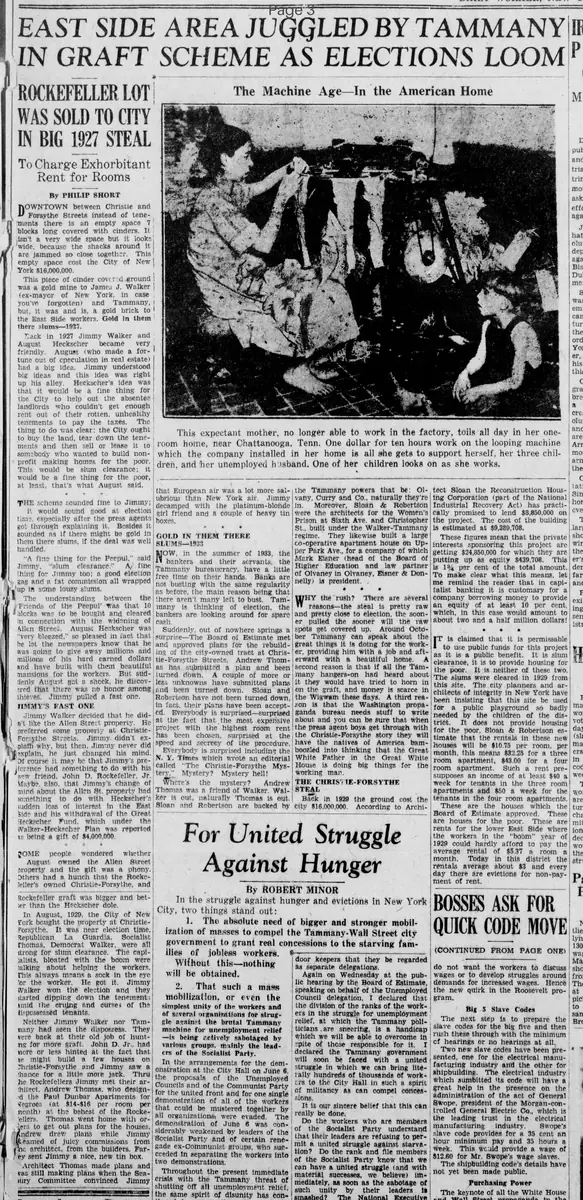
Downtown between Christie and Forsythe Streets instead of tenements there is an empty space 7 blocks long covered with cinders. It isn't a very wide space but it looks wide because the shacks around it are jammed so close together. This empty space cost the City of New York $16,000,000.
This piece of cinder covered ground was a gold mine to James J. Walker (ex-mayor of New York, in case you've forgotten) and Tammany. But, it was and is, a gold brick to the East Side workers. Gold in them there slums-1927.
Back in 1927 Jimmy Walker and August Heckscher became very friendly. August (who made a fortune out of speculation in real estate) had a big idea. Jimmy understood big ideas and this idea was right up his alley. Heckscher's idea was that it would be a fine thing for the City to help out the absentee landlords who couldn't get enough rent out of their rotten, unhealthy tenements to pay the taxes. The thing to do was clear: the City ought to buy the land, tear down the tenements and then sell or lease it to somebody who wanted to build non-profit making homes for the poor. This would be slum clearance; it would be a fine thing for the poor, at least, that's what August said.
THE scheme sounded fine to Jimmy; it would sound good at election times, especially after the press agents got through explaining it. Besides it sounded as if there might be gold in them there slums, if the deal was well handled.
"A fine thing for the Peepul," said Jimmy, "slum clearance." A fine thing for Jimmy too: a good election gag and a fat commission all wrapped up in some lousy slums.
The understanding between the Friends of the Peepul' was that 10 blocks was to be bought and cleared in connection with the widening of Allen Street. August Heckscher was "very pleased," so pleased in fact that he let the newspapers know that he was going to give away millions and millions of his hard earned dollars and have built with them beautiful mansions for the workers. But suddenly August got a shock, he discovered that there was no honor among thieves. Jimmy pulled a fast one.
JIMMY'S FAST ONE
Jimmy Walker decided that he didn't like the Allen Street property. He preferred some property at Christie-Forsythe Streets. Jimmy didn't explain why, but then, Jimmy never did explain, he just changed his mind. Of course it may be that Jimmy's preference had something to do with his new friend, John D. Rockefeller, Jr. Maybe, also, that Jimmy's change of mind about the Allen St. property had something to do with Heckscher's sudden loss of interest in the East Side and his withdrawal of the Great Heckscher Fund, which under the Walker-Heckscher Plan was reported as being a gift of $4,000,000.
SOME people wondered whether August owned the Allen Street property and the gift was a phony. Others had a hunch that the Rockefellers owned Christie-Forsythe, and Rockefeller graft was bigger and better than the Heckscher dole.
In August, 1929, the City of New York bought the property at Christie-Forsythe. It was near election time, Republican La Guardia, Socialist Thomas, Democrat Walker, were all strong for slum clearance. The capitalists, bloated with the boom were talking about helping the workers. This always means a sock in the eye for the worker. He got it. Jimmy Walker won the election and they started ripping down the tenement. amid the crying and curses of the dispossessed tenants.
Neither Jimmy Walker nor Tammany had seen the dispossess. They were back at their old job of hunting for more graft. John D. Jr., had more or less hinted at the fact that he might build a few houses on Christie-Forsythe and Jimmy saw a chance for a little more jack. Thru the Rockefellers Jimmy met their architect, Andrew Thomas, who designed the Paul Dunbar Apartments for Negroes (at $14-$16 per room per month) at the behest of the Rockefellers. Thomas went home with orders to get out plans for the houses. Andrew drew plans while Jimmy dreamed of juicy commissions from the architect, from the builders. Farley sent Jimmy a nice, new tin box.
Architect Thomas made plans and was still making plans when the Seabury Committee convinced Jimmy that European air was a lot more salubrious than New York air. Jimmy decamped with the platinum-blonde girl friend and a couple of heavy tin boxes.
GOLD IN THEM THERE SLUMS-1933
NOW, in the summer of 1933, the bankers and their servants, the Tammany bureaucracy, have a little free time on their hands. Banks are not busting with the same regularity as before, the main reason being that there aren't many left to bust. Tammany is thinking of election, the bankers are looking around for spare cash.
Suddenly, out of nowhere springs a surprise-The Board of Estimate met and approved plans for the rebuilding of the city-owned tract at Christie-Forsythe Streets. Andrew Thomas has submitted a plan and been turned down. A couple of more or less unknowns have submitted plans and been turned down. Sloan and Robertson have not been turned down. in fact, their plans have been accepted. Everybody is surprised-surprised at the fact that the most expensive project with the highest room rent has been chosen, surprised at the speed and secrecy of the procedure. Everybody is surprised including the N. Y. Times which wrote an editorial called "The Christie-Forsythe Mystery." Mystery? Mystery hell!
Where's the mystery? Andrew Thomas was a friend of Walker. Walker is out, naturally Thomas is out. Sloan and Robertson are backed by the Tammany powers that be: Olvany, Curry and Co., naturally they're in. Moreover, Sloan & Robertson were the architects for the Women's Prison at Sixth Ave. and Christopher St., built under the Walker-Tammany regime. They likewise built a large co-operative apartment house on Upper Park Ave., for a company of which Mark Eisner (head of the Board of Higher Education and law partner of Olvany in Olvany, Eisner & Donnelly) is president.
Why the rush? There are several reasons-the steal is pretty raw and pretty close to election, the sooner pulled the sooner will the raw spots get covered up. Around October Tammany can speak about the great things it is doing for the worker, providing him with a job and afterward with a beautiful home. A second reason is that if all the Tammany hangers-on had heard about it they would have tried to horn in on the graft, and money is scarce in the Wigwam these days. A third reason is that the Washington propaganda bureau needs stuff to write about and you can be sure that when the press agent boys get through with the Christie-Forsythe story they will have the natives of America bamboozled into thinking that the Great White Father in the Great White House is doing big things for the working man.
THE CHRISTIE-FORSYTHE STEAL
Back in 1929 the ground cost the city $16,000,000. According to Archi-
What sub-type of article is it?
What themes does it cover?
What keywords are associated?
What entities or persons were involved?
Where did it happen?
Story Details
Key Persons
Location
East Side, New York City, Between Christie And Forsythe Streets
Event Date
1927 1933
Story Details
Tammany Hall and Jimmy Walker orchestrate a slum clearance scheme, buying land for $16M in 1929 at Christie-Forsythe Streets, influenced by Rockefeller interests, displacing tenants amid graft; by 1933, plans for expensive rebuilding approved secretly for further profit before elections.