Thank you for visiting SNEWPapers!
Sign up free
The New York Journal, And Daily Patriotic Register
New York, New York County, New York
What is this article about?
In Letter V, a gentleman from Dutchess County criticizes the 1787 Constitutional Convention for producing a flawed constitution that threatens liberties, highlights Alexander Hamilton's unauthorized signing for New York, and urges amendments like a bill of rights, equitable representation, no standing army, and opposition to slavery expansion. Dated January 10, 1788.
Clipping
OCR Quality
Full Text
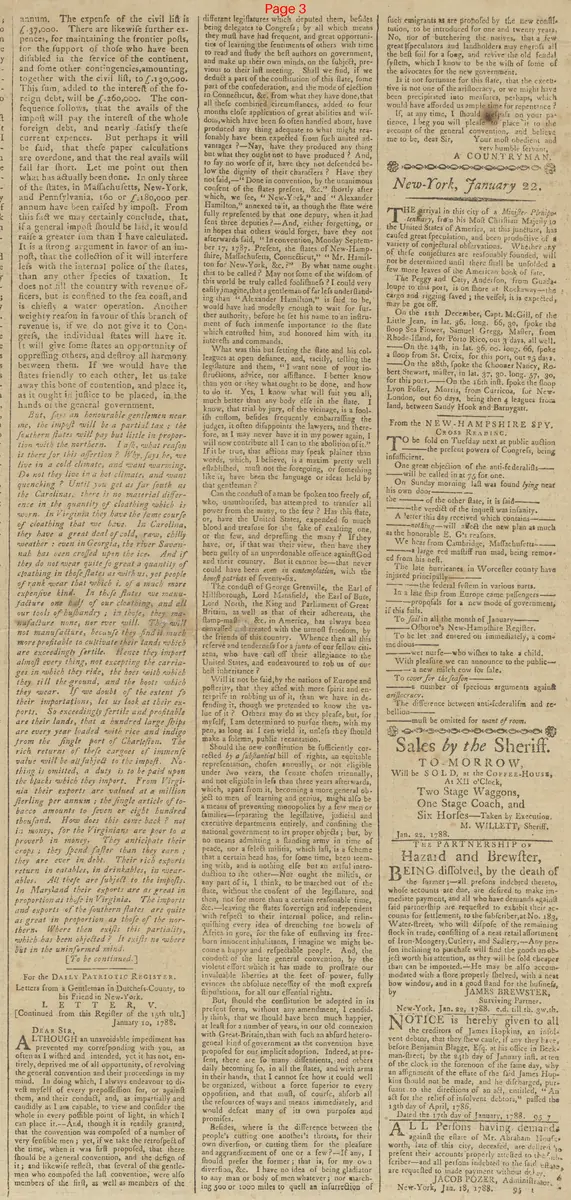
Letters from a Gentleman in Dutchess-County, to his Friend in New-York.
LETTER V.
[Continued from this Register of the 15th ult.]
January 10, 1788.
DEAR SIR,
ALTHOUGH an unavoidable impediment has prevented my corresponding with you, as often as I wished and intended, yet it has not, entirely, deprived me of all opportunity, of revolving the general convention and their proceedings in my mind. In doing which, I always endeavour to divest myself of every prepossession for, or against them, and their conduct, and, as impartially and candidly as I am capable, to view and consider the whole in every possible point of light, in which I can place it.--And, though it is readily granted, that the convention was composed of a number of very sensible men; yet, if we take the retrospect of the time, when it was first proposed, that there should be a general convention, and the design of it: and likewise reflect, that several of the gentlemen who composed the last convention, were also members of the first, as well as members of the different legislatures which deputed them, besides being delegates to Congress; by all which means they must have had frequent, and great opportunity of learning the sentiments of others with time to read and study the best authors on government, and make up their own minds, on the subject, previous to their last meeting. Shall we find, if we deduct a part of the constitution of this state, some part of the confederation, and the mode of election in Connecticut, &c, from what they have done, that all these combined circumstances, added to four months close application of great abilities and wisdom, which have been so often handed about, have produced any thing adequate to what might reasonably have been expected from such united advantages?--Nay, have they produced any thing but what they ought not to have produced? And, to say no more of it, have they not descended below the dignity of their characters? Have they not said,--"Done in convention, by the unanimous consent of the states present, &c." shortly after which, we see, "New-York," and "Alexander Hamilton," annexed to it, as though the state were fully represented by that one deputy, when it had sent three deputies?--And, either forgetting, or in hopes that others would forget, have they not afterwards said, "In convention, Monday September 17, 1787. Present, the states of New-Hampshire, Massachusetts, Connecticut," "Mr. Hamilton for New-York, &c.?" By what name ought this to be called? May not some of the wisdom of this world be truly called foolishness? I could very easily imagine, that a gentleman of far less understanding than "Alexander Hamilton," is said to be, would have had modesty enough to wait for further authority, before he set his name to an instrument of such immense importance to the state which entrusted him, and honored him with its interests and commands. What was this but setting the state and his colleagues at open defiance, and, tacitly, telling the legislature and them, "I want none of your instructions, advice, nor assistance. I better know than you or they what ought to be done, and how to do it. Yes, I know what will suit you all, much better than any body else in the state. I know, that trial by jury, of the vicinage, is a foolish custom, besides frequently embarrassing the judges, it often disappoints the lawyers, and therefore, as I may never have it in my power again, I will now contribute all I can to the abolition of it." If it be true, that actions may speak plainer than words, which, I believe, is a maxim pretty well established, must not the foregoing, or something like it, have been the language or ideas held by that gentleman? Can the conduct of a man be spoken too freely of, who, unauthorised, has attempted to transfer all power from the many, to the few? Has this state, or, have the United States, expended so much blood and treasure for the sake of exalting one, or the few, and depressing the many? If they have, or, if that was their view, then have they been guilty of an unpardonable offence against God and their country. But it cannot be--that never could have been even in contemplation, with the honest patriots of seventy-six. The conduct of George Grenville, the Earl of Hillsborough, Lord Mansfield, the Earl of Bute, Lord North, the King and Parliament of Great Britain, as well as that of their adherents, the stamp-men, &c. in America, has always been canvassed and treated with the utmost freedom, by the friends of this country. Whence then all this reserve and tenderness for a junto of our fellow citizens, who have cast off their allegiance to the United States, and endeavoured to rob us of our best inheritance? Will it not be said, by the nations of Europe and posterity, that they acted with more spirit and enterprise in robbing us of it, than we have in defending it, though we pretended to know the value of it? Others may do as they please, but, for myself, I am determined to pursue them, with my pen, as long as I can wield it, unless they should make a solemn, public recantation. Should the new constitution be sufficiently corrected by a substantial bill of rights, an equitable representation, chosen annually, or not eligible under two years, the senate chosen triennially, and not eligible in less than three years afterwards, which, apart from it, becoming a more general object to men of learning and genius, might also be a means of preventing monopolies by a few men or families--separating the legislative, judicial and executive departments entirely, and confining the national government to its proper objects; but, by no means admitting a standing army in time of peace, nor a select militia, which last, is a scheme that a certain head has, for some time, been teeming with, and is nothing else but an artful introduction to the other--Nor ought the militia, or any part of it, I think, to be marched out of the state, without the consent of the legislature, and then, not for more than a certain reasonable time, &c.--leaving the states sovereign and independent with respect to their internal police, and relinquishing every idea of drenching the bowels of Africa in gore, for the sake of enslaving its free-born innocent inhabitants, I imagine we might become a happy and respectable people. And, the conduct of the late general convention, by the violent effort which it has made to prostrate our invaluable liberties at the feet of power, fully evinces the absolute necessity of the most express stipulations, for all our essential rights. But, should the constitution be adopted in its present form, without any amendment, I candidly think, that we should have been much happier, at least for a number of years, in our old connexion with Great-Britain, than with such an absurd heterogeneous kind of government as the convention have proposed for our implicit adoption. Indeed, at present, there are so many dissentients, and others daily becoming so, in all the states, and with arms in their hands, that I cannot see how it could well be organized, without a force superior to every opposition, and that must, of course, absorb all the resources of ways and means immediately, and would defeat many of its own purposes and promises. Besides, where is the difference between the people's cutting one another's throats, for their own diversion, or cutting them for the pleasure and aggrandizement of one or a few?--If any, I should prefer the former; that is, for my own diversion, &c. I have no idea of being gladiator to any man or body of men whatever; nor marching 500 or 1000 miles to quell an insurrection of such emigrants as are proposed by the new constitution, to be introduced for one and twenty years. No, nor of butchering the natives, that a few great speculators and landholders may engross all the best soil for a song, and revive the old feudal system, which I know to be the wish of some of the advocates for the new government. Is it not fortunate for this state, that the executive is not one of the aristocracy, or we might have been precipitated into measures, perhaps, which would have afforded us ample time for repentance? If, at any time, I should trespass on your patience, I beg you will please to place it to the account of the general convention, and believe me to be, dear Sir, Your most obedient and very humble servant, A COUNTRYMAN.
What sub-type of article is it?
What themes does it cover?
What keywords are associated?
What entities or persons were involved?
Letter to Editor Details
Author
A Countryman
Recipient
Dear Sir
Main Argument
the constitutional convention produced a flawed and dangerous constitution that undermines liberties and transfers power to the few; it criticizes alexander hamilton's unauthorized actions and calls for amendments including a bill of rights, equitable representation, separation of powers, no standing army, state sovereignty, and opposition to slavery.
Notable Details