Thank you for visiting SNEWPapers!
Sign up free
The Virginia Gazette
Richmond, Williamsburg, Richmond County, Virginia
What is this article about?
Major Henry Lee's detailed orders for a surprise attack on British-held Powles Hook, New Jersey, on August 18, 1779, including march formation, assault tactics, prisoner handling, and retreat plan. The document was captured when volunteer Mr. Meale was taken prisoner.
Clipping
OCR Quality
Full Text
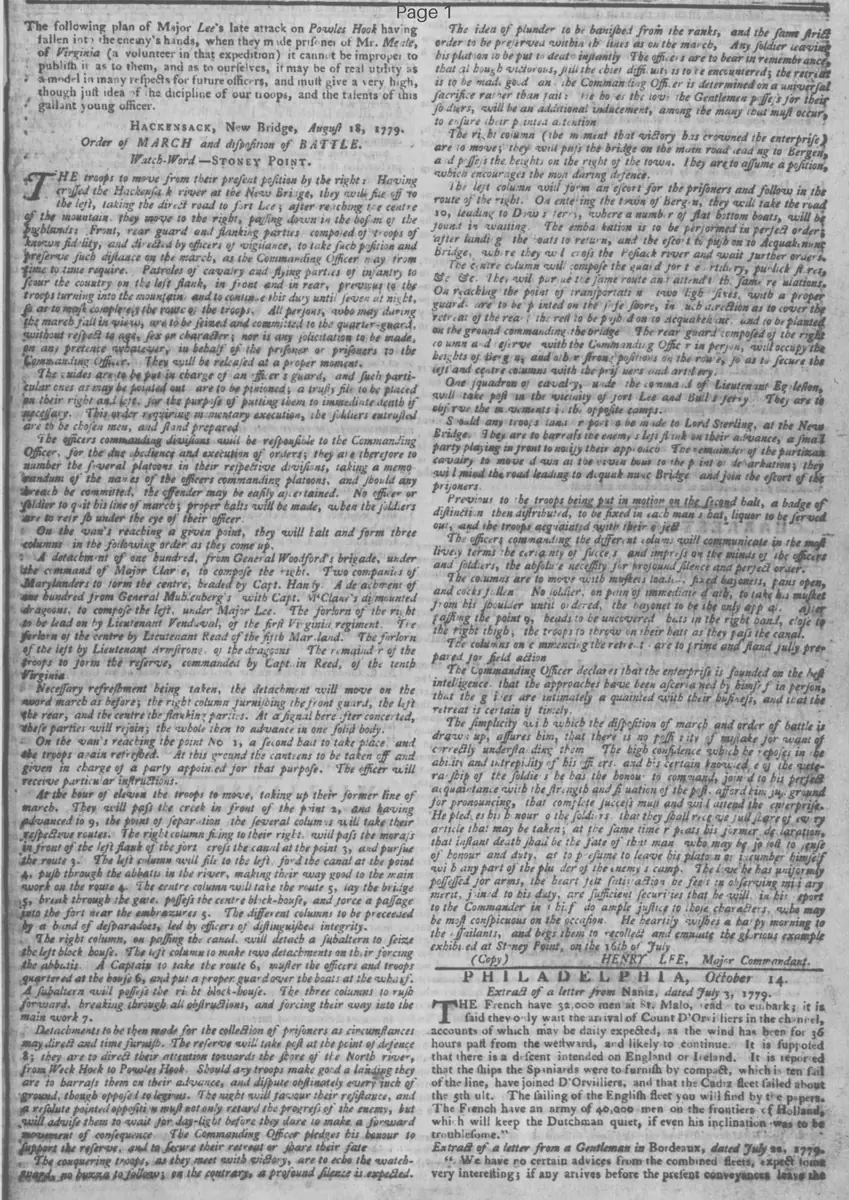
Hackensack, New Bridge, August 18, 1779
Order of MARCH and disposition of BATTLE.
Watch-Word—Stoney Point.
The troops to move from their present position by the right: Having crossed the Hackensack river at the New Bridge, they will file off to the left, taking the direct road to Fort Lee; after reaching the centre of the mountain, they move to the right, passing down in the bottom of the highlands: Front, rear guard and flanking parties composed of troops of known fidelity, and directed by officers of vigilance, to take such position and preserve such distance as the march, as the Commanding Officer may from time to time require. Patrols of cavalry and flying parties of infantry to scour the country on the left flank, in front and in rear, previous to the troops turning into the mountain, and to continue this duty until seven at night, so as to make completely the route of the troops. All persons, who may during the march fall in view, are to be seized and committed to the quarter-guard, without respect to age, sex or character; nor is any solicitation to be made, on any pretence whatsoever, in behalf of the prisoner or prisoners to the Commanding Officer. They will be released at a proper moment.
The guides are to be put in charge of an officer's guard, and such particular ones as may be pointed out are to be pinioned; a trusty file to be placed on their right and left, for the purpose of putting them to immediate death if necessary. This order requiring momentary execution, the soldiers entrusted are to be chosen men, and hand prepared.
The officers commanding divisions will be responsible to the Commanding Officer, for the due obedience and execution of orders; they are therefore to number the several platoons in their respective divisions, taking a memorandum of the names of the officers commanding platoons, and should any breach be committed, the offender may be easily ascertained. No officer or soldier to quit his line of march; proper halts will be made, when the soldiers are to rest under the eye of their officer.
On the van's reaching a given point, they will halt and form three columns in the following order as they come up: A detachment of one hundred, from General Woodford's brigade, under the command of Major Clare, to compose the right. Two companies of Marylanders to form the centre, headed by Capt. Handy. A detachment of one hundred from General Muhlenberg's with Capt. O'Clane's dismounted dragoons, to compose the left, under Major Lee. The forlorn of the right to be lead on by Lieutenant Venduval, of the first Virginia regiment. The forlorn of the centre by Lieutenant Read of the fifth Maryland. The forlorn of the left by Lieutenant Armstrong, of the dragoons. The remainder of the troops to form the reserve, commanded by Captain Reed, of the tenth Virginia.
Necessary refreshment being taken, the detachment will move on the road march as before; the right column furnishing the front guard, the left the rear, and the centre the flanking parties. At a signal hereafter concerted, these parties will rejoin; the whole then to advance in one solid body.
On the van's reaching the point No. 1, a second halt to take place, and the troops again refreshed. At this ground the canteens to be taken off and given in charge of a party appointed for that purpose. The officer will receive particular instructions.
At the hour of eleven the troops to move, taking up their former line of march. They will pass the creek in front of the point 2, and having advanced to 9, the point of separation the several columns will take their respective routes. The right column filing to their right, will pass the morass in front of the left flank of the fort cross the canal at the point 3, and pursue the route 3. The left column will file to the left, ford the canal at the point 4, push through the abbatis in the river, making their way good to the main work on the route 4. The centre column will take the route 5, lay the bridge 5, break through the gate, pass the centre block-house, and force a passage into the fort near the embrasures 5. The different columns to be preceded by a band of desperadoes, led by officers of distinguished integrity.
The right column, on passing the canal, will detach a subaltern to seize the left block house. The left column to make two detachments on their forcing the abbatis. A Captain to take the route 6, muster the officers and troops quartered at the house 6, and put a proper guard over the boats at the wharf. A subaltern will possess the right block-house. The three columns to rush forward, breaking through all obstructions, and forcing their way into the main work 7.
Detachments to be then made for the collection of prisoners as circumstances may direct and time furnish. The reserve will take post at the point of defence 8; they are to direct their attention towards the shore of the North river, from Weehawk to Powles Hook. Should any troops make good a landing they are to harass them on their advance, and dispute obstinately every inch of ground, though opposed to legions. The night will favour their resistance, and resolute pointed opposition must not only retard the progress of the enemy, but will advise them to wait for day-light before they dare to make a forward movement of consequence. The Commanding Officer pledges his honour to support the reserve, and to secure their retreat or share their fate.
The conquering troops, as they meet with victory, are to echo the watch-word no huzza to follow; on the contrary, a profound silence is expected.
The idea of plunder to be banished from the ranks, and the same order to be preserved within its lines as on the march. Any soldier leaving his platoon to be put to death instantly. The officers are to bear in remembrance that although victorious, still the chief difficulty is to be encountered; the retreat is to be made good and the Commanding Officer is determined on a universal sacrifice rather than fail: he hopes the love the Gentlemen pays for their colours, will be an additional inducement, among the many that must occur to ensure their pointed attention.
The right column (the moment that victory has crowned the enterprise) are to move; they will pass the bridge on the main road leading to Bergen, and possess the heights on the right of the town. They are to assume a position, which encourages the most daring defence.
The left column will form an escort for the prisoners and follow in the route of the right. On entering the town of Bergen, they will take the road 10, leading to Drew's ferry, where a number of flat bottom boats, will be found in waiting. The embarkation is to be performed in perfect order after landing the oats to return, and the escort to push on to Acquackanonk Bridge, where they will cross the Passaic river and wait further orders.
The centre column will compose the guard for the artillery, public stores, &c. &c. They will pursue the same route and attend the same regulations.
On reaching the point of transportation two light pieces, with a proper guard, are to be pointed on the Jersey shore, in such a direction as to cover the retreat of the rear— the rest to be pushed on to Acquackanonk, and reimplanted on the ground commanding the bridge. The rear guard composed of the right column and reserve with the Commanding Officer in person, will occupy the heights of Bergen, and strong positions on the route, so as to secure the left and centre columns with the prisoners and artillery.
One squadron of cavalry, under the command of Lieutenant Egerton, will take post in the vicinity of Fort Lee and Bull's ferry. They are to observe the movements in the opposite camps. Should any troops land report a post to be made to Lord Sterling, at the New Bridge. They are to harass the enemy's left flank on their advance, a small party playing in front to notify their approach. The remainder of the partisan cavalry to move down at the seven hour to the point of embarkation; they will mind the road leading to Acquackanonk Bridge and join the escort of the prisoners.
Previous to the troops being put in motion on the second halt, a badge of distinction then distributed, to be fixed in each man's hat, liquor to be served out, and the troops acquainted with their object.
The officers commanding the different columns will communicate in the most lively terms the certainty of success and impress on the minds of the officers and soldiers, the absolute necessity for profound silence and perfect order.
The columns are to move with muskets loaded, fixed bayonets, pans open, and cocks fallen. No soldier, on pain of immediate death, to take his musket from his shoulder until ordered, the bayonet to be the only appointed after taking the point 9, heads to be uncovered hats in the right hand, close to the right thigh; the troops to throw on their hats as they pass the canal.
The columns on commencing the retreat are to prime and load fully prepared for field action.
The Commanding Officer declares that the enterprise is founded on the best intelligence, that the approaches have been ascertained by him in person, that the guides are intimately acquainted with their business, and that the retreat is certain if timely.
The simplicity with which the disposition of march and order of battle is drawn up, assures him, that there is no possibility of mistake for want of correctly understanding them. The high confidence which he reposes in the ability and intrepidity of his officers, and his certain knowledge of the veteran ship of the soldiers he has the honour to command, joined to his perfect acquaintance with the strength and situation of the post afford him just ground for pronouncing, that complete success must and will attend the enterprise.
He pledges his honour to the soldiers, that they shall receive just share at every article that may be taken; at the same time repeats his former declaration, that instant death shall be the fate of that man who may be so lost to sense of honour and duty, as to presume to leave his platoon or incumber himself with any part of the plunder of the enemy's camp. The love he has uniformly possessed for arms, the heart felt satisfaction he feels in observing military merit, joined to his duty, are sufficient securities that he will, in his report to the Commander in chief do ample justice to those characters, who may be most conspicuous on the occasion. He heartily wishes a happy morning to the assailants, and begs them to recollect and emulate the glorious example exhibited at Stony Point, on the 16th of July.
(Copy)
HENRY LEE, Major Commandant.
What sub-type of article is it?
What themes does it cover?
What keywords are associated?
What entities or persons were involved?
Where did it happen?
Story Details
Key Persons
Location
Powles Hook, Hackensack, New Bridge, Fort Lee, Bergen, New Jersey
Event Date
August 18, 1779
Story Details
Major Henry Lee's orders detail the march from Hackensack across the Hackensack River to Fort Lee, formation into three columns for assault on Powles Hook, seizure of blockhouses and prisoners, reserve defense, silent advance with bayonets, retreat via Bergen to Drew's ferry and Acquackanonk Bridge, emphasizing discipline, no plunder, and certain success.