Thank you for visiting SNEWPapers!
Sign up free
Constitutional Whig
Richmond, Virginia
What is this article about?
A Western Citizen praises much of the amended Virginia constitution but strongly opposes its representation basis including slaves, arguing it unjustly favors slaveholders and violates rights; also criticizes religious provisions restricting associations and disfranchising clergy as unnecessary and harmful to Christianity.
Clipping
OCR Quality
Full Text
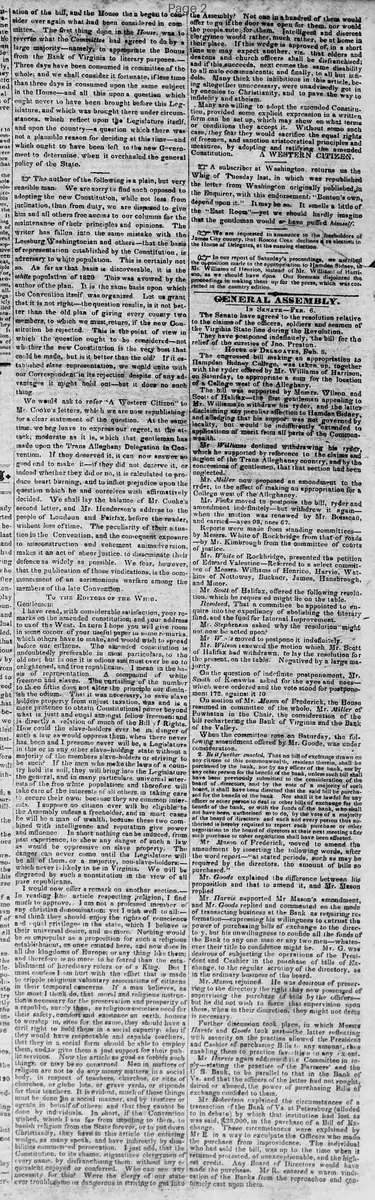
Gentlemen:
I have read, with considerable satisfaction, your remarks on the amended constitution; and your address to us of the West. In turn I hope you will give room in some corner of your useful paper to some remarks, which others have to make, and would wish to spread before our citizens. The amended constitution is undoubtedly preferable in most particulars, to the old one; but in one it is odious and must ever be so to enlightened, and true republicans. I mean in the basis of representation. A compound of white freemen and slaves. The curtailing of the number to three fifths does not alter the principle nor diminish the odium. That it was necessary, to save slave holders property from unjust taxation, was and is a mere pretence to obtain Constitutional power beyond what is just and equal amongst fellow freemen: and is directly a violation of much of the Bill of Rights.
How could the slave-holders ever be in danger of such a law as would oppress them, when there never has been and I presume never will be, a Legislature in this or in any other slave-holding state without a majority of the members slave-holders or striving to be such? If the men who make the laws of a country hold its soil, they will bring into the Legislature the general, and in many particulars, universal interests of the free white population: and therefore will take care of the interests of all others, in taking care to secure their own: because they are common interests. I suppose no citizen ever will be eligible to the Assembly unless a freeholder, and in most cases he will be a man of wealth, because these two combined with intelligence and reputation give power and influence. In short nothing can be induced, from past experience, to show any danger of such a law as would be oppressive on slave property. The danger can never come until the Legislature will be all of them, or a majority, non-slave-holders:--which never is likely to be in Virginia. We will be disgraced by such a constitution in the view of all pure republicans.
I would now offer a remark on another section.--In reading the article respecting religion, I find much to approve. I am not a professed member of any christian denomination: yet I wish well to all:--and think they should enjoy the rights of conscience and equal privileges in the state, which I believe is their universal desire, and no more. Nothing would be so unpopular as a proposition for such a religious establishment, as once existed here, and now does in all the kingdoms of Europe; or any thing like them; and therefore is no more to be feared than the establishment of hereditary rulers or of a King. But I must confess I am hurt with the effort that is made to cripple religious voluntary associations of citizens in their temporal concerns. If a man believes, as the most I think do, that moral and religious instruction is necessary for the preservation and prosperity of a republic, surely then, as religious societies need for their safety, comfort and existence on earth, houses to worship in, sites for the same, they should have a civil right to hold them in a social capacity: also if they would have respectable and capable teachers, that they in a social form should be able to employ them, and to give them a just support for their public services. Now the article as good as forbids such things; or may be so construed." Men in matters of religion are not to do any money matters in a social body, in respect of teachers, churches, or sites of churches, or glebe lots, or grave yards, or stipends or their teachers. It is evident, much of these things must be done in a social manner, and by trustees or agents in behalf of others: and that they cannot be done by individuals. In short, if the Convention wished, which I am far from imputing to them, to banish religion from the State forever, or to put down Christianity, they have in this article the entering wedge, as many speak, and have indirectly by disabilities commenced persecution. I just add, that the Constitution, to its shame, stigmatizes clergymen of every name, by disfranchising them, without any equivalent enjoyed or conferred. Who can see any necessity for this? Were the clergy of our state ever troublesome or dangerous in striving to get into the Assembly? Not one in a hundred of them would offer to go if the door was open for them, nor would the people vote for them. Intelligent and discreet clergymen would rather, much rather, be at home in their place. If this wedge is approved of, in a short time we may expect another, viz. that elders and deacons and church officers shall be disfranchised; and if this succeeds, next comes the same disability to all male communicants; and finally, to all but infidels. Many think the inhibitions in this article, being altogether unnecessary, were unadvisedly got in by enemies to Christianity, and to pave the way to infidelity and atheism.
Many are willing to adopt the amended Constitution, provided some explicit expression in a written form can be set up, which may show on what terms or conditions they accept it. Without some such clause, they fear they would sacrifice the equal rights of freemen, and sanction aristocratical principles and measures, by adopting and ratifying the amended Constitution.
A WESTERN CITIZEN.
What sub-type of article is it?
What themes does it cover?
What keywords are associated?
What entities or persons were involved?
Letter to Editor Details
Author
A Western Citizen
Recipient
The Editors Of The Whig
Main Argument
the amended constitution is preferable in most respects but odious in its basis of representation combining white freemen and slaves at three-fifths, which violates equal rights and the bill of rights under pretense of protecting slaveholders; it also unadvisably restricts religious voluntary associations and disfranchises clergy, potentially paving the way for persecution and infidelity.
Notable Details