Thank you for visiting SNEWPapers!
Sign up free
Alexandria Gazette
Alexandria, Alexandria County, District Of Columbia
What is this article about?
On February 18, U.S. Senator Benton introduced a resolution to expunge a 1834 Senate resolution criticizing President Jackson's actions on public revenue, calling it illegal and unjust. Debate ensued with objections from Sen. Poindexter on constitutional grounds, countered by Sens. Brown and Leigh. Objection withdrawn; resolution ordered printed.
Clipping
OCR Quality
Full Text
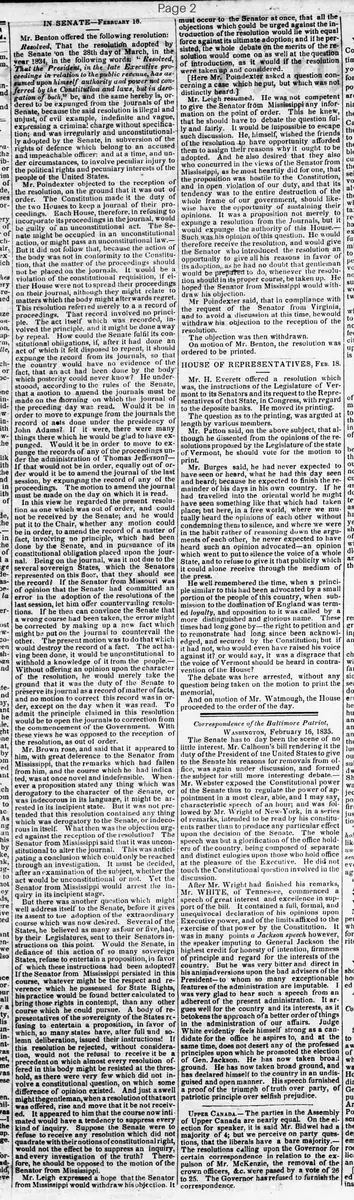
Mr. Benton offered the following resolution:
Resolved, That the resolution adopted by the Senate on the 28th day of March, in the year 1834, in the following words: "Resolved, That the President, in the late Executive proceedings in relation to the public revenue, has assumed upon himself authority and power not conferred by the Constitution and laws, but in derogation of both," be, and the same hereby is, ordered to be expunged from the journals of the Senate, because the said resolution is illegal and unjust, of evil example, indefinite and vague, expressing a criminal charge without specification; and was irregularly and unconstitutionally adopted by the Senate, in subversion of the rights of defence which belong to an accused and impeachable officer: and at a time, and under circumstances, to involve peculiar injury to the political rights and pecuniary interests of the people of the United States.
Mr. Poindexter objected to the reception of the resolution, on the ground that it was out of order. The Constitution made it the duty of the two Houses to keep a journal of their proceedings. Each House, therefore, in refusing to incorporate its proceedings in the journal, would be guilty of an unconstitutional act. The Senate might be occupied in an unconstitutional action, or might pass an unconstitutional law. But it did not follow that, because the action of the body was not in conformity to the Constitution, that the matter of the proceedings should not be placed on the journals. It would be a violation of the constitutional requisition, if either House were not to spread their proceedings on their journal, although they might relate to matters which the body might afterwards regret. This resolution referred merely to a record of proceedings. That record involved no principle, and it might be done away by repeal. How could the Senate fulfil its constitutional obligations, if, after it had done an act of which it felt disposed to repent, it should expunge the record from its journals, so that the country would have no evidence of the fact, that an act had been done by the body which posterity could never know? He understood, according to the rules of the Senate, that a motion to amend the journals must be made on the morning on which the journal of the preceding day was read. Would it be in order to move to expunge from the journals the record of acts done under the presidency of John Adams? If it were, there were many things there which he would be glad to have expunged. Would it be in order to move to expunge the records of any of the proceedings under the administration of Thomas Jefferson? If that would not be in order, equally out of order would it be to amend the journal of the last session, by expunging the record of any of the proceedings. The motion to amend the journal must be made on the day on which it is read. In this view he regarded the present resolution as one which was out of order, and could not be received by the Senate; and he would put it to the Chair, whether any motion could be in order, to amend the record of a matter of fact, involving no principle, which had been done by the Senate, and in pursuance of its constitutional obligation placed upon the journal. Being on the journal, was it not due to the several sovereign States, which the Senators represented on this floor, that they should see the record? If the Senator from Missouri was of opinion that the Senate had committed an error in the adoption of the resolutions of the last session, let him offer countervailing resolutions. If he then can convince the Senate that a wrong course had been taken, the error might be corrected by making up a new fact which might be put on the journal to countervail the other. The present motion was to do that which would destroy the record of a fact. The act having been done, it would be unconstitutional to withhold a knowledge of it from the people. Without offering an opinion upon the character of the resolution, he would merely take the ground that it was the duty of the Senate to preserve its journal as a record of matter of facts, and no motion to correct this record was in order, except on the day when it was read. To admit the principle claimed in this resolution would be to open the journals to correction from the commencement of the Government. With these views he was opposed to the reception of the resolution, as out of order.
Mr. Brown rose, and said that it appeared to him, with great deference to the Senator from Mississippi, that the remarks which had fallen from him, and the course which he had indicated, was at once novel and indefensible. Whenever a proposition stated any thing which was derogatory to the character of the Senate, or was indecorous in its language, it might be arrested in its incipient state. But it was not pretended that this resolution contained any thing which was derogatory to the Senate, or indecorous in itself. What then was the objection urged against the reception of the resolution? The Senator from Mississippi said that it was unconstitutional to alter the journal. This was anticipating a conclusion which could only be reached through an investigation. It must be decided, after an examination of the subject, whether the act would be unconstitutional or not. Yet the Senator from Mississippi would arrest the inquiry in its incipient stage. But there was another question which might well address itself to the Senate, before it gives its assent to the adoption of the extraordinary course which was now desired. Several of the States, he believed as many as four or five, had, by their Legislatures, sent to their Senators instructions on this point. Would the Senate, in defiance of this action of so many sovereign States, refuse to entertain a proposition, in favor of which these instructions had been adopted? If the Senator from Mississippi persisted in this course, whatever might be the respect and reverence which he possessed for State Rights, his practice would be found better calculated to bring those rights in contempt, than any other course which he could pursue. A body of representatives of the sovereignty of the States refusing to entertain a proposition, in favor of which, so many states have, after full and solemn deliberation, issued their instructions! If this resolution be rejected, without consideration, would not the refusal to receive it be a precedent on which almost every resolution offered in this body might be resisted at the threshold, as there were very few which did not involve a constitutional question, on which some difference of opinion existed. And just as well might the gentleman, when a resolution of that sort was offered, rise and move that it be not received. It appeared to him that the course now intimated would have a tendency to suppress every kind of inquiry. Suppose the Senate were to refuse to receive any resolution which did not quadrate with their notions of constitutional right, would not the effect be to suppress an inquiry, and every investigation of the truth? Therefore, he should be opposed to the motion of the Senator from Mississippi.
Mr. Leigh expressed a hope that the Senator from Mississippi would withdraw his objection. It must occur to the Senator at once, that all the objections which could be urged against the introduction of the resolution would lie with equal force against its ultimate adoption; and if he persisted, the whole debate on the merits of the resolution would come on as well at the question of introduction, as it would if the resolution were taken up and considered.
[Here Mr. Poindexter asked a question concerning a case which he put, but which was not distinctly heard.]
Mr. Leigh resumed. He was not competent to give the Senator from Mississippi any information on the point of order. This he knew, that he should have to debate the question fully and fairly. It would be impossible to escape such discussion. He, himself, wished the friends of the resolution to have opportunity afforded them to assign their reasons why it ought to be adopted. And he also desired that they also who concurred in the views of the Senator from Mississippi, as he most heartily did for one, that the proposition was hostile to the Constitution, and in open violation of our duty, and that its tendency was to the entire destruction of the whole frame of our government, should likewise have the opportunity of sustaining their opinions. It was a proposition not merely to expunge a resolution from the Journals, but it would expunge the authority of this House. Such was his opinion of this question. He would therefore receive the resolution, and would give the Senator who introduced the resolution an opportunity to give all his reasons in favor of its adoption, as he had no doubt that gentleman would be prepared to do, whenever the resolution should in its proper course, be taken up. He hoped the Senator from Mississippi would withdraw his objection.
Mr. Poindexter said, that in compliance with the request of the Senator from Virginia, and to avoid a discussion at this time, he would withdraw his objection to the reception of the resolution.
The objection was then withdrawn.
On motion of Mr. Benton, the resolution was ordered to be printed.
What sub-type of article is it?
What keywords are associated?
What entities or persons were involved?
Domestic News Details
Event Date
February 18
Key Persons
Outcome
objection to reception withdrawn; resolution ordered to be printed.
Event Details
Senator Benton introduced a resolution to expunge a 1834 Senate resolution criticizing President Jackson's handling of public revenue, arguing it was illegal, unjust, and unconstitutionally adopted. Senator Poindexter objected on grounds of order and constitutionality, emphasizing the duty to maintain journals. Senators Brown and Leigh argued against the objection, highlighting state instructions and the need for debate. Poindexter withdrew his objection.