Thank you for visiting SNEWPapers!
Sign up free
Editorial
August 23, 1893
Ceredo Advance
Ceredo, Wayne County, West Virginia
What is this article about?
Editorial advises prompt payment of small bills to maintain money circulation, prevent debt accumulation, and relieve financial strain, noting a chain reaction of nonpayment and suggesting July 1 as a fresh start. (Baltimore Sun)
Clipping
OCR Quality
98%
Excellent
Full Text
Pay Your Little Bills.
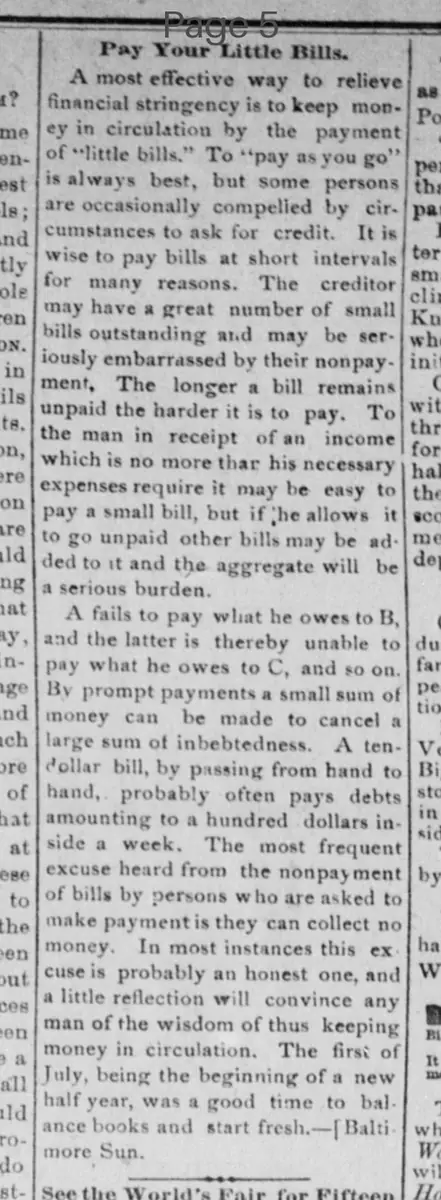
A most effective way to relieve financial stringency is to keep money in circulation by the payment of little bills. To "pay as you go" is always best, but some persons are occasionally compelled by circumstances to ask for credit. It is wise to pay bills at short intervals for many reasons. The creditor may have a great number of small bills outstanding and may be seriously embarrassed by their nonpayment. The longer a bill remains unpaid the harder it is to pay. To the man in receipt of an income which is no more than his necessary expenses require it may be easy to pay a small bill, but if he allows it to go unpaid other bills may be added to it and the aggregate will be a serious burden.
A fails to pay what he owes to B, and the latter is thereby unable to pay what he owes to C, and so on. By prompt payments a small sum of money can be made to cancel a large sum of indebtedness. A ten-dollar bill, by passing from hand to hand, probably often pays debts amounting to a hundred dollars inside a week. The most frequent excuse heard from the nonpayment of bills by persons who are asked to make payment is they can collect no money. In most instances this excuse is probably an honest one, and a little reflection will convince any man of the wisdom of thus keeping money in circulation. The first of July, being the beginning of a new half year, was a good time to balance books and start fresh.—[Baltimore Sun.]
A most effective way to relieve financial stringency is to keep money in circulation by the payment of little bills. To "pay as you go" is always best, but some persons are occasionally compelled by circumstances to ask for credit. It is wise to pay bills at short intervals for many reasons. The creditor may have a great number of small bills outstanding and may be seriously embarrassed by their nonpayment. The longer a bill remains unpaid the harder it is to pay. To the man in receipt of an income which is no more than his necessary expenses require it may be easy to pay a small bill, but if he allows it to go unpaid other bills may be added to it and the aggregate will be a serious burden.
A fails to pay what he owes to B, and the latter is thereby unable to pay what he owes to C, and so on. By prompt payments a small sum of money can be made to cancel a large sum of indebtedness. A ten-dollar bill, by passing from hand to hand, probably often pays debts amounting to a hundred dollars inside a week. The most frequent excuse heard from the nonpayment of bills by persons who are asked to make payment is they can collect no money. In most instances this excuse is probably an honest one, and a little reflection will convince any man of the wisdom of thus keeping money in circulation. The first of July, being the beginning of a new half year, was a good time to balance books and start fresh.—[Baltimore Sun.]
What sub-type of article is it?
Economic Policy
What keywords are associated?
Paying Bills
Financial Circulation
Debt Payment
Prompt Payment
Money Circulation
What entities or persons were involved?
Baltimore Sun
Editorial Details
Primary Topic
Importance Of Prompt Payment Of Small Bills
Stance / Tone
Advisory And Promotional Of Financial Responsibility
Key Figures
Baltimore Sun
Key Arguments
Pay As You Go Is Always Best
Prompt Payment Relieves Financial Stringency By Keeping Money In Circulation
Unpaid Bills Accumulate And Become Burdensome
Nonpayment Creates A Chain Of Indebtedness
A Small Sum Can Cancel Large Indebtedness Through Circulation
Common Excuse Of Inability To Collect Money Is Addressed By Reflection On Circulation Benefits
July 1 Is A Good Time To Balance Books And Start Fresh