Thank you for visiting SNEWPapers!
Sign up free
Letter to Editor
January 3, 1766
The New Hampshire Gazette And Historical Chronicle
Portsmouth, Greenland, Rockingham County, New Hampshire
What is this article about?
In a 1765 letter to the Editor of Lloyd's Evening Post, 'A Virginian' defends American colonists against accusations of ingratitude for opposing the Stamp Act, arguing it stems from defending essential rights rather than lack of appreciation for British favors. Warns that curbing colonial assemblies could lead to defection and harm Britain's interests.
Clipping
OCR Quality
98%
Excellent
Full Text
LONDON, September 11, 1765.
To the Editor of Lloyd's Evening Post.
SIR,
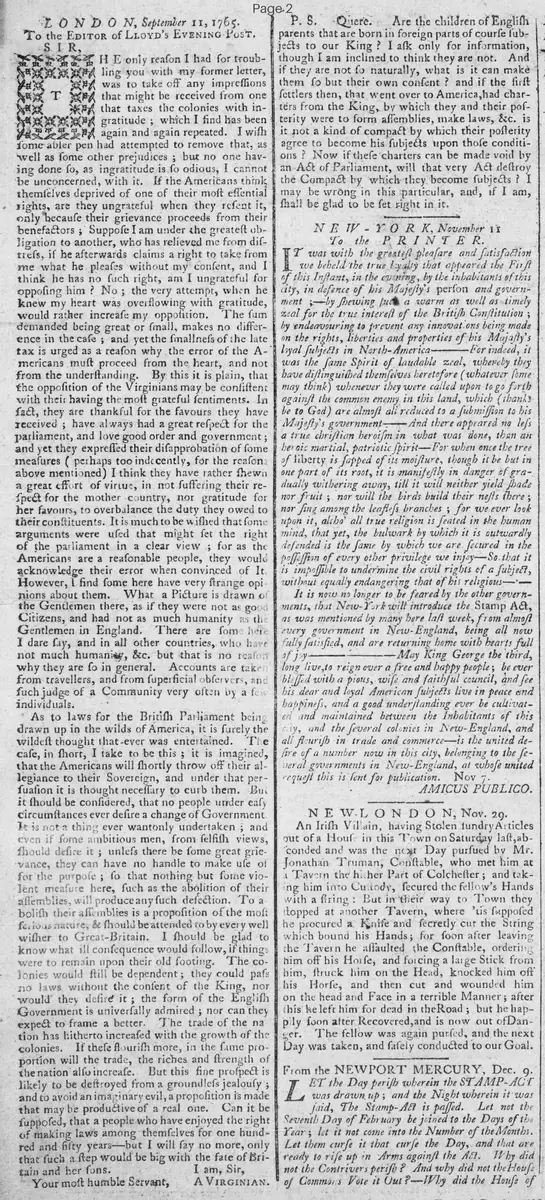
The only reason I had for troubling you with my former letter, it was to take off any impressions that might be received from one that taxes the colonies with ingratitude; which I find has been again and again repeated. I wish some abler pen had attempted to remove that, as well as some other prejudices; but no one having done so, as ingratitude is so odious, I cannot be unconcerned with it. If the Americans think themselves deprived of one of their most essential rights, are they ungrateful when they resent it, only because their grievance proceeds from their benefactors? Suppose I am under the greatest obligation to another, who has relieved me from distress, if he afterwards claims a right to take from me what he pleases without my consent, and I think he has no such right, am I ungrateful for opposing him? No; the very attempt, when he knew my heart was overflowing with gratitude, would rather increase my opposition. The sum demanded being great or small, makes no difference in the case; and yet the smallness of the late tax is urged as a reason why the error of the Americans must proceed from the heart, and not from the understanding. By this it is plain, that the opposition of the Virginians may be consistent with their having the most grateful sentiments. In fact, they are thankful for the favours they have received; have always had a great respect for the parliament, and love good order and government; and yet they expressed their disapprobation of some measures (perhaps too indecently, for the reasons above mentioned) I think they have rather shewn a great effort of virtue, in not suffering their respect for the mother country, nor gratitude for her favours, to overbalance the duty they owed to their constituents. It is much to be wished that better arguments were used that might set the right of the parliament in a clear view; for as the Americans are a reasonable people, they would acknowledge their error when convinced of it. However, I find some here have very strange opinions about them. What a Picture is drawn of the Gentlemen there, as if they were not as good Citizens, and had not as much humanity as the Gentlemen in England. There are some here I dare say, and in all other countries, who have not much humanity, &c. but that is no reason why they are so in general. Accounts are taken from travellers, and from superficial observers, and such judge of a Community very often by a few individuals.
As to laws for the British Parliament being drawn up in the wilds of America, it is surely the wildest thought that ever was entertained. The case, in short, I take to be this; it is imagined, that the Americans will shortly throw off their allegiance to their Sovereign, and under that persuasion it is thought necessary to curb them. But it should be considered, that no people under easy circumstances ever desire a change of Government. It is not a thing ever wantonly undertaken; and even if some ambitious men, from selfish views, should desire it; unless there be some great grievance, they can have no handle to make use of for the purpose; so that nothing but some violent measure here, such as the abolition of their assemblies, will produce any such defection. To abolish their assemblies is a proposition of the most serious nature, & should be attended to by every well wisher to Great-Britain. I should be glad to know what ill consequence would follow, if things were to remain upon their old footing. The colonies would still be dependent; they could pass no laws without the consent of the King, nor would they desire it; the form of the English Government is universally admired; nor can they expect to frame a better. The trade of the nation has hitherto increased with the growth of the colonies. If these flourish more, in the same proportion will the trade, the riches and strength of the nation also increase. But this fine prospect is likely to be destroyed from a groundless jealousy: and to avoid an imaginary evil, a proposition is made that may be productive of a real one. Can it be supposed, that a people who have enjoyed the right of making laws among themselves for one hundred and fifty years--but I will say no more, only that such a step would be big with the fate of Britain and her sons.
I am, Sir,
Your most humble Servant,
A VIRGINIAN
P.S. Query. Are the children of English parents that are born in foreign parts of course subjects to our King? I ask only for information, though I am inclined to think they are not. And if they are not so naturally, what is it can make them so but their own consent? and if the first settlers then, that went over to America, had charters from the King, by which they and their posterity were to form assemblies, make laws, &c. is it not a kind of compact by which their posterity agree to become his subjects upon those conditions? Now if these charters can be made void by an Act of Parliament, will that very Act destroy the Compact by which they become subjects? I may be wrong in this particular, and, if I am, shall be glad to be set right in it.
To the Editor of Lloyd's Evening Post.
SIR,
The only reason I had for troubling you with my former letter, it was to take off any impressions that might be received from one that taxes the colonies with ingratitude; which I find has been again and again repeated. I wish some abler pen had attempted to remove that, as well as some other prejudices; but no one having done so, as ingratitude is so odious, I cannot be unconcerned with it. If the Americans think themselves deprived of one of their most essential rights, are they ungrateful when they resent it, only because their grievance proceeds from their benefactors? Suppose I am under the greatest obligation to another, who has relieved me from distress, if he afterwards claims a right to take from me what he pleases without my consent, and I think he has no such right, am I ungrateful for opposing him? No; the very attempt, when he knew my heart was overflowing with gratitude, would rather increase my opposition. The sum demanded being great or small, makes no difference in the case; and yet the smallness of the late tax is urged as a reason why the error of the Americans must proceed from the heart, and not from the understanding. By this it is plain, that the opposition of the Virginians may be consistent with their having the most grateful sentiments. In fact, they are thankful for the favours they have received; have always had a great respect for the parliament, and love good order and government; and yet they expressed their disapprobation of some measures (perhaps too indecently, for the reasons above mentioned) I think they have rather shewn a great effort of virtue, in not suffering their respect for the mother country, nor gratitude for her favours, to overbalance the duty they owed to their constituents. It is much to be wished that better arguments were used that might set the right of the parliament in a clear view; for as the Americans are a reasonable people, they would acknowledge their error when convinced of it. However, I find some here have very strange opinions about them. What a Picture is drawn of the Gentlemen there, as if they were not as good Citizens, and had not as much humanity as the Gentlemen in England. There are some here I dare say, and in all other countries, who have not much humanity, &c. but that is no reason why they are so in general. Accounts are taken from travellers, and from superficial observers, and such judge of a Community very often by a few individuals.
As to laws for the British Parliament being drawn up in the wilds of America, it is surely the wildest thought that ever was entertained. The case, in short, I take to be this; it is imagined, that the Americans will shortly throw off their allegiance to their Sovereign, and under that persuasion it is thought necessary to curb them. But it should be considered, that no people under easy circumstances ever desire a change of Government. It is not a thing ever wantonly undertaken; and even if some ambitious men, from selfish views, should desire it; unless there be some great grievance, they can have no handle to make use of for the purpose; so that nothing but some violent measure here, such as the abolition of their assemblies, will produce any such defection. To abolish their assemblies is a proposition of the most serious nature, & should be attended to by every well wisher to Great-Britain. I should be glad to know what ill consequence would follow, if things were to remain upon their old footing. The colonies would still be dependent; they could pass no laws without the consent of the King, nor would they desire it; the form of the English Government is universally admired; nor can they expect to frame a better. The trade of the nation has hitherto increased with the growth of the colonies. If these flourish more, in the same proportion will the trade, the riches and strength of the nation also increase. But this fine prospect is likely to be destroyed from a groundless jealousy: and to avoid an imaginary evil, a proposition is made that may be productive of a real one. Can it be supposed, that a people who have enjoyed the right of making laws among themselves for one hundred and fifty years--but I will say no more, only that such a step would be big with the fate of Britain and her sons.
I am, Sir,
Your most humble Servant,
A VIRGINIAN
P.S. Query. Are the children of English parents that are born in foreign parts of course subjects to our King? I ask only for information, though I am inclined to think they are not. And if they are not so naturally, what is it can make them so but their own consent? and if the first settlers then, that went over to America, had charters from the King, by which they and their posterity were to form assemblies, make laws, &c. is it not a kind of compact by which their posterity agree to become his subjects upon those conditions? Now if these charters can be made void by an Act of Parliament, will that very Act destroy the Compact by which they become subjects? I may be wrong in this particular, and, if I am, shall be glad to be set right in it.
What sub-type of article is it?
Persuasive
Political
Reflective
What themes does it cover?
Constitutional Rights
Politics
Taxation
What keywords are associated?
American Ingratitude
Stamp Act Opposition
Colonial Rights
Parliament Authority
Virginia Protest
Assemblies Abolition
British Charters
What entities or persons were involved?
A Virginian
The Editor Of Lloyd's Evening Post
Letter to Editor Details
Author
A Virginian
Recipient
The Editor Of Lloyd's Evening Post
Main Argument
american opposition to the tax is not ingratitude but defense of essential rights against taxation without consent; curbing colonial assemblies risks defection and harms britain's prosperity.
Notable Details
Analogy Of Personal Obligation And Opposition
Reference To Virginia Opposition
Warning On Abolition Of Assemblies
P.S. Query On Natural Subjects And Charters As Compact