Thank you for visiting SNEWPapers!
Sign up free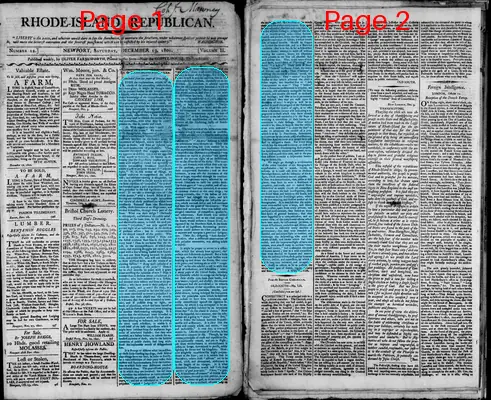
Rhode Island Republican
Newport, Newport County, Rhode Island
What is this article about?
This editorial, concluded from a prior issue, defends Rhode Island legislative resolutions against accusations by a stenographer and federalists of prejudicing juries in a case involving Judge Dorrance. It criticizes Providence federalist press for instilling biases and political malice, portraying the resolutions as restorative of public harmony and republican virtue.
Merged-components note: This is a continuation of the same editorial piece across pages 1 and 2, as indicated by the flowing text content and sequential reading orders.
Clippings
1 of 2
OCR Quality
Full Text
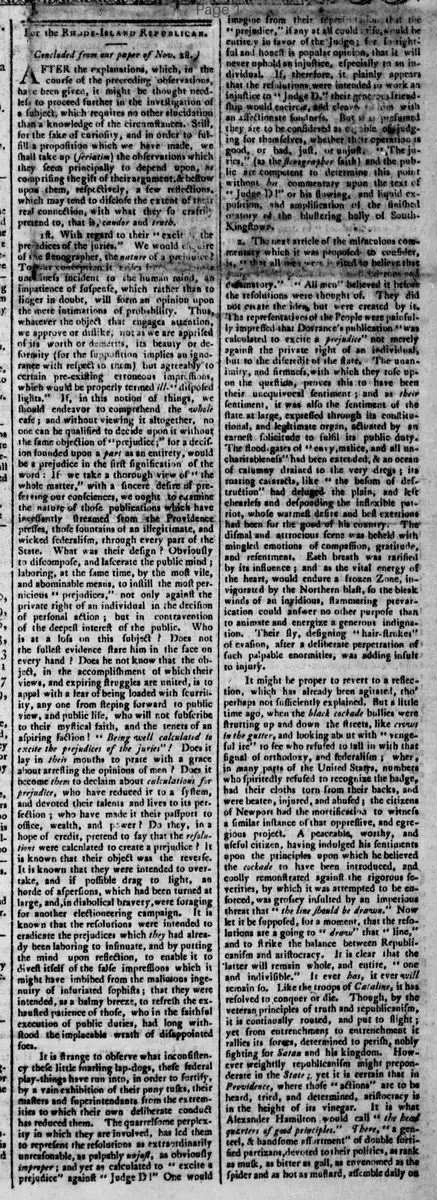
(Concluded from our paper of Nov. 28.)
AFTER the explanations, which, in the course of the preceding observations, have been given, it might be thought needless to proceed further in the investigation of a subject, which requires no other elucidation than a knowledge of the circumstances. Still, for the sake of curiosity, and in order to fulfill a proposition which we have made, we shall take up seriatim the observations which they seem principally to depend upon, as comprising the gist of their argument, & bestow upon them, respectively, a few reflections, which may tend to disclose the extent of their real connection, with what they so craftily pretend to, that is, candor and truth.
1st. With regard to their "exciting the prejudices of the juries." We would inquire of the stenographer, the nature of a prejudice? To our conception it evinces for instance one of the innate incidents to the human mind, an impatience of suspense, which rather than to linger in doubt, will form an opinion upon the mere intimations of probability. Thus, whatever the object that engages attention, we approve or dislike; not as we are apprised of its worth or demerits, its beauty or deformity (or the supposition implies an ignorance with respect to them) but agreeably to certain pre-existing erroneous impressions, which would be properly termed ill-disposed lights." If, in this notion of things, we should endeavor to comprehend the whole case ; and without viewing it altogether, no one can be qualified to decide upon it without the same objection of "prejudice;" for a decision founded upon a part as an entirety, would be a prejudice in the first signification of the word : if- we take a thorough view of "the whole matter," with a sincere desire of preserving our consciences, we ought to examine the nature of those publications which have incessantly streamed from the Providence press, those fountains of an illegitimate, and wicked federalism, through every part of the State. What was their design ? Obviously to discompose, and lacerate the public mind ; laboring, at the same time, by the most vile, and abominable means, to instill the most pernicious "prejudices," not only against the private right of an individual in the decision of personal action ; but in contravention of the deepest interest of the public. Who is at a loss on this subject ? Does not the fullest evidence stare him in the face on every hand ? Does he not know that the object, in the accomplishment of which their views, and expiring struggles are united, is to appal with a fear of being loaded with currility, any one from stepping forward to public view. and public life, who will not subscribe to their mystical faith, and the tenets of an aspiring faction! "Being well calculated to excite the prejudices of the juries"! Does it lay in their mouths to prate with a grace about arresting the opinions of men ? Does it become them to declaim about calculations for prejudice, who have reduced it to a system, and devoted their talents and lives to its perfection : who have made it their passport to office, wealth, and power ? Do they, in a hope of credit, pretend to say that the resolutions were calculated to create a prejudice ? It is known that their object was the reverse. It is known that they were intended to overtake, and if possible drag to light, an horde of aspersions, which had been turned at large, and, in diabolical bravery, were foraging for another electioneering campaign. It is known that the resolutions were intended to eradicate the prejudices which they had already been laboring to insinuate, and by putting the mind upon reflection, to enable it to divest itself of the false impressions which it might have imbibed from the malicious ingenuity of infuriated sophists; that they were intended, as a balmy breeze, to refresh the exhausted patience of those. who in the faithful execution of public duties, had long withstood. the implacable wrath of disappointed foes.
It is strange to observe what inconsistency these little snarling lap-dogs, these federal play-things have run into, in order to fortify, by a vain exhibition of their puny tricks, their masters and superintendents from the extremities to which their own deliberate conduct has reduced them. The quarrelsome perplexity in which they are involved, has led them to represent the resolutions as extraordinarily unreasonable, as palpably unjust, as obviously improper ; and yet as calculated to "excite a prejudice" against "Judge D!" One would imagine from their representation, that the "prejudice," if any at all could arise, would be entirely in favor of the Judge; for so rightful and honest is popular opinion, that it will never uphold an injustice, especially to an individual. If, therefore, it plainly appears that the resolutions were intended to work an injustice to "Judge D." their generous friend. Ship would encircle, and cleave to him with an affectionate fondness. But was penned they are to be considered as cy: able of judging for themselves, whether their operation is good, or bad. just. or unjust. The ju ries," (as the stenographer saith) and the pub. lic are competent to determine this point without but commentary upon the text of "Judge !" or his flowing. and liquid ex position, and amplification of. the finished oratory ek the. blustering bully of South- Kingstown.
2d. The next article of the miraculous com mentary which it was proposed- to consider. is, "that all men were invited to believe that Moderonsond deamutory." To. All men" believed it before the resolutions were thought of. They did not create the idea but were created by it. The representatives of the People were painfully impressed that Dorrance's publication "was calculated to excite a prejudice" not merely against the private right of an individual, but to the discredit of The state. The unanimity, and firmness, with which they spoke up- on the question, proves this: to have been their unequivocal sentiment ; and as their Sentiment. it was also the sentiment of the state. at large, expressed through its constitutional, and legitimate organ, actuated by an earnest solicitude to fulfill its public duty. The flood-gates of envy, malice, and all un- charitableness had been extended, & an ocean of calumny drained to the very dregs ; ins torrents. cataracts, like "the beam of des-: truction" had deluged. the plain, and let cheerless and desponding the inflexible pat riot, whose warmest desire and best exertions had been for the good of his country?- The dismal and atrocious scene was beheld with mingled emotions of compassion, gratitude, and resentment. Each breast was rarified by its influence ; and as the vital energy of the heart, would endure a frozen Zone, in- vigorated by the Northern blast, so the bleak winds of an invidious, stammering prevar- ication could answer no other purpose than to animate and energize a generous indigna tion. . Their sly, deigning "hair-strokes" of evasion, after a deliberate perpetration of such palpable enormities, was adding insult to injury.
It might be proper to revert to a reflec tion, which has already been agitated, tho' perhaps not sufficiently explained." But a little time ago, when the black cockade bullies were strutting up and down the streets, like crows in the gutter, and looking about with "venge ful ire" to see who refused to fall in with that signal of orthodoxy, and federalism ; when. in many parts of the United States, numerous who spiritedly refused to recognize the badge, had their cloths torn from their backs, and were beaten, injured, and abused ; the citizens of Newport had the mortification to witness a similar instance of that oppressive, and egregious project. A peaceable, worthy, and useful citizen, having indulged his sentiments upon the principles upon which he believed the cockade to have been introduced, and coolly remonstrated against the rigorous c- verities, by which it was attempted to be en- forced, was grossly insulted by an imperious threat that "the line should be drawn." Now let it be supposed, for a moment, that the reso lutions are a going to "draw" that "line," and to strike the balance between Republi canism and aristocracy. It is clear that the "latter will remain whole, and entire, " one and indivisible." It ever has, it ever will scmpain so. Like the troops of Catiline, it has resolved to conquer or die. Though, by the veteran principles of truth and republicanism it is continually routed, and put to flight ; yet from entrenchment to entrenchment it rallies its forces, determined to perish, nobly fighting for Satan and his kingdom. How ever weightily republicanism might preponderate in the State ;. yet it is certain that in Providence, where those "actions" are to be heard, tried, and determined, aristocracy is in the height of its vinegar. It is what Alexander Hamilton would call "the head quarters of good principles." There. "a gen- teel, & handsome assortment" of double forti fied partisans, devoted to their politics, as rank as musk, as bitter as gall, as envenomed as the pider and as hot as mustard, assemble daily on
the exchange, and, like monkeys in the woods their teeth are always conspicuous. So pungent is their animosity, that like mad-cats, they could eat fire without feeling it, or bite off the head of a twenty-penny nail.--Thus fashioned loaded, and primed, every one that passes must give the countersign, or sustain, a whole broadside of federal sarcasm. Should he happen to survive the broad-side, and in a shattered condition (that is to say, as far as federal bullets can flatter) attempt to make off without having his colour; cutters are dispatched with permits to cut him off, plunder, sink, and destroy him. Who, in the name of common sense, would think of "inviting" these folk to do to believe"! Their faith is fixed: They "believe" in Pontius Pilate, the traitor of heaven, and earth: They "believe" in resisting the decrees of political, moral, and religious destiny: They "believe" in a spirit similar to that which actuated the chief of fallen angels, and impelled him to "defy Omnipotence to arms:" They "believe" that a strenuous perseverance in iniquity, and enormity, will ultimately extinguish the lamp of truth, and involve the world in darkness, and bondage; and that as lords paramount, and absolute they may yet walk upon the shoulders of men! It might as well be expected to arrest the progress of the Potomac, or to dispel the shades of night, as to offer them a sentiment (in any wise indicating a repugnance to those which they have already braced to the last extremity,) in the hope of working a conviction in their hearts, or a contrition in their feelings. How absurd would it be, then, to suppose that the resolutions were intended "to draw the line" in order to anticipate the verdict of a jury, which is to sit in Providence, surrounded, and overrun by the whole pay of aristocracy. The idea is as irrational as it would be to add fuel to mitigate a flame. For every thing which has the remotest tendency, or most distant implication of intercepting their projects, has been found by repeated experiment, to enliven, and expand their zeal, and in the present instance to excite a desperation bordering on fanaticism.
We might go through a consideration of the other branches of the stenographer's expostulation; but it would, indeed, be tedious, as it could only serve to illustrate his insignificance, and the obliquity of his designs, which are already but too palpable. It is clear to a demonstration, that, although at first glance, they seem to wear a semblance of propriety, and truth, and to extend themselves thro' an ample circuit of comprehension; yet upon the least investigation, they are found bleak and barren as the heath, and to terminate in the same single point, which is the low cunning, and shallow artifice of the stenographer. It is manifest that the resolutions were erected upon a large, and liberal basis ;--that, apart from every private, and personal consideration, they breathe an ennobled spirit of general harmony; that they were suggested by a comprehensive, and accurate view, of the complicated efforts which have been made, by inflammatory jacobins, to create disturbance, confusion and dismay, and to involve in difficulty every measure of government: that they were intended as a faithful, and auspicious light to comfort, and encourage the desponding, who amid the clouds of dust, and smoke which had been raised, and the impetuous flight of darts and arrows, were almost ready to exclaim "vexation, and vanity." and to abandon the cause of human nature : that as a mild corrective, they were devised to separate and remove from the political system, those guilty humours of envy, malice, and oppression, by which it had so long been lacerated, and ravaged ;-- and, finally to restore, as far as possible, the accustomed tone of health, vigour, vivacity and freedom.
A SPECTATOR.
What sub-type of article is it?
What keywords are associated?
What entities or persons were involved?
Editorial Details
Primary Topic
Defense Of Legislative Resolutions Against Federalist Accusations Of Jury Prejudice
Stance / Tone
Strongly Anti Federalist And Pro Republican, Satirical And Indignant
Key Figures
Key Arguments