Thank you for visiting SNEWPapers!
Sign up free
Literary
December 5, 1871
Staunton Spectator
Staunton, Virginia
What is this article about?
Dialect poem by Mrs. F. G. De Fontaine depicting an elderly enslaved woman's reminiscence of pre-Civil War plantation life, mourning the deaths of her family and the master's kin due to war and hardship, longing for times gone by.
Clipping
OCR Quality
98%
Excellent
Full Text
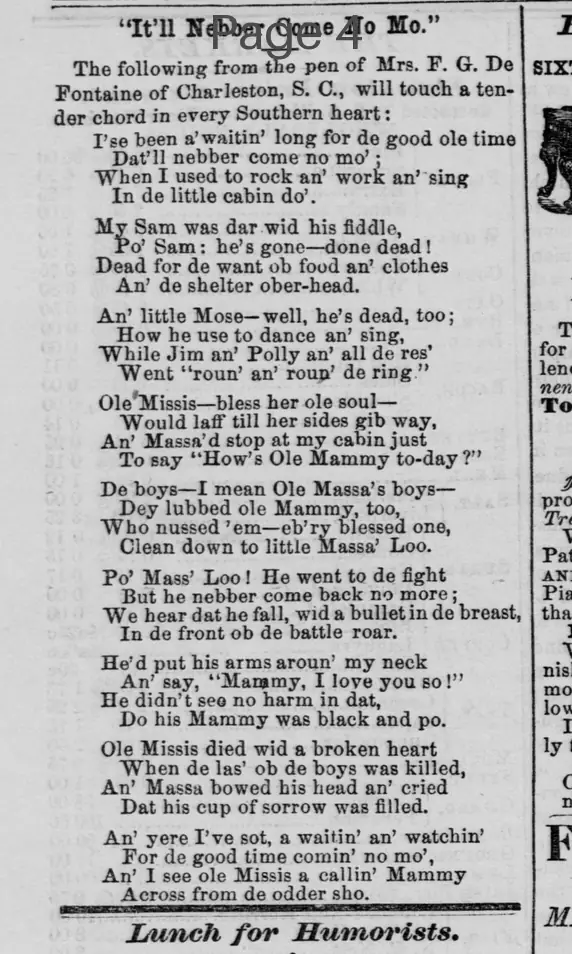
The following from the pen of Mrs. F. G. De Fontaine of Charleston, S. C., will touch a tender chord in every Southern heart:
I'se been s'waitin' long for de good ole time
Dat'll nobber come no mo';
When I used to rock an' work an' sing
In de little cabin do'.
My Sam was dar wid his fiddle
Po Sam: he's gone-done dead!
Dead for de want ob food an' clothes
An' de shelter ober head.
An' little Mose-well, he's dead, too;
How he use to dance an' sing,
While Jim an' Polly an' all de res'
Went "roun' an' roun' de ring"
Ole Missis--bless her ole soul--
Would laff till her sides gib way.
An' Massa'd stop at my cabin just
To say "How's Ole Mammy to-day?"
De boys-I mean Ole Massa's boys-
Dey lubbed ole Mammy, too,
Who nussed'em-eb'ry blessed one,
Clean down to little Massa' Loo.
Po' Massa' Loo! He went to de fight
But he nebber come back no more:
We hear dat he fali, wid a bullet in de breast.
In de front ob de battle roar,
He'd put his arms aroun' my neck
An' say, "Mammy, I loye you so!"
He didn't sco no harm in dat,
Do his Mammy was black and po'.
Ole Missis died wid a broken heart
When de las' ob de boys was killed,
An' Massa bowed his head an' cried
Dat his cup of sorrow was filled,
An' yere I've sot, a waitin' an' watchin'
For de good time comin' no mo'.
An' I see ole Missis callin' Mammy
Across from de odder sho'.
I'se been s'waitin' long for de good ole time
Dat'll nobber come no mo';
When I used to rock an' work an' sing
In de little cabin do'.
My Sam was dar wid his fiddle
Po Sam: he's gone-done dead!
Dead for de want ob food an' clothes
An' de shelter ober head.
An' little Mose-well, he's dead, too;
How he use to dance an' sing,
While Jim an' Polly an' all de res'
Went "roun' an' roun' de ring"
Ole Missis--bless her ole soul--
Would laff till her sides gib way.
An' Massa'd stop at my cabin just
To say "How's Ole Mammy to-day?"
De boys-I mean Ole Massa's boys-
Dey lubbed ole Mammy, too,
Who nussed'em-eb'ry blessed one,
Clean down to little Massa' Loo.
Po' Massa' Loo! He went to de fight
But he nebber come back no more:
We hear dat he fali, wid a bullet in de breast.
In de front ob de battle roar,
He'd put his arms aroun' my neck
An' say, "Mammy, I loye you so!"
He didn't sco no harm in dat,
Do his Mammy was black and po'.
Ole Missis died wid a broken heart
When de las' ob de boys was killed,
An' Massa bowed his head an' cried
Dat his cup of sorrow was filled,
An' yere I've sot, a waitin' an' watchin'
For de good time comin' no mo'.
An' I see ole Missis callin' Mammy
Across from de odder sho'.
What sub-type of article is it?
Poem
Elegy
What themes does it cover?
Death Mortality
Slavery Abolition
War Peace
What keywords are associated?
Dialect Poem
Plantation Life
Mammy Lament
Civil War Loss
Southern Nostalgia
What entities or persons were involved?
Mrs. F. G. De Fontaine Of Charleston, S. C.
Literary Details
Author
Mrs. F. G. De Fontaine Of Charleston, S. C.
Subject
Touch A Tender Chord In Every Southern Heart
Key Lines
I'se Been S'waitin' Long For De Good Ole Time
Dat'll Nobber Come No Mo';
Po' Massa' Loo! He Went To De Fight
But He Nebber Come Back No More:
Ole Missis Died Wid A Broken Heart
When De Las' Ob De Boys Was Killed,
An' Yere I've Sot, A Waitin' An' Watchin'
For De Good Time Comin' No Mo'.