Thank you for visiting SNEWPapers!
Sign up free
Phenix Gazette
Alexandria, Virginia
What is this article about?
In October 1831, Americans in Paris, at General Lafayette's request, formed a committee to distribute U.S. contributions aiding Polish exiles after their failed independence struggle. The committee assists in relieving refugees arriving destitute in France, emphasizing continued support for Poland's cause.
Clipping
OCR Quality
Full Text
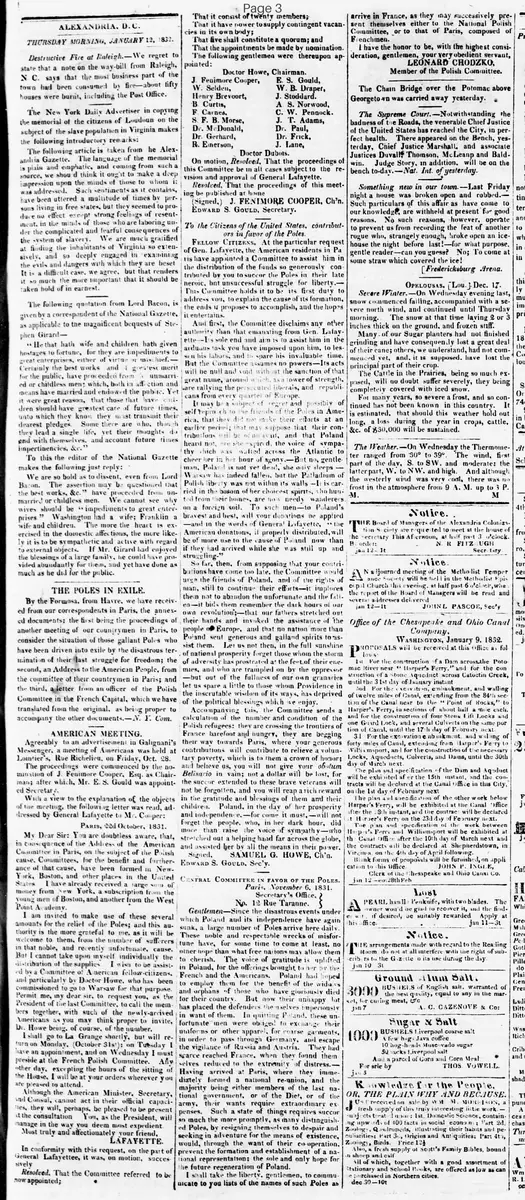
By the Formosa, from Havre, we have received from our correspondents in Paris, the annexed documents: the first being the proceedings of another meeting of our countrymen in Paris, to consider the situation of those gallant Poles who have been driven into exile by the disastrous termination of their last struggle for freedom; the second, an Address to the American People, from the committee of their countrymen in Paris; and the third, a letter from an officer of the Polish Committee in the French Capital, which we have translated from the original, as being proper to accompany the other documents.—N. Y. Com.
AMERICAN MEETING.
Agreeably to an advertisement in Galignani's Messenger, a meeting of Americans was held at Lointier's, Rue Richelieu, on Friday, Oct. 28. The proceedings were commenced by the nomination of J. Fenimore Cooper, Esq. as Chairman; after which, Mr. E. S. Gould was appointed Secretary.
With a view to the explanation of the objects of the meeting, the following letter was read, addressed by General Lafayette to Mr. Cooper:
Paris, 22d October, 1831.
My Dear Sir: You are doubtless aware, that, in consequence of the Address of the American Committee in Paris, on the subject of the Polish cause, Committees, for the benefit and furtherance of that cause, have been formed in New York, Boston, and other places in the United States. I have already received a large sum of money from New York, a subscription from the young men of Boston, and another from the West Point Academy. I am invited to make use of these several amounts for the relief of the Poles; and this authority is the more grateful to me, as it will be welcome to them, from the number of sufferers in that noble, and recently unfortunate, cause. But I cannot take upon myself individually the distribution of the supplies I wish to be assisted by a Committee of American fellow-citizens, and particularly by Doctor Howe, who has been commissioned to go to Warsaw for that purpose. Permit me, my dear sir, to request you, as the President of the last Committee, to call the members together, with such of the newly-arrived Americans as you may think proper to invite, Dr. Howe being, of course, of the number. I shall go to La Grange shortly, but will return on Monday, (October 31st); on Tuesday I have an appointment, and on Wednesday I must preside at the French Polish Committee. Any other day, excepting the hours of the sitting of the House, I will be at your orders wherever you are pleased to attend. Although the American Minister, Secretary, and Consul, cannot act in their official capacities, they will, perhaps, be pleased to be present at the consultation. You, as the President, will manage in the way you deem most expedient.
Most truly and affectionately your friend,
LAFAYETTE.
In conformity with this request, on the part of General Lafayette, it was, on motion, successively
Resolved, That the Committee referred to be now appointed;
That it consist of twenty members;
That it have power to supply contingent vacancies in its own body;
That five shall constitute a quorum; and
That the appointments be made by nomination.
The following gentlemen were thereupon appointed:
Doctor Howe, Chairman.
J. Fenimore Cooper,
E. S. Gould,
W. Selden,
W. B. Draper,
Henry Brevoort,
J. Stoddard,
B. Curtis,
A. S. Norwood,
F. Carnes,
C. W. Pennock,
S. F. B. Morse,
J. T. Adams,
Dr. McDonald,
Dr. Paul,
Dr. Gerhard,
Dr. Frick,
R. Emerson,
J. Lane,
Doctor Dubois.
On motion, Resolved, That the proceedings of this Committee be in all cases subject to the revision and approval of General Lafayette.
Resolved, That the proceedings of this meeting be published at home.
(Signed.) J. FENIMORE COOPER, Ch'n.
EDWARD S. GOULD, Secretary.
To the Citizens of the United States, contributors in favor of the Poles.
Fellow Citizens, At the particular request of Gen. Lafayette, the American residents in Paris have appointed a Committee to assist him in the distribution of the funds so generously contributed by you to succor the Poles in their late heroic, but unsuccessful struggle for liberty. This Committee holds it to be its first duty to address you, to explain the cause of its formation, the ends it proposes to accomplish, and the hopes it entertains.
And first, the Committee disclaims any other authority than that emanating from Gen. Lafayette—Its sole end and aim is to assist him in the arduous task you have imposed upon him, to lessen his labors, and to spare his invaluable time. But the Committee assumes no powers—Its acts will be null and void without the sanction of that great name, around which, as a tower of strength, are rallying the persecuted liberals, and republicans from every quarter of Europe.
It may be a subject of regret and possibly of self reproach to the friends of the Poles in America, that they did not make their efforts at an earlier period; that may suppose that their contributions would be of no avail, and that Poland heard not, ere she "expired," the voice of sympathy which was wafted across the Atlantic to cheer her in her hour of agony.—But no, gentlemen, Poland is not yet dead, she only sleeps—Warsaw has indeed fallen, but the Palladium of Polish liberty was not within its walls—It is carried in the bosom of her choicest spirits, who, hunted from their homes, are now needy wanderers on a foreign soil. To such men—to Poland's bravest and best, will your donations be applied—and, in the words of General Lafayette, "the American donations, if properly distributed, will be of more use to the cause of Poland now than if they had arrived while she was still up and struggling—"
So far, then, from supposing that your contributions have come too late, the Committee would urge the friends of Poland, and of the rights of man, still to continue their efforts—it implores them not to abandon the unfortunate and the fallen—it bids them remember the dark hours of our own revolution;—that our fathers stretched out their hands and invoked the assistance of the people of Europe, and that no nation more than Poland sent generous and gallant spirits to assist them. Let us not then, in the full sunshine of national prosperity forget those who in the storm of adversity has prostrated at the feet of their enemies, and who are trampled on by the oppressor—but out of the fullness of our own granaries let us spare a little to those whom Providence in the inscrutable wisdom of its ways, has deprived of the political blessings which we enjoy.
Accompanying this, the Committee sends a calculation of the number and condition of the Polish refugees: they are crossing the frontiers of France barefoot and hungry, they are begging their way towards Paris, where your generous contributions will contribute to relieve a voluntary poverty, which is to them a crown of honor; and believe us, you will not give your obolum Belisario in vain; not a dollar will be lost, for the succor extended to these brave veterans will not be forgotten, and you will reap a rich reward in the gratitude and blessings of them and their children. Poland, in the day of her prosperity and independence—for come it must—will not forget the people, who, in her dark hour, did more than raise the voice of sympathy—who stretched out a helping hand far across the globe, and assisted her by all the means in their power.
Signed,
SAMUEL G. HOWE, Ch'n.
EDWARD S. GOULD, Sec'y.
Central Committee in favor of the Poles.
Paris, November 6, 1831.
Secretary's Office,
No. 12 Rue Taranne.
Gentlemen—Since the disastrous events under which Poland and its independence have again sunk, a large number of Poles arrive here daily. These noble and respectable wrecks of misfortune have, for some time to come at least, no other hope than what free nations may allow them to cherish. The voice of gratitude is uplifted in Poland, for the offerings brought to her by the French and the Americans. Poland had hoped to employ them for the benefit of the widows and orphans of those who have gloriously died for their country. But now their unhappy lot has placed the defenders themselves imperiously in want of them. In quitting Poland, these unfortunate men were obliged to exchange their uniforms or other apparel, for coarse garments, in order to pass through Germany, and escape the vigilance of Russia and Austria. They had scarce reached France, when they found themselves reduced to the extremity of distress. Having arrived at Paris, where they immediately formed a national re-union, and the majority being either members of the last national government, or of the Diet, or of the army, their wants require extraordinary expenses. Such a state of things requires succor so much the more promptly, as many distinguished Poles, by resigning themselves to despair and seeking in adventure for the means of existence, would, through the want of their co-operation, prevent the formation and establishment of a national representation; the sole and only hope for the future regeneration of Poland.
I shall take the liberty, gentlemen, to communicate to you lists of the names of such Poles as arrive in France, as they may successively present themselves either to the National Polish Committee, or to that of Paris, composed of Frenchmen.
I have the honor to be, with the highest consideration, gentlemen, your very obedient servant,
LEONARD CHODZKO
Member of the Polish Committee.
What sub-type of article is it?
What keywords are associated?
What entities or persons were involved?
Where did it happen?
Foreign News Details
Primary Location
Paris
Event Date
October 28, 1831
Key Persons
Outcome
polish struggle for independence failed disastrously; warsaw fallen; numerous polish exiles arriving in france destitute and in need of aid; american funds to be distributed for their relief.
Event Details
Americans in Paris held a meeting on October 28, 1831, at Lafayette's request, to form a 20-member committee chaired by Doctor Howe to assist in distributing U.S. contributions to Polish exiles. The committee's address urges continued support, noting exiles' dire conditions and potential for Poland's future regeneration. A letter from the Polish Committee describes daily arrivals of destitute Poles and requests aid to prevent despair and support national representation.