Thank you for visiting SNEWPapers!
Sign up free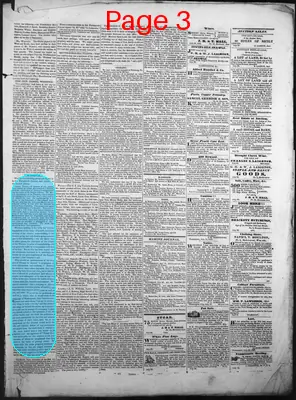
Editorial
July 23, 1833
The New Hampshire Gazette
Portsmouth, Rockingham County, New Hampshire
What is this article about?
An editorial responds to criticism of a proposed theater in Lowell, MA, where selectmen denied a license due to moral concerns. It defends theaters, arguing that vices like drunkenness and lewdness occur in all professions, including printing, and should not condemn the stage.
Clipping
OCR Quality
98%
Excellent
Full Text
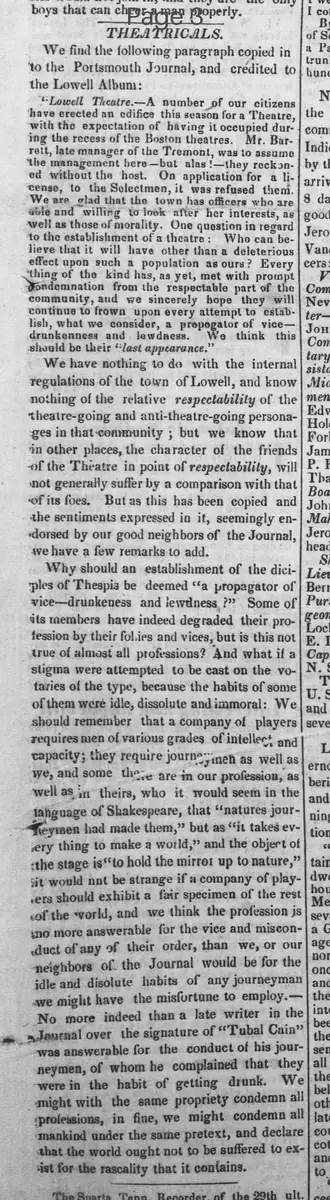
THEATRICALS.
We find the following paragraph copied into the Portsmouth Journal, and credited to the Lowell Album:
Lowell Theatre.--A number of our citizens have erected an edifice this season for a Theatre, with the expectation of having it occupied during the recess of the Boston theatres. Mr. Barrett, late manager of the Tremont, was to assume the management here--but alas!--they reckoned without the host. On application for a license, to the Selectmen, it was refused them. We are glad that the town has officers who are able and willing to look after her interests, as well as those of morality. One question in regard to the establishment of a theatre: Who can believe that it will have other than a deleterious effect upon such a population as ours? Every thing of the kind has, as yet, met with prompt condemnation from the respectable part of the community, and we sincerely hope they will continue to frown upon every attempt to establish, what we consider, a propagator of vice--drunkenness and lewdness. We think this should be their "last appearance."
We have nothing to do with the internal regulations of the town of Lowell, and know nothing of the relative respectability of the theatre-going and anti-theatre-going personages in that community; but we know that in other places, the character of the friends of the Theatre in point of respectability, will not generally suffer by a comparison with that of its foes. But as this has been copied and the sentiments expressed in it, seemingly endorsed by our good neighbors of the Journal we have a few remarks to add.
Why should an establishment of the disciples of Thespis be deemed "a propagator of vice-drunkenness and lewdness?" Some of its members have indeed degraded their profession by their follies and vices, but is this not true of almost all professions? And what if a stigma were attempted to be cast on the votaries of the type, because the habits of some of them were idle, dissolute and immoral: We should remember that a company of players requires men of various grades of intellect and capacity; they require journeymen as well as we, and some there are in our profession, as well as in theirs, who it would seem in the language of Shakespeare, that "nature's journeymen had made them," but as "it takes every thing to make a world," and the object of the stage is "to hold the mirror up to nature," it would not be strange if a company of players should exhibit a fair specimen of the rest of the world, and we think the profession is no more answerable for the vice and misconduct of any of their order, than we, or our neighbors of the Journal would be for the idle and dissolute habits of any journeyman we might have the misfortune to employ.--No more indeed than a late writer in the Journal over the signature of "Tubal Cain" was answerable for the conduct of his journeymen, of whom he complained that they were in the habit of getting drunk. We might with the same propriety condemn all professions, in fine, we might condemn all mankind under the same pretext, and declare that the world ought not to be suffered to exist for the rascality that it contains.
We find the following paragraph copied into the Portsmouth Journal, and credited to the Lowell Album:
Lowell Theatre.--A number of our citizens have erected an edifice this season for a Theatre, with the expectation of having it occupied during the recess of the Boston theatres. Mr. Barrett, late manager of the Tremont, was to assume the management here--but alas!--they reckoned without the host. On application for a license, to the Selectmen, it was refused them. We are glad that the town has officers who are able and willing to look after her interests, as well as those of morality. One question in regard to the establishment of a theatre: Who can believe that it will have other than a deleterious effect upon such a population as ours? Every thing of the kind has, as yet, met with prompt condemnation from the respectable part of the community, and we sincerely hope they will continue to frown upon every attempt to establish, what we consider, a propagator of vice--drunkenness and lewdness. We think this should be their "last appearance."
We have nothing to do with the internal regulations of the town of Lowell, and know nothing of the relative respectability of the theatre-going and anti-theatre-going personages in that community; but we know that in other places, the character of the friends of the Theatre in point of respectability, will not generally suffer by a comparison with that of its foes. But as this has been copied and the sentiments expressed in it, seemingly endorsed by our good neighbors of the Journal we have a few remarks to add.
Why should an establishment of the disciples of Thespis be deemed "a propagator of vice-drunkenness and lewdness?" Some of its members have indeed degraded their profession by their follies and vices, but is this not true of almost all professions? And what if a stigma were attempted to be cast on the votaries of the type, because the habits of some of them were idle, dissolute and immoral: We should remember that a company of players requires men of various grades of intellect and capacity; they require journeymen as well as we, and some there are in our profession, as well as in theirs, who it would seem in the language of Shakespeare, that "nature's journeymen had made them," but as "it takes every thing to make a world," and the object of the stage is "to hold the mirror up to nature," it would not be strange if a company of players should exhibit a fair specimen of the rest of the world, and we think the profession is no more answerable for the vice and misconduct of any of their order, than we, or our neighbors of the Journal would be for the idle and dissolute habits of any journeyman we might have the misfortune to employ.--No more indeed than a late writer in the Journal over the signature of "Tubal Cain" was answerable for the conduct of his journeymen, of whom he complained that they were in the habit of getting drunk. We might with the same propriety condemn all professions, in fine, we might condemn all mankind under the same pretext, and declare that the world ought not to be suffered to exist for the rascality that it contains.
What sub-type of article is it?
Moral Or Religious
What keywords are associated?
Theater Morality
Vice In Professions
Lowell Theater
Moral Condemnation
Professional Vices
Shakespeare Reference
What entities or persons were involved?
Lowell Selectmen
Mr. Barrett
Portsmouth Journal
Lowell Album
Tubal Cain
Editorial Details
Primary Topic
Defense Of Theaters Against Accusations Of Propagating Vice
Stance / Tone
Defensive Of Theater, Critical Of Moral Condemnation
Key Figures
Lowell Selectmen
Mr. Barrett
Portsmouth Journal
Lowell Album
Tubal Cain
Key Arguments
Theaters Are Not Inherently Propagators Of Vice Like Drunkenness And Lewdness
Vices And Follies Exist In All Professions, Including Printing
A Theater Company Reflects The Diversity Of Society, Including Its Flaws
Professions Should Not Be Condemned For The Misconduct Of Some Members
Anti Theater Stance Could Justify Condemning All Mankind For Its Rascality