Thank you for visiting SNEWPapers!
Sign up free
Gazette Of The United States, & Philadelphia Daily Advertiser
Philadelphia, Philadelphia County, Pennsylvania
What is this article about?
Introduction to intercepted letters from Napoleon's Egyptian expedition, critiquing French motives, preparations, and the campaign's failures, including army miseries and the Battle of the Nile's impact. Published in Philadelphia Gazette, May 11.
Merged-components note: Merged sequential components across pages 2 and 3 that form a single cohesive article introducing and analyzing Bonaparte's letters from the Egyptian expedition, including apparent OCR duplicate in one segment.
Clippings
1 of 2
OCR Quality
Full Text
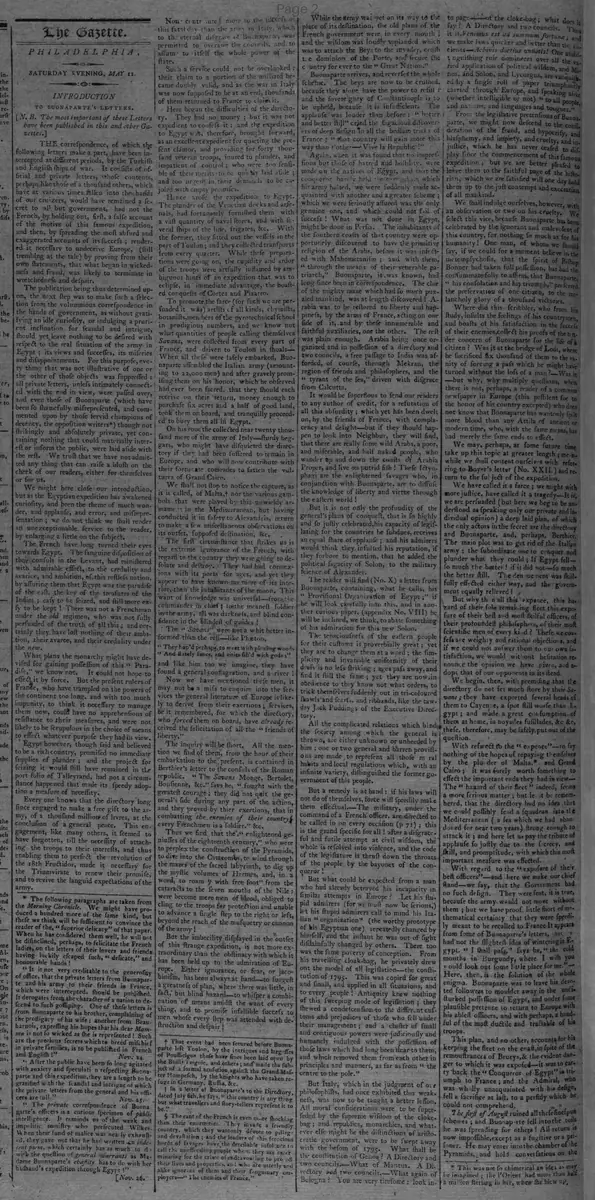
PHILADELPHIA,
SATURDAY EVENING, MAY 11.
INTRODUCTION
TO BUONAPARTE'S LETTERS.
[N. B. The most important of these Letters have been published in this and other Gazettes.]
THE correspondence, of which the following letters make a part, have been intercepted at different periods, by the Turkish and English ships of war. It consists of official and private letters, whose contents, perhaps like those of a thousand others, which have at various times fallen into the hands of our cruizers, would have remained a secret to all but government, had not the French, by holding out, first, a false account of the motive of this famous expedition, and then, by spreading the most absurd and exaggerated accounts of its success; rendered it necessary to undeceive Europe, (still trembling at the tale) by proving from their own statements, that what began in wickedness and fraud, was likely to terminate in wretchedness and despair.
The publication being thus determined upon, the next step was to make such a selection from the voluminous correspondence in the hands of government, as without gratifying an idle curiosity, or indulging a prurient inclination for scandal and intrigue, should yet leave nothing to be desired with respect to the real situation of the army in Egypt; its views and success, its miseries and disappointments. For this purpose, every thing that was not illustrative of one or the other of those objects was suppressed: all private letters, unless intimately connected with the end in view, were passed over, and even those of Buonaparte (which have been so shamefully misrepresented, and commented upon by those fervid champions of decency, the opposition writers*) though not strikingly and absolutely private, yet containing nothing that could materially interest or inform the public, were laid aside with the rest. We trust that we have not admitted any thing that can raise a blush on the cheek of our readers, either for themselves or for us.
We might here close our introduction, but as the Egyptian expedition has awakened curiosity, and been the theme of much wonder, and applause, and error, and misrepresentation; we do not think we shall render an unexceptionable service to the reader, by enlarging a little on the subject.
The French have long turned their eyes towards Egypt. The sanguine disposition of their consuls in the Levant, had ministered with admirable effect, to the credulity and avarice, and ambition, of this restless nation, by assuring them that Egypt was the paradise of the east, the key of the treasures of the Indies; easy to be seized, and still more easy to be kept! There was not a Frenchman under the old regimen, who was not fully persuaded of the truth of all this; and certainly they have lost nothing of their ambition, their avarice, and their credulity under the new.
What plans the monarchy might have devised for gaining possession of this 'Paradise,' we know not. It could not hope to effect it by force. But the present rulers of France, who have trampled on the powers of the continent too long, and with too much impunity, to think it necessary to manage them now, could have no apprehensions of resistance to their measures, and were not likely to be scrupulous in the choice of means to effect whatever purpose they had in view.
Egypt however, though said and believed to be a rich country, promised no immediate supplies of plunder; and the project for seizing it would still have remained in the portfolio of Talleyrand, had not a circumstance happened that made its speedy adoption a measure of necessity.
Every one knows that the directory long since engaged to make a free gift to the army, of a thousand million of livres, at the conclusion of a general peace. This engagement, like many others, it seemed to have forgotten, till the necessity of attaching the troops to their interests, and thus enabling them to perfect the revolution of the 18th Fructidor, made it necessary for the Triumvirate to renew their promise, and to revive the languid expectations of the army.
* The following paragraphs are taken from the Morning Chronicle. We might have produced a hundred more of the same kind, but these we think will be sufficient to convince the reader of the, 'superior delicacy' of that paper. When he has considered them well, he will not be disinclined, perhaps, to felicitate the French ladies, on the letters of their lovers and friends having luckily escaped such, 'delicate,' and honourable hands!
'It is not very creditable to the generosity of office, that the private letters from Buonaparte and his army to their friends in France, which were intercepted, should be published. It derogates from the character of a nation to descend to such gossiping. One of these letters is from Buonaparte to his brother, complaining of the profligacy of his wife; another from Beauharnais, expressing his hopes that his dear Mamma is not so wicked as he is represented! Such are the precious secrets which breed mischief in private families, is to be published in French and English!' Nov. 24.
'After the public have been so long agitated with anxiety and speculation respecting Bonaparte and this expedition, they are at length to be gratified with the scandal and intrigue of which the private letters from the general and his officers are full.' Ncv. 25.
'The private correspondence of Bonaparte's officers is a curious specimen of public intelligence. It reminds us of the weak and impolitic ministry who persecuted Wilkes. When their fund of malice was nearly exhausted, they gave out that he had written an indecent poem, which certainly has as much to do with the question of general warrants as Madame Bonaparte's chastity has to do with her husband's expedition through Egypt!'
No circumstance contributed more to the success of this factious day than the army in Italy, which to the eternal disgrace of Buonaparte, was permitted to overawe the councils, and to assume to itself the whole power of the state.
Such a service could not be overlooked: their claim to a portion of the milliard became doubly valid, and as the war in Italy was now supposed to be at an end, thousands of them returned to France to claim it.
Here began the difficulties of the directory. They had no money; but it was not expedient to confess it: and the expedition to Egypt was, therefore, brought forward, as an excellent expedient for quieting the present clamor, and providing for forty thousand veteran troops, inured to plunder, and impatient of control; who were too sensible of their merits to be quietly laid aside; and too urgent in their demands to be cajoled with empty promises.
Hence arose the expedition to Egypt. The plunder of the Venetian docks and arsenals, had fortunately furnished them with a vast quantity of naval stores, and with several ships of the line, frigates, &c. With the former, they fitted out the vessels in the port of Toulon; and they collected transports from every quarter. While these preparations were going on, the cupidity and ardor of the troops were artfully inflamed by ambiguous hints of an expedition that was to eclipse, in immediate advantage, the boasted conquests of Cortes and Pizarro.
To promote the farce (for such we are persuaded it was) artists of all kinds, chemists, botanists, members of the pyrotechnical school in prodigious numbers, and we know not what quantities of people calling themselves Savans, were collected from every part of France, and driven to Toulon in shoals.
When all these were safely embarked, Buonaparte assembled the Italian army (amounting to 22,000 men) and after gravely promising them on his honor, which he observed had ever been sacred, that they should each receive on their return, money enough to purchase six acres and a half of good land, took them on board, and tranquilly proceeded to bury them all in Egypt.
On his route he collected near twenty thousand more of the army of Italy—sturdy beggars, who might have disquieted the directory if they had been suffered to remain in Europe, and who will now contribute with their fortunate comrades to fatten the vultures of Grand Cairo.
We shall not stop to notice the capture, as it is called, of Malta, nor the various gambols that were played by this unwieldy armament in the Mediterranean, but having conducted it in safety to Alexandria, return to make a few miscellaneous observations on its outset, supposed destination, &c.
The first circumstance that strikes us is the extreme ignorance of the French, with regard to the country they were going to desolate and destroy. They had had connexions with its ports for ages, and yet they appear to have known no more of its interior, than the inhabitants of the moon. This want of knowledge was universal—from the commander in chief to the meanest soldier in the army, all was darkness, and blind confidence in the blindest of guides!
The 'Savans' were not a whit better informed than the rest—like Phaeton,
They hop'd perhaps, to meet with pleasing woods
And stately towns, and cities fill'd with gods:
and like him too we imagine, they have found a general conflagration, and a river!
Now we have mentioned these men, it may not be amiss to enquire into the services the general literature of Europe is likely to derive from their exertions; services, be it remembered, for which the directory, who forced them on board, have already received the felicitation of all the 'friends of liberty.'
The inquiry will be short. All the mention we find of them, from the hour of their embarkation to the present, is contained in Berthier's letter to the consuls of the Roman republic. 'The Savans Monge, Bertolet, Bougainville, &c.' says he, 'fought with the greatest courage; they did not quit the general's side during any part of the action, and they proved by their exertions, that in combatting the enemies of their country every Frenchman is a soldier.' &c.
Thus we find that the 'enlightened geniuses of the eighteenth century,' who were to perplex the construction of the Pyramids, to dive into the Catacombs, to wind through the mazes of the sacred labyrinth, to dig up the mystic volumes of Hermes, and, in a word, to roam 'with free foot' from the cataracts to the seven mouths of the Nile: were become mere men of blood, obliged to cling to the troops for protection and unable to advance a single step to the right or left, beyond the reach of the musquetry or cannon of the army!
But the imbecility displayed in the outset of this strange expedition, is not more extraordinary than the obstinacy with which it has been held up to the admiration of Europe. Either ignorance, or fear, or jacobinism, has been always at hand—to suggest a greatness of plan, where there was little, in fact, but blind hazard—to whisper a combination of means amidst the want of every thing, and to promise infallible success to men whose every step was attended with destruction and despair!
+ That event had been secured before Buonaparte left Toulon, by the intrigues and largesses of Poussielgue these have since been laid open by the Bailli Teigoise, and others; and made the subject of a formal accusation against the Grand Master Hompesch, by the knights who have taken refuge in Germany, Russia, &c.
In a letter of Buonaparte's to the Directory, dated July 6th, he says, 'this country is any thing but what travelers and story-tellers represent it to be.'
& The cant of the French is even more shocking than their enormities. They invade a friendly country, which they wantonly devote to pillage and devastation; and the leaders of this ferocious horde of savages have the detestable insolence to call the unoffending people whom they are exterminating or the crime of endeavouring to protect their lives and properties, and who are utterly and alike ignorant of them and their sanguinary employers—'The enemies of France.'
While the army was yet on its way to the place of its destination, the old plans of the French government were in every mouth; and the wisdom was loudly applauded which was to attach the Beys to the invader, cross the dominion of the Porte, and secure the country for ever to the 'Great Nation.'
Buonaparte arrives, and reverses the whole scheme. The beys are now to be crushed, because they alone have the power to resist; and the sovereignty of Constantinople is to be upheld, because it is insufficient. The applause was louder than before: 'better and better still' cried the sagacious discoverers of deep design in all the bedlam tricks of France: 'that country will gain more this way than t'other Vive la Republique!'
Again, when it was found that no impressions but those of hatred and hostility, were made on the natives of Egypt, and that the conqueror hardly held the ground on which his army halted, we were suddenly made acquainted with another and greater scheme; which we were seriously assured was the only genuine one, and which could not fail of success! What was not done in Egypt, might be done in Persia. The inhabitants of the southern coasts of that country were opportunely discovered to have the primitive religion of the Arabs, before it was infected with Mahometanism; and with them, 'through the means of their venerable patriarch,' Buonaparte, it was known, had long since been in correspondence. The clue of the mighty maze which had so much puzzled mankind, was at length discovered! Arabia was to be restored to liberty and happiness, by the arms of France, acting on one side of it, and by these innumerable and faithful auxiliaries, on the other. The rest was plain enough. Arabia being once organized and in possession of a Directory and two councils, a free passage to India was afforded, of course, through Mekran, the region of friends and philosophers, and the 'tyrant of the east,' driven with disgrace from Calcutta.
It would be superfluous to send our readers to any author of credit, for a refutation of all this absurdity; which yet has been dwelt on, by the friends of France, with complacency and delight—but if they should happen to look into Niebuhr, they will find, that there are really some wild Arabs, a poor, and miserable, and half naked people, who wander up and down the coasts of Arabia Proper, and live on putrid fish! These Ichthyophagi are the enlightened savages who, in conjunction with Buonaparte, are to diffuse the knowledge of liberty and virtue through the eastern world!
But it is not only the profundity of the general's plans of conquest, that is so highly and so justly celebrated, his capacity of legislating for the countries he subdues, receives an equal share of applause; and his admirers would think they insulted his reputation, if they forbore to mention, that he added the political sagacity of Solon, to the military science of Alexander.
The reader will find (No. X) a letter from Buonaparte, containing, what he calls, his 'Provisional Organization of Egypt;' if he will look carefully into this, and in another curious paper, (appendix No. VIII) he will be inclined, we think, to abate something of his admiration for this new Solon.
The tenaciousness of the eastern people for their customs is proverbially great; yet they are to change them at a word; the simplicity and invariable uniformity of their dress is no less striking; ages pass away, and find it still the same; yet they are now, in obedience to they know not what orders, to trick themselves suddenly out in tri-coloured shawls and scarfs, and ribbands, like the tawdry Jack Puddings of the Executive Directory.
All the complicated relations which bind the society among which the general is thrown, are either unknown or unheeded by him; one or two general and barren provisions are made to represent all those moral habits and local regulations which, with an infinite variety, distinguished the former government of this people.
But a remedy is at hand: if his laws will not do of themselves, force will speedily make them effectual.—The military, under the command of a French officer, are directed to be called in on every occasion (p 71); this is the grand specific for all! after a disgraceful and futile attempt at civil wisdom, the whole is resolved into violence, and the code of the legislature is thrust down the throats of the people by the bayonet of the conqueror!
But what could be expected from a man who had already betrayed his incapacity in similar attempts in Europe? Let his stupid admirers (for we must now be serious,) let his stupid admirers call to mind his Italian 'organization' (the worthy prototype of his Egyptian one) repeatedly changed by himself, and the instant he was out of sight disdainfully changed by others. There too was the same poverty of conception. From his travelling cloak-bag, he privately drew out the model of all legislation—the constitution of 1795. This was copied for great and small, and applied in all situations, and to every people! Antiquity knew nothing of this sweeping mode of legislation; they shewed a condescension to the different customs and prejudices of those who fell under their management; and a cluster of small and contiguous powers were judiciously and humanely indulged with the possession of those laws which had long been dear to them, and which removed them from each other in principles and manners, as far as from 'the centre to the pole.'
But Italy, which in the judgment of our philosophers, had once exhibited this weakness, was now to be taught a better lesson. All moral considerations were to be superseded by the supreme wisdom of the cloak-bag; and republics, monarchies, and whatever else might be the distinctions of aristocratic government, were to be swept away with the broom of 1795. What shall be the constitution of Genoa? A Directory and two councils. What of Mantua? A Directory and two councils.—What again of Bologna? You are very tiresome: look into page 1 of the cloak-bag; what does it say? A Directory and two councils. Thus it is, Venimus est ad summum fortunæ; and we make laws quicker and better than the ancients—Achivis doctius unotis! One undistinguishing rule domineers over all the varied applications of political wisdom, and Minos, and Solon, and Lycurgus, are vanquished by a single roll of paper triumphantly carried through Europe, and speaking alike (whether intelligible or not) 'to all people, and nations, and languages and tongues.'
From the legislative pretensions of Buonaparte, we might now descend to the consideration of the fraud, and hypocrisy, and blasphemy, and impiety, and cruelty, and injustice, which he has never ceased to display since the commencement of this famous expedition; but we are better pleased to leave them to the faithful page of the historian, which we are satisfied will one day hold them up to the just contempt and execration of all mankind.
We shall indulge ourselves, however, with an observation or two on his cruelty. We select this vice, because Buonaparte has been celebrated by the ignorant and malevolent of this country, for nothing so much as for his humanity! One man, of whom we should say, if we could for a moment believe in the metempsychosis, that the spirit of Bishop Bonner had taken full possession, has had the consummate folly to assert, that Buonaparte, 'his consolation and his triumph,' preferred the preservation of one citizen, to the melancholy glory of a thousand victories.
Where did this scribbler, who from his study, insults the feelings of his countrymen, and boasts of his satisfaction in the success of their enemies, collect his proofs of the tender concern of Buonaparte for the life of a citizen? Was it at the bridge of Lodi, where he sacrificed six thousand of them to the vanity of forcing a pass which he might have turned without the loss of a man? Was it—but why, why multiply questions, when there is not, perhaps, a reader of a common newspaper in Europe (this petulant foe to the honor of his country excepted) who does not know that Buonaparte has wantonly spilt more blood than any Attila of ancient or modern time, who, with the same means, has had merely the same ends to effect.
We may, perhaps, at some future time take up this topic at greater length; mean-while we shall content ourselves with referring to Boyer's letter (No. XXII.) and return to the subject of the expedition.
We have called it a farce; we might with more justice, have called it a tragedy—It is, we are persuaded (but here we beg to be understood as speaking only our private and individual opinion) a deep laid plan, of which the only actors in the secret are the directory and Buonaparte, and, perhaps, Berthier.
The main plot was to get rid of the Italian army; the subordinate one to conquer and plunder what they could; If Egypt fell— so much the better! if it did not—so much the better still. The double event was killingly effected either way, and the government equally relieved!
But why then all this expense, this hazard of their sole remaining fleet this exposure of their best and most skilful officers, of their profoundest philosophers, of their most scientific men of every kind? These we confess are weighty and rational objections, and if we could not answer them to our own satisfaction, we would without hesitation renounce the opinion we have given, and adopt that of our opponents in its stead.
We begin then, with premising that the directory do not set much store by their Savans; they have exported several heads of them to Cayenne, a spot still worse than Egypt; and made a great consumption of them at home, in noyades guillotines, &c. &c. these, therefore, may be safely put out of the question.
With respect to the 'expense'—to say nothing of the hopes of repaying themselves by the plunder of Malta, * and Grand Cairo; it was surely worth something to effect the important ends they had in view— The 'hazard of their fleet' indeed, seems a more serious matter: but let it be remembered, that the directory had no idea that we could possibly send a squadron into the Mediterranean (a sea which we had abandoned for near two years) strong enough to attack it; and here let us pay the tribute of applause so justly due to the secrecy, and skill, and promptitude, with which this most important measure was effected.
With regard to the 'exposure of their best officers' —and here we make our chief stand—we say, that the Government had no such design. They were sent, it is true, because the army would not move without them; but we have proof, little short of mathematical certainty that they were speedily meant to be recalled to France It appears from some of Buonaparte's letters, that he had not the slightest idea of wintering in Egypt. 'I shall pass,' says he, 'the cold months in Burgundy, where I wish you would look out some little place for me.'
Here, then, is the solution of the whole enigma. Buonaparte was to leave his devoted followers to moulder away in the undisturbed possession of Egypt, and under some plausible pretence to return to Europe with his ablest officers, and with perhaps, a handful of the most ductile and tractable of his troops.
This plan, and no other, accounts for his keeping the fleet on the coast, in spite of the remonstrances of Brueys, & the evident danger to which it was exposed—it was to carry back the 'Conqueror of Egypt' in triumph to France; and the Admiral, who was wholly unacquainted with his design, fell a sacrifice at last, to a perfidy which he could not comprehend.
The first of August ruined all these fine-spun schemes; and Buonaparte fell into the toils he was spreading for others! All return is now impossible, except as a fugitive or a prisoner. He may enter into the chamber of the Pyramids, and hold conversations on the
* This was not so chimerical an idea as may be imagined; the l'Orient had more than half a million sterling in her, when he blew up.
He may tomb in Cheops, with Imans, and with Muftis; he may organize, and conquer, and plant botanic gardens, and establish menageries; he may pass from the Delta to the Thebaid, and from the Thebaid to the Delta, with his train of tricoloured Sheiks, and be hailed as the Ali Buonaparte of the country—all is still but folly: his final destruction can neither be averted nor delayed; and his unreasonable mummeries will but serve to take away all dignity from the catastrophe of the drama: and render him at once terrible and ridiculous.
Before our readers accuse us of being too sanguine in our expectations, or too precipitate in our judgment, let them carefully peruse the following correspondence. They will find every officer in the army dissatisfied with his situation, and impatient to return to France; execrating the climate and the country and lamenting the folly that led him to embark in so wild, absurd, and hopeless an expedition. They will find the whole army without tents, baggage, or ammunition, without medicines or wine, or brandy, with few of the necessaries, and none of the comforts of life.
This was a faithful picture of their situation before the destruction of their fleet—what it is since they may easily conjecture. If, then, they will add to this accumulation of misery and despair, the inveterate hostility of the Arabs, the treachery of the Egyptians, and the destructive warfare of the Mamelukes, together with the nauseous and peculiar diseases of the country, the intolerable heats, and pestilential winds, the devouring myriads of venomous insects, and the stench and putrefaction of ten thousand stagnant pools, they will not, we imagine, be much inclined to dispute the justice of our conclusions.
What sub-type of article is it?
What keywords are associated?
What entities or persons were involved?
Where did it happen?
Foreign News Details
Primary Location
Egypt
Event Date
July 6th
Key Persons
Outcome
destruction of french fleet on the first of august; army in misery without supplies, facing hostility from arabs, egyptians, mamelukes, diseases, and harsh conditions; buonaparte's plans ruined, return impossible except as fugitive or prisoner.
Event Details
Intercepted correspondence reveals the French expedition to Egypt as a scheme to rid the Directory of demanding Italian army veterans; preparations from Toulon with 40,000 troops and savants; landing at Alexandria; ignorance of Egypt; failed conquests and legislative impositions; criticism of Buonaparte's cruelty and hypocrisy; ultimate failure after fleet's destruction.