Thank you for visiting SNEWPapers!
Sign up free
The Watchman
Hartford, Hartford County, Connecticut
What is this article about?
'The Retrospect No. VIII' argues that false religious revivals are distinct from and detrimental to genuine ones like the 1740 Great Revival, critiques unverified reporting in religious papers, and recounts a misrepresented revival account by an evangelist in a town with three parishes.
Clipping
OCR Quality
Full Text
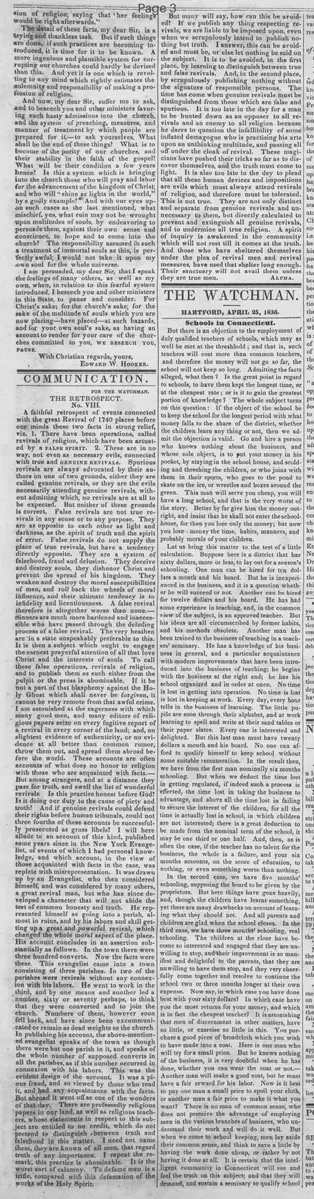
FOR THE WATCHMAN.
THE RETROSPECT.
No. VIII
A faithful retrospect of events connected with the great Revival of 1740 places before our minds these two facts in strong relief, viz. 1. There have been operations, called revivals of religion, which have been actuated by a FALSE SPIRIT. 2. These are in no way, not even as necessary evils, connected with true and GENUINE REVIVALS. Spurious revivals are always advocated by their authors on one of two grounds, either they are called genuine revivals, or they are the evils necessarily attending genuine revivals, without admitting which, no revivals are at all to be expected. But neither of these grounds is correct. False revivals are not true revivals in any sense or to any purpose. They are as opposite to each other as light and darkness, as the spirit of truth and the spirit of error. False revivals do not supply the place of true revivals, but have a tendency directly opposite. They are a system of falsehood, fraud and delusion. They deceive and destroy souls, they dishonor Christ and prevent the spread of his kingdom. They weaken and destroy the moral susceptibilities of men, and roll back the wheels of moral influence, and their ultimate tendency is to infidelity and licentiousness. A false revival therefore is altogether worse than none.—Sinners are much more hardened and inaccessible who have passed through the deluding process of a false revival. The very heathen are in a state unspeakably preferable to this. It is then a subject which ought to engage the earnest prayerful attention of all that love Christ and the interests of souls. To call these false operations, revivals of religion, and to publish them as such either from the pulpit or the press is abominable. If it be not a part of that blasphemy against the Holy Ghost which shall never be forgiven, it cannot be very remote from that awful crime. I am astonished at the eagerness with which many good men, and many editors of religious papers seize on every fugitive report of a revival in every corner of the land; and, on slightest evidence of authenticity, or no evidence at all better than common rumor, throw them out, and spread them abroad before the world. These accounts are often accounts of what does no honor to religion with those who are acquainted with facts.—But among strangers, and at a distance they pass for truth, and swell the list of wonderful revivals. Is this practice honest before God? Is it doing our duty to the cause of piety and truth? And if genuine revivals could defend their rights before human tribunals, could not three fourths of these accounts be successfully prosecuted as gross libels? I will here allude to an account of this kind, published some years since in the New York Evangelist, of events of which I had personal knowledge, and which account, in the view of those acquainted with facts in the case, was replete with misrepresentation. It was drawn up by an Evangelist, who then considered himself, and was considered by many others, a great revival man, but who has since developed a character that will not abide the test of common honesty and truth. He represented himself as going into a parish, almost in ruins, and by his labors and skill getting up a great and powerful revival, which changed the whole moral aspect of the place. His account concludes in an assertion substantially as follows. In the town there were three hundred converts. Now the facts were these. This evangelist came into a town consisting of three parishes. In two of the parishes were revivals without any connexion with his labors. He went to work in the third, and by one means and another led a number, sixty or seventy perhaps, to think that they were converted and to join the church. Numbers of them, however soon fell back, and have since been excommunicated or remain as dead weights to the church. In publishing his account, the above-mentioned evangelist speaks of the town as though there were but one parish in it, and speaks of the whole number of supposed converts in all the parishes, as if this number occurred in connexion with his labors. This was the evident design of the account. It was a pious fraud, and so viewed by those who read it, and had any acquaintance with the facts. But abroad it went off as one of the wonders of that day. There are professed religious papers in our land, as well as religious teachers, whose statements in respect to this subject are entitled to no credit, which do not pretend to distinguish between truth and falsehood in this matter. I need not name them, they are known of all men, that regard truth of any importance. I repeat the remark, this practice is abominable. It is the worst sort of calumny. To defame men is a trifle, compared with this defamation of the works of the Holy Spirit.
But many will say, how can this be avoided? If we publish any thing respecting revivals, we are liable to be imposed upon, even when we scrupulously intend to publish nothing but truth. I answer, this can be avoided and must be, or else let nothing be said on the subject. It is to be avoided, in the first place, by learning to distinguish between true and false revivals. And, in the second place, by scrupulously publishing nothing without the signature of responsible persons. The time has come when genuine revivals must be distinguished from those which are false and spurious. It is too late in the day for a man to be hunted down as an opposer to all revivals and an enemy to all religion because he dares to question the infallibility of some inflated demagogue who is practising his arts upon an unthinking multitude, and passing all off under the cloak of revival. These magicians have pushed their tricks so far as to discover themselves, and the truth must come to light. It is also too late in the day to plead that all these human devices and impositions are evils which must always attend revivals of religion, and therefore must be tolerated. This is not true. They are not only distinct and separate from genuine revivals and unnecessary to them, but directly calculated to prevent and extinguish all genuine revivals, and to undermine all true religion. A spirit of inquiry is awakened in the community which will not rest till it comes at the truth. And those who have sheltered themselves under the plea of revival men and revival measures, have used that shelter long enough. Their sanctuary will not avail them unless they are true men.
ALPHA.
What sub-type of article is it?
What themes does it cover?
What keywords are associated?
What entities or persons were involved?
Story Details
Key Persons
Event Date
1740
Story Details
A retrospect on the Great Revival of 1740 distinguishes true revivals from false ones actuated by a spirit of error, fraud, and delusion that harm souls and religion; critiques eager, unverified publication of revival reports in religious papers as dishonest and blasphemous; recounts a misrepresented account in the New York Evangelist by an evangelist claiming credit for 300 converts in a town, when actual conversions linked to him were far fewer and many backslid.