Thank you for visiting SNEWPapers!
Sign up free
Letter to Editor
November 17, 1738
The Virginia Gazette
Richmond, Williamsburg, Richmond County, Virginia
What is this article about?
Musiphilus submits to Mr. Parks an altered fable 'Bacchus and the Satyr,' originally inspired by the Archbishop of Cambray, presenting a moral on satire's right to correct the faults of the high-born.
Clipping
OCR Quality
98%
Excellent
Full Text
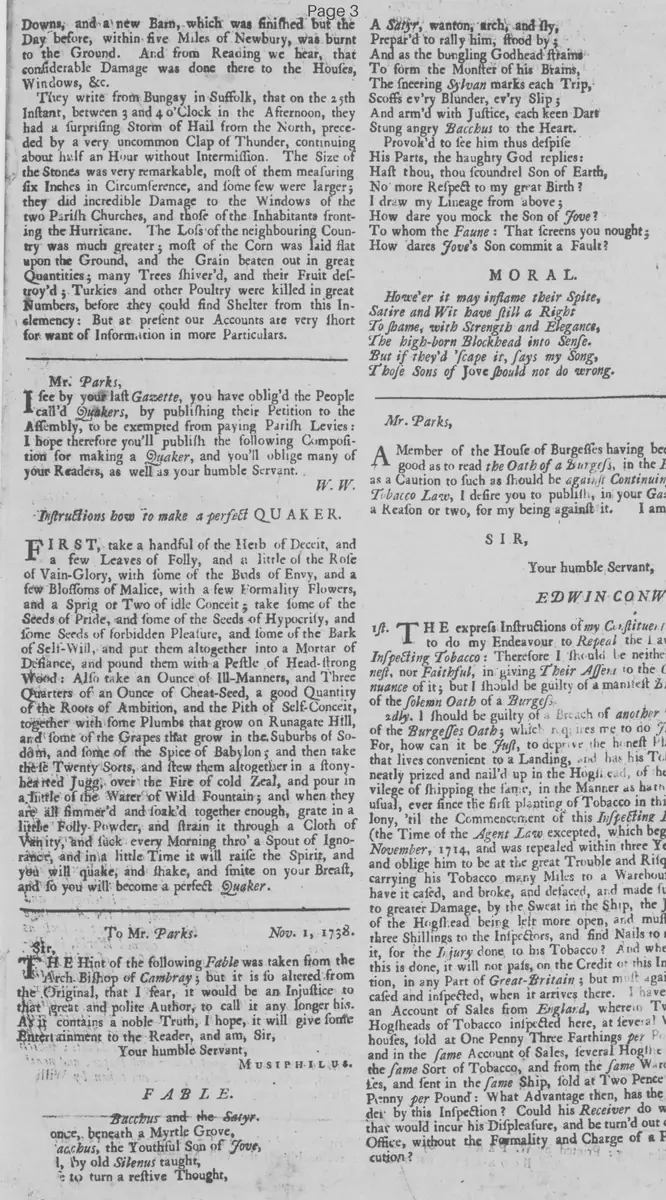
To Mr. Parks.
Nov. 1, 1738.
The Hint of the following Fable was taken from the Arch-Bishop of Cambray; but it is so altered from the Original, that I fear, it would be an Injustice to that great and polite Author, to call it any longer his. As it contains a noble Truth, I hope, it will give some Entertainment to the Reader, and am, Sir,
Your humble Servant,
MUSIPHILUS.
FABLE.
Bacchus and the Satyr.
Once, beneath a Myrtle Grove,
Bacchus, the Youthful Son of Jove,
By old Silenus taught,
To turn a restive Thought,
A Satyr, wanton, arch and sly,
Prepar'd to rally him, stood by;
And as the bungling Godhead strain'd
To form the Monster of his Brains.
The sneering Sylvan marks each Trip,
Scoffs ev'ry Blunder, ev'ry Slip;
And arm'd with Justice, each keen Dart
Stung angry Bacchus to the Heart.
Provok'd to see him thus despise
His Parts, the haughty God replies:
Hast thou, thou scoundrel Son of Earth,
No more Respect to my great Birth?
I draw my Lineage from above;
How dare you mock the Son of Jove?
To whom the Faun: That concerns you nought;
How dares Jove's Son commit a Fault?
MORAL.
Howe'er it may inflame their Spite,
Satire and Wit have still a Right
To blame, with Strength and Elegance,
The high-born Blockhead into Sense.
But if they'd 'Scape it, Says my Song:
Those Sons of Jove should not do wrong.
Nov. 1, 1738.
The Hint of the following Fable was taken from the Arch-Bishop of Cambray; but it is so altered from the Original, that I fear, it would be an Injustice to that great and polite Author, to call it any longer his. As it contains a noble Truth, I hope, it will give some Entertainment to the Reader, and am, Sir,
Your humble Servant,
MUSIPHILUS.
FABLE.
Bacchus and the Satyr.
Once, beneath a Myrtle Grove,
Bacchus, the Youthful Son of Jove,
By old Silenus taught,
To turn a restive Thought,
A Satyr, wanton, arch and sly,
Prepar'd to rally him, stood by;
And as the bungling Godhead strain'd
To form the Monster of his Brains.
The sneering Sylvan marks each Trip,
Scoffs ev'ry Blunder, ev'ry Slip;
And arm'd with Justice, each keen Dart
Stung angry Bacchus to the Heart.
Provok'd to see him thus despise
His Parts, the haughty God replies:
Hast thou, thou scoundrel Son of Earth,
No more Respect to my great Birth?
I draw my Lineage from above;
How dare you mock the Son of Jove?
To whom the Faun: That concerns you nought;
How dares Jove's Son commit a Fault?
MORAL.
Howe'er it may inflame their Spite,
Satire and Wit have still a Right
To blame, with Strength and Elegance,
The high-born Blockhead into Sense.
But if they'd 'Scape it, Says my Song:
Those Sons of Jove should not do wrong.
What sub-type of article is it?
Poetic
Satirical
Ethical Moral
What themes does it cover?
Morality
Social Issues
What keywords are associated?
Bacchus Satyr
Fable Moral
Satire Wit
High Born Faults
Noble Truth
What entities or persons were involved?
Musiphilus
Mr. Parks
Letter to Editor Details
Author
Musiphilus
Recipient
Mr. Parks
Main Argument
satire and wit have the right to blame and correct the faults of the high-born with strength and elegance, but the nobility should avoid wrongdoing to escape such criticism.
Notable Details
Hint Taken From The Arch Bishop Of Cambray But Significantly Altered
Fable Written In Verse
Moral Emphasizes Justice In Satire Regardless Of Birth