Thank you for visiting SNEWPapers!
Sign up free
Literary
July 29, 1841
The Charlotte Journal
Charlotte, Mecklenburg County, North Carolina
What is this article about?
Announcement that Mr. Gouverneur is writing a biography of Mr. Monroe using valuable papers from the last 50 years. Extract describes how Mrs. Monroe's visit to prison aroused public sympathy, saving Madame La Fayette from execution during the French Revolution, while Mr. Monroe was U.S. minister in Paris.
Clipping
OCR Quality
95%
Excellent
Full Text
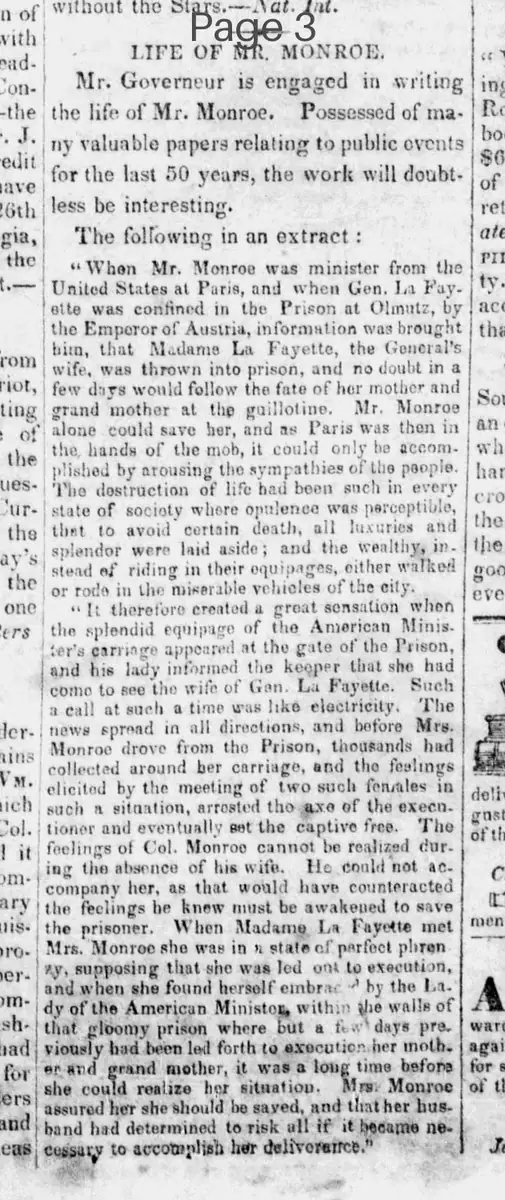
LIFE OF MR. MONROE
Mr. Gouverneur is engaged in writing the life of Mr. Monroe. Possessed of many valuable papers relating to public events for the last 50 years, the work will doubtless be interesting.
The following is an extract:
"When Mr. Monroe was minister from the United States at Paris, and when Gen. La Fayette was confined in the Prison at Olmutz, by the Emperor of Austria, information was brought him, that Madame La Fayette, the General's wife, was thrown into prison, and no doubt in a few days would follow the fate of her mother and grand mother at the guillotine. Mr. Monroe alone could save her, and as Paris was then in the hands of the mob, it could only be accomplished by arousing the sympathies of the people. The destruction of life had been such in every state of society where opulence was perceptible, that to avoid certain death, all luxuries and splendor were laid aside; and the wealthy, instead of riding in their equipages, either walked or rode in the miserable vehicles of the city.
"It therefore created a great sensation when the splendid equipage of the American Minister's carriage appeared at the gate of the Prison, and his lady informed the keeper that she had come to see the wife of Gen. La Fayette. Such a call at such a time was like electricity. The news spread in all directions, and before Mrs. Monroe drove from the Prison, thousands had collected around her carriage, and the feelings elicited by the meeting of two such females in such a situation, arrested the axe of the executioner and eventually set the captive free. The feelings of Col. Monroe cannot be realized during the absence of his wife. He could not accompany her, as that would have counteracted the feelings he knew must be awakened to save the prisoner. When Madame La Fayette met Mrs. Monroe she was in a state of perfect phrensy, supposing that she was led out to execution, and when she found herself embraced by the Lady of the American Minister, within the walls of that gloomy prison where but a few days previously had been led forth to execution her mother and grand mother, it was a long time before she could realize her situation. Mrs. Monroe assured her she should be saved, and that her husband had determined to risk all if it became necessary to accomplish her deliverance."
Mr. Gouverneur is engaged in writing the life of Mr. Monroe. Possessed of many valuable papers relating to public events for the last 50 years, the work will doubtless be interesting.
The following is an extract:
"When Mr. Monroe was minister from the United States at Paris, and when Gen. La Fayette was confined in the Prison at Olmutz, by the Emperor of Austria, information was brought him, that Madame La Fayette, the General's wife, was thrown into prison, and no doubt in a few days would follow the fate of her mother and grand mother at the guillotine. Mr. Monroe alone could save her, and as Paris was then in the hands of the mob, it could only be accomplished by arousing the sympathies of the people. The destruction of life had been such in every state of society where opulence was perceptible, that to avoid certain death, all luxuries and splendor were laid aside; and the wealthy, instead of riding in their equipages, either walked or rode in the miserable vehicles of the city.
"It therefore created a great sensation when the splendid equipage of the American Minister's carriage appeared at the gate of the Prison, and his lady informed the keeper that she had come to see the wife of Gen. La Fayette. Such a call at such a time was like electricity. The news spread in all directions, and before Mrs. Monroe drove from the Prison, thousands had collected around her carriage, and the feelings elicited by the meeting of two such females in such a situation, arrested the axe of the executioner and eventually set the captive free. The feelings of Col. Monroe cannot be realized during the absence of his wife. He could not accompany her, as that would have counteracted the feelings he knew must be awakened to save the prisoner. When Madame La Fayette met Mrs. Monroe she was in a state of perfect phrensy, supposing that she was led out to execution, and when she found herself embraced by the Lady of the American Minister, within the walls of that gloomy prison where but a few days previously had been led forth to execution her mother and grand mother, it was a long time before she could realize her situation. Mrs. Monroe assured her she should be saved, and that her husband had determined to risk all if it became necessary to accomplish her deliverance."
What sub-type of article is it?
Prose Fiction
What themes does it cover?
Political
Liberty Freedom
What keywords are associated?
Monroe Biography
Lafayette Rescue
French Revolution
American Diplomacy
Prison Visit
Public Sympathy
What entities or persons were involved?
Mr. Gouverneur
Literary Details
Title
Life Of Mr. Monroe
Author
Mr. Gouverneur
Subject
Extract On Saving Madame La Fayette During The French Revolution
Form / Style
Biographical Narrative Extract
Key Lines
It Therefore Created A Great Sensation When The Splendid Equipage Of The American Minister's Carriage Appeared At The Gate Of The Prison, And His Lady Informed The Keeper That She Had Come To See The Wife Of Gen. La Fayette.
Such A Call At Such A Time Was Like Electricity.
The Feelings Elicited By The Meeting Of Two Such Females In Such A Situation, Arrested The Axe Of The Executioner And Eventually Set The Captive Free.