Thank you for visiting SNEWPapers!
Sign up free
Jackson Advocate
Jackson, Hinds County, Mississippi
What is this article about?
A 1959-1960 study by Mr. Skinner details the agricultural economy of the Belgian Congo and Ruanda-Urundi up to 1958, highlighting production increases, research efforts, export crops like coffee and palm oil, and significant U.S. trade involvement, under a major development plan.
Clipping
OCR Quality
Full Text
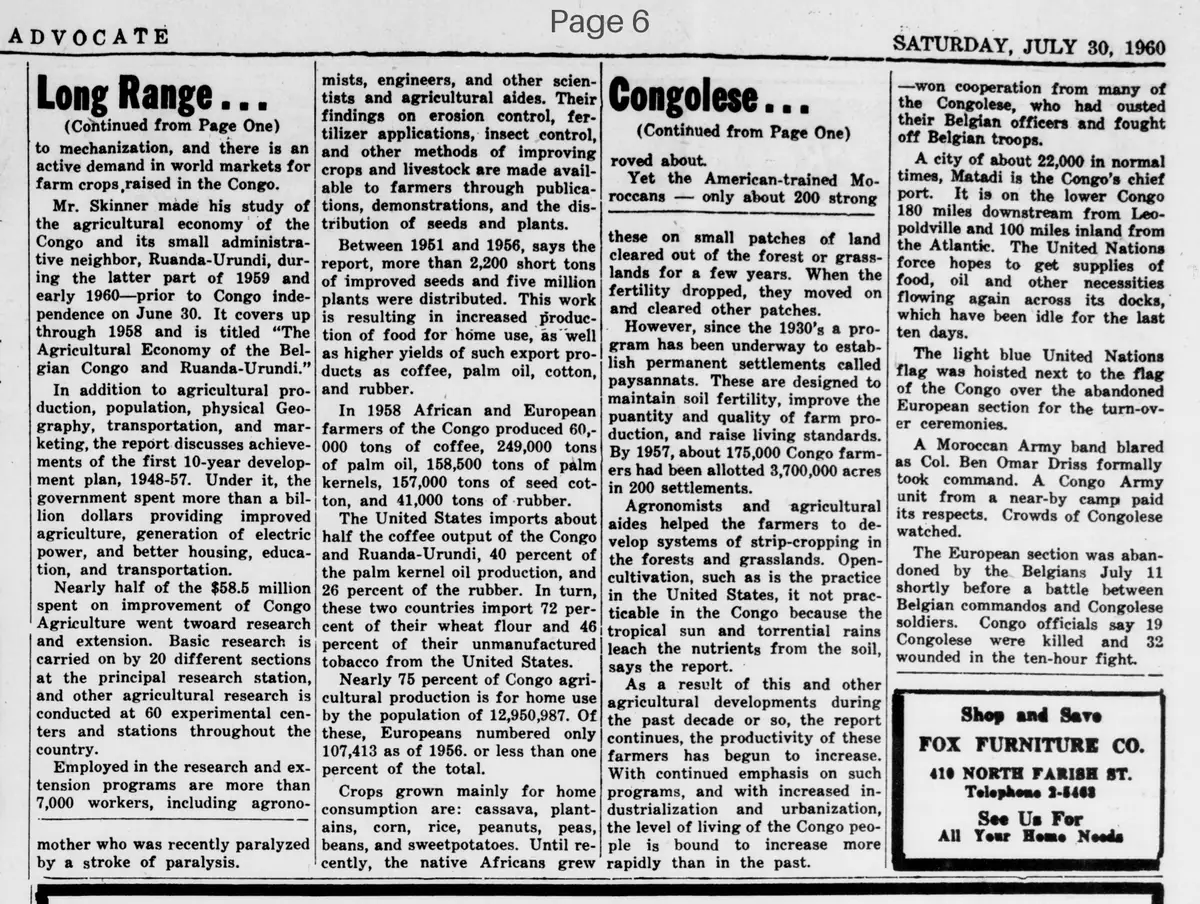
(Continued from Page One)
to mechanization, and there is an active demand in world markets for farm crops raised in the Congo.
Mr. Skinner made his study of the agricultural economy of the Congo and its small administrative neighbor, Ruanda-Urundi, during the latter part of 1959 and early 1960-prior to Congo independence on June 30. It covers up through 1958 and is titled "The Agricultural Economy of the Belgian Congo and Ruanda-Urundi."
In addition to agricultural production, population, physical geography, transportation, and marketing, the report discusses achievements of the first 10-year development plan, 1948-57. Under it, the government spent more than a billion dollars providing improved agriculture, generation of electric power, and better housing, education, and transportation.
Nearly half of the $58.5 million spent on improvement of Congo Agriculture went toward research and extension. Basic research is carried on by 20 different sections at the principal research station, and other agricultural research is conducted at 60 experimental centers and stations throughout the country.
Employed in the research and extension programs are more than 7,000 workers, including agronomists, engineers, and other scientists and agricultural aides. Their findings on erosion control, fertilizer applications, insect control and other methods of improving crops and livestock are made available to farmers through publications, demonstrations, and the distribution of seeds and plants.
Between 1951 and 1956, says the report, more than 2,200 short tons of improved seeds and five million plants were distributed. This work is resulting in increased production of food for home use, as well as higher yields of such export products as coffee, palm oil, cotton, and rubber.
In 1958 African and European farmers of the Congo produced 60,000 tons of coffee, 249,000 tons of palm oil, 158,500 tons of palm kernels, 157,000 tons of seed cotton, and 41,000 tons of rubber.
The United States imports about half the coffee output of the Congo and Ruanda-Urundi, 40 percent of the palm kernel oil production, and 26 percent of the rubber. In turn, these two countries import 72 percent of their wheat flour and 46 percent of their unmanufactured tobacco from the United States.
Nearly 75 percent of Congo agricultural production is for home use by the population of 12,950,987. Of these, Europeans numbered only 107,413 as of 1956, or less than one percent of the total.
Crops grown mainly for home consumption are: cassava, plantains, corn, rice, peanuts, peas, beans, and sweet potatoes. Until recently, the native Africans grew
What sub-type of article is it?
What keywords are associated?
What entities or persons were involved?
Where did it happen?
Foreign News Details
Primary Location
Belgian Congo And Ruanda Urundi
Event Date
Latter Part Of 1959 And Early 1960
Key Persons
Outcome
increased agricultural production including 60,000 tons of coffee, 249,000 tons of palm oil, 158,500 tons of palm kernels, 157,000 tons of seed cotton, and 41,000 tons of rubber in 1958; u.s. imports half the coffee, 40% of palm kernel oil, 26% of rubber; government spent over a billion dollars on 1948-57 development plan with $58.5 million on agriculture.
Event Details
Mr. Skinner's study covers agricultural production, population, geography, transportation, marketing, and achievements of the 1948-57 development plan in the Belgian Congo and Ruanda-Urundi. It details research and extension efforts with over 7,000 workers, distribution of improved seeds and plants, leading to higher yields of export crops like coffee, palm oil, cotton, rubber, and food for home use. Most production is for local consumption by a population of nearly 13 million, mostly African.