Thank you for visiting SNEWPapers!
Sign up free
The Fairfield Herald
Winnsboro, Fairfield County, South Carolina
What is this article about?
A Washington correspondent details President Johnson's Amnesty Proclamation, highlighting former U.S. and Confederate congressmen now eligible for pardon, notable exclusions among high-ranking Confederate officials, military leaders, governors, and diplomats, and the estimated 100-500 still excluded.
Clipping
OCR Quality
Full Text
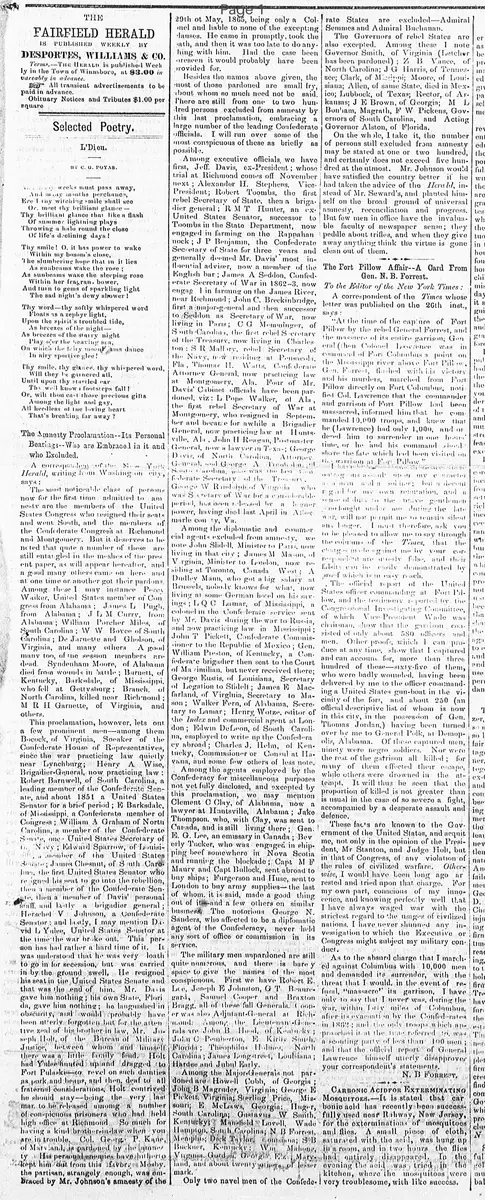
A correspondent of the N.Y. Herald, writing from Washington city, says:
The most noticeable class of persons now for the first time admitted to amnesty are the members of the United States Congress who resigned their seats and went South, and the members of the Confederate Congress at Richmond and Montgomery. But it deserves to be noted that quite a number of these are still entangled in the meshes of the press as will appear hereafter, and a good many others came on here and at one time or another got their pardons.
Among these I may instance Paris Walker, United States member of Congress from Alabama; James L Pugh, from Alabama; J L M Curry, from Alabama; William Porcher Miles, of South Carolina; W W Boyce of South Carolina; De Jarnette and Gholson, of Virginia, and many others. A good many too, of the secession members are dead. Sydenham Moore, of Alabama died from wounds in battle; Burnett, of Kentucky, Barksdale, of Mississippi, who fell at Gettysburg; Branch, of North Carolina, killed near Richmond; M R H Garnette, of Virginia, and others.
This proclamation, however, lets out a few prominent men--among them Bocock, of Virginia, Speaker of the Confederate House of Representatives, since the war practicing law quietly near Lynchburg; Henry A Wise, Brigadier-General, now practicing law; Robert Barnwell, of South Carolina, a leading member of the Confederate Senate, and about 1851 a United States Senator for a brief period; E Barksdale, of Mississippi, a Confederate member of Congress; William A Graham of North Carolina, a member of the Confederate Senate, once United States Secretary of the Navy; Edward Sparrow, of Louisiana, a member of the United States Senate; James Chesnut, of South Carolina, the first United States Senator who resigned his seat to go into the rebellion, since then a member of Davis' personal staff, and lastly a brigadier general; Herschel V. Johnson, a Confederate Senator; and lastly, I may mention David L Yulee, United States Senator at the time the war broke out. This person has had rather a hard time of it. It was understood that he was very loath to go in for secession, but was carried in by the ground swell. He resigned his seat in the United States Senate and that was the end of him. Mr. Davis gave him nothing; his own State, Florida, gave him nothing; he languished in obscurity and would probably have been utterly forgotten but for the attentive zeal of his brother-in-law, Mr. Joseph Holt, of the Bureau of Military Justice, between whom and Lincoln there was a little family fondness. Holt had Yulee hunted up and dragged to Fort Pulaski where he reveled on such dainties as pork and beans, and then, deaf to all fraternal considerations, Holt contrived he should stay--being the very last man to be released among a number of conspicuous prisoners who had held high office at Richmond. So much for having a kind brother-in-law when you are in trouble. Col. George P. Kane, of Maryland is pardoned by the amnesty. His personal enemies have hitherto kept him out from this favor. Gen. Mosby, the partisan, strangely enough, was embraced by Mr. Johnson's amnesty of the 29th of May, 1865, being only a Colonel and liable to none of the excepting clauses. He came in promptly, took the oath, and then it was too late to do anything with him. Had the case been foreseen it would probably have been provided for.
Besides the names above given, the most of those pardoned are small fry, about whom so much need not be said. There are still from one to two hundred persons excluded from amnesty by this last proclamation, embracing a large number of the leading Confederate officials. I will run over some of the most conspicuous of these as briefly as possible.
Among executive officials, we have first, Jeff. Davis, ex-President; whose trial at Richmond comes off November next; Alexander H. Stephens, Vice-President; Robert Toombs, the first rebel Secretary of State, then a brigadier general; R M T Hunter, an ex-United States Senator, successor to Toombs in the State Department, now engaged in farming on the Rappahannock; J P Benjamin, the Confederate Secretary of State for three years and generally deemed Mr. Davis' most influential adviser, now a member of the English bar; James A Seddon, Confederate Secretary of War in 1862-3, now engaged in farming on the James River, near Richmond; John C. Breckinridge, first a major-general and then successor to Seddon as Secretary of War, now living in Paris; C G Memminger, of South Carolina, the first rebel Secretary of the Treasury, now living in Charleston; S R Mallory, rebel Secretary of the Navy, now residing at Pensacola, Fla.; Thomas J. Watts, Confederate Attorney General, now practicing law at Montgomery, Ala. Four of Mr. Davis' Cabinet officials have been pardoned, viz: L Pope Walker, of Ala., the first rebel Secretary of War at Montgomery, who resigned in September and became for awhile a Brigadier General, now practicing law at Huntsville, Ala.; John H Reagan, Postmaster General, now a lawyer in Texas; George Davis, of North Carolina, Attorney General; and George A Trenholm, who was the last Confederate Secretary of the Treasury. George W Randolph of Virginia who was Secretary of War for a short period, has been released by a higher power, having died last April in Albemarle county, Va.
Among the diplomatic and commercial agents excluded from amnesty, we note John Slidell, Minister to Paris, now living in that city; James M Mason, of Virginia, Minister to London, now residing at Toronto, Canada West; A Dudley Mann, who got a high salary at Brussels, nobody knows for what, now living at some German hotel on his savings; L Q C Lamar, of Mississippi, a colonel in the Confederate service sent by Mr. Davis during the war to Russia, and now practicing law in Mississippi; John T Pickett, Confederate Commissioner to the Republic of Mexico; Gen. William Preston, of Kentucky, a Confederate brigadier then sent to the Court of Maximilian, but never received there; George Eustis, of Louisiana, Secretary of Legation to Slidell; James E Macfarland, of Virginia, Secretary to Mason; Walker Fearn, of Alabama, Secretary to Lamar; Henry Hotze, editor of the Index and commercial agent at London; Edwin DeLeon, of South Carolina, employed to write up the Confederacy abroad; Charles J. Helm, of Kentucky, Commissioner or Consul at Havana, and some few others of less note.
Among the agents employed by the Confederacy for miscellaneous purposes not yet fully disclosed, and excepted by this proclamation, we may mention Clement C Clay, of Alabama, now a lawyer at Huntsville, Alabama; Jake Thompson, who, with Clay, was sent to Canada, and is still living there; Gen. E. G. Lee, an emissary in Canada; Beverly Tucker, who was engaged in shipping beef somewhere in Nova Scotia and running the blockade; Capt M I Maury and Capt Bullock, sent abroad to buy ships; Ferguson and Huse, sent to London to buy army supplies--the last of whom, it is said, made a good thing out of it; and a few others on similar business. The notorious George N. Sanders, who affected to be a diplomatic agent of the Confederacy, never held any sort of office or commission in its service.
The military men unpardoned are still quite numerous, and there is barely space to give the names of the most conspicuous. First we have Robert E. Lee, Joseph E Johnston, G T. Beauregard, Samuel Cooper and Braxton Bragg, all of these full Generals. Cooper was also Adjutant-General at Richmond. Among the Lieutenant-Generals are John B. Hood, of Kentucky; John C Pemberton, E Kirby Smith, Florida; Theophilus Holmes, North Carolina; James Longstreet, Louisiana; Hardee and Jubal Early.
Among the Major-Generals not pardoned are Howell Cobb, of Georgia; John B Magruder, Virginia; George E Pickett, Virginia; Sterling Price, Missouri; E. McLaws, Georgia; Huger, South Carolina; Gustavus W. Smith, Kentucky; Mansfield Lovell, Wade Hampton, South Carolina; N B Forrest, Memphis; Dick Taylor, Louisiana; S B Buckner, Kentucky; Wm. Mahone, Virginia; Gordon, Georgia, Earl Van Dorn, and about twenty others of lesser mark.
Only two naval men of the Confederate States are excluded--Admiral Semmes and Admiral Buchanan.
The Governors of rebel States are also excepted. Among these I note Governor Smith, of Virginia (Letcher has been pardoned); Z B Vance, of North Carolina; J G Harris, of Tennessee; Clark, of Mississippi; Moore, of Louisiana; Allen, of same State, died in Mexico; Lubbock, of Texas; Rector, of Arkansas; J E Brown, of Georgia; M L Bonham, Magrath, F W Pickens, Governors of South Carolina, and Acting Governor Alston, of Florida.
On the whole, I take it, the number of persons still excluded from amnesty may be stated at one or two hundred, and certainly does not exceed five hundred at the utmost. Mr. Johnson would have satisfied the country better if he had taken the advice of the Herald, instead of Mr. Seward's, and planted himself on the broad ground of universal amnesty, reconciliation and progress. But few men in office have the invaluable faculty of newspaper sense; they peddle about trifles, and when they give away anything think the virtue is gone clean out of them.
What sub-type of article is it?
What keywords are associated?
What entities or persons were involved?
Where did it happen?
Domestic News Details
Primary Location
Washington City
Key Persons
Outcome
amnesty granted to many former confederate congressmen and officials, excluding 100-500 prominent figures including jefferson davis, robert e. lee, and various cabinet members, generals, governors, and diplomats; some deaths noted among secession members; mosby pardoned under earlier amnesty of may 29, 1865.
Event Details
Correspondent reports on President Johnson's Amnesty Proclamation admitting former U.S. and Confederate congressmen to amnesty, listing pardoned and deceased members, prominent men still excluded like Bocock and Yulee, details on Yulee's imprisonment, pardons for Kane and Mosby, and extensive lists of excluded executive, diplomatic, miscellaneous, military, naval, and gubernatorial officials, estimating 100-500 exclusions.