Thank you for visiting SNEWPapers!
Sign up free
Story
January 8, 1799
Gazette Of The United States, & Philadelphia Daily Advertiser
Philadelphia, Philadelphia County, Pennsylvania
What is this article about?
In a House debate on December 28, the speaker refutes Mr. Gallatin's claim that his party aims to provoke war with France to crush opponents, highlighting the mission's ineffectiveness and past aggressive personal attacks by Gallatin against administration figures.
Clipping
OCR Quality
95%
Excellent
Full Text
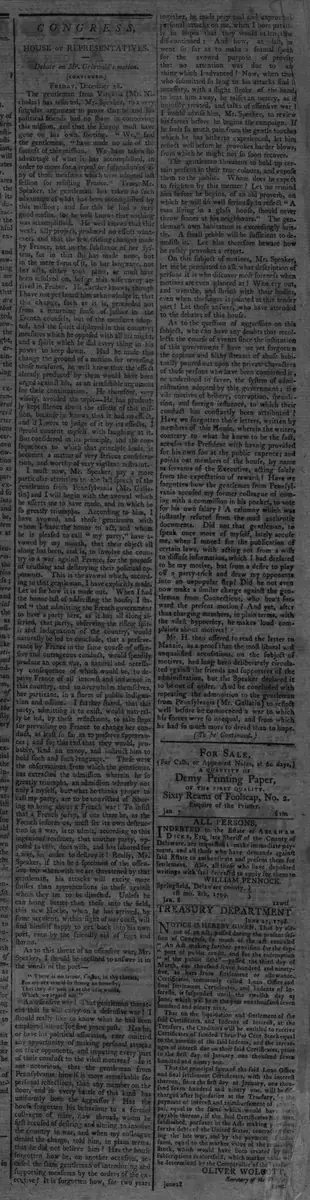
CONGRESS,
HOUSE OF REPRESENTATIVES.
Debate on Mr. Griswold's motion
(continued.)
FRIDAY, December 28.
The gentleman from Virginia (Mr. Nicholas) has resorted, Mr. Speaker, to a very singular argument to prove that he and his political friends had no share in contriving this mission, and that the Envoy must have gone on his own footing. "We," said the gentleman, "have made no use of the success of this mission. We have taken no advantage of what it has accomplished, in order to move for a repeal or suspension of any of those measures which were adopted last session for resisting France." True, Mr. Speaker, the gentleman has taken no such advantage of what has been accomplished by this mission; and for this he had a very good reason. For he well knows that nothing was accomplished. He well knows that this weak, silly project, produced no effect whatever, 'and that the few trifling changes made by France, not in the substance of her system, for in that she has made none, but in the mere form of it, in her language, not her acts, either took place, or must have been resolved on, before this wise envoy arrived in France. He further knows, though I have not yet heard him acknowledge it, that this change, such as it is, proceeded not from a returning sense of justice in the French councils, but of the measures adopted, and the spirit displayed in this country; measures which he opposed with all his might, and a spirit which he did every thing in his power to keep down. Had he made this change the ground of a motion for reversing those measures, he well knew that the effect already produced by them would have been urged against his, as an irresistible argument for their continuation. He therefore, very wisely, avoided the topic He has prudently kept silence about the effects of this mission, because he knows that it had no effect, and if I were to judge of it by its effects, I should content myself with laughing at it. But considered in its principle, and the consequences to which that principle leads, it becomes a matter of very serious consideration, and worthy of very vigilant restraint.
I must now, Mr. Speaker, pay a more particular attention to the last speech of the gentleman from Pennsylvania (Mr. Gallatin) and I will begin with the avowal which he asserts me to have made, and in which he so greatly triumphs. According to him, I have avowed, and those gentlemen with whom I have the honor to act, and whom he is pleased to call "my party," have avowed by my mouth, that their object all along has been, and is, to involve the country in a war against France, for the purpose of crushing and destroying their political opponents. This is the avowal which, according to that gentleman, I have explicitly made. Let us see how it is made out. When I had the honor last of addressing the house, I stated "that admitting the French government to have a party here, as it has all along asserted, that party, observing the rising spirit and indignation of the country, would naturally be led to conclude, that a perseverance by France in the same course of offensive and outrageous conduct, would speedily produce an open war, a natural and necessary consequence of which would be, to deprive France of all interest and influence in this country, and to overwhelm themselves, her partizans, in a storm of public indignation and odium. I farther stated, that this party, admitting it to exist, would naturally be led, by these reflections, to take steps for prevailing on France to change her conduct, at least so far as to preserve appearances; and for this end that they would, probably, send an envoy, and instruct him to hold such and such language." These were the observations from which the gentleman has extracted the admission wherein he so greatly triumphs, an admission whereby not only I myself, but what he thinks proper to call my party, are to be convicted of laboring to bring about a French war! To insinuate that a French party, if one there be, as the French inform us, must see its own destruction in a war, is to admit, according to this ingenious reasoner, that another party, opposed to this, does wish, and has labored for a war, in order to destroy it! Really, Mr. Speaker, if this be a specimen of the offensive war wherewith we are threatened by that gentleman, his attacks will excite more smiles than apprehensions in those against whom they are to be directed. Unless he can bring better than these into the field, this new Hoche, when he has arrived, by some accident, within sight of our coast, will find himself happy to get back into his own port, even by the friendly aid of fogs and storms.
As to this threat of an offensive war, Mr. Speaker, I should be inclined to answer it in the words of the poet—
"There is no terror, Cassius, in thy threats,
For we are arm'd so strong in honesty,
That they do pass us as the idle winds
Which we regard not."
An offensive war! That gentleman threatens that he will carry on a defensive war! I should really like to know what he had been employed about for five years past. Has he, or have his political associates, ever omitted any opportunity of making personal attacks on their opponents, and imputing every part of their conduct to the vilest motives? Is it not notorious, that the gentleman from Pennsylvania himself is more remarkable for personal reflections, than any member on the floor, and in every battle of this kind has uniformly been the aggressor? Has the house forgotten his behaviour to a former colleague of mine, now abroad, whom he first accused of desiring and aiming to involve the country in war, and when my colleague denied the charge, told him, in plain terms, that he did not believe him? Has the house forgotten how he, on another occasion, accused the same gentleman of introducing and supporting measures by the orders of the executive? It is forgotten how, for two years together, he made perpetual and unprovoked personal attacks on me, when I bore patiently in hopes that they would at length be discontinued: And how, at last, he went so far as to make a formal speech for the avowed purpose of proving that no attention was due to anything which I advanced? Now, when those who submitted so long to his attacks find it necessary, with a slight stroke of the hand, to beat him away, he raises an outcry, as if unjustly treated, and talks of offensive war! I would advise him, Mr. Speaker, to review his forces before he begins the campaign. If he feels so much pain from the gentle touches which he has hitherto experienced, let him reflect well before he provokes harder blows; from which he might not so soon recover.
The gentleman threatens to hold up certain persons in their true colours, and expose them to the public. Whom does he expect to frighten by this menace? Let me remind him before he begins, of an old proverb, on which he will do well seriously to reflect "A man living in a glass house, should never throw stones at his neighbours." The gentleman's own habitation is exceedingly brittle. A small pebble will be sufficient to demolish it. Let him therefore beware how he rashly provokes a retort.
On this subject of motives, Mr. Speaker, let me be permitted to ask what description of persons it is who discover most soreness when motives are even glanced at! Who cry out, and wreathe, and shrink with their bodies, even when the finger is pointed at this tender part! Let those answer, who have attended to the debates of this house.
As to the question of aggression on this subject, who can have any doubts that recollects the course of events since the institution of this government? Have we yet forgotten the copious and filthy streams of abuse habitually poured out upon the private characters of those persons who have been concerned in, or understood to favor, the system of administration adopted by this government; the vile motives of bribery, corruption, peculation, and foreign influence, to which their conduct has constantly been attributed? Have we forgotten those letters, written by members of this House, wherein the writer contrary to what he knew to be the fact, accuses the President with having provided for his own son at the public expence; and points out members of the house, by name as servants of the Executive, acting solely from the expectation of reward! Have we forgotten how the gentleman from Pennsylvania accused my former colleague of coming with a commission in his pocket, to vote for his own salary? A calumny which was instantly refuted from the most authentic documents. Did not that gentleman, to speak once more of myself, lately accuse me, when I moved for the publication of certain laws, with acting not from a wish to diffuse information, which I had declared to be my motive, but from a desire to play off a party-trick and draw my opponents into an unpopular step? Did he not even now make a similar charge against the gentleman from Connecticut, who brought forward the present motion? And yet, after thus charging members, in plain terms, with the vilest hypocrisy, he makes loud complaints about motives!,
Mr. H. then offered to read the letter to Mazzei, as a proof that the most liberal and unqualified accusations, on the subject of motives, had long been deliberately circulated against the friends and supporters of the administration, but the Speaker declared it to be out of order. And he concluded with repeating the admonition to the gentleman from Pennsylvania (Mr. Gallatin) to reflect well before he commenced a war to which his forces were so unequal, and from which he had so much more to dread than to hope.
(To be Continued.)
HOUSE OF REPRESENTATIVES.
Debate on Mr. Griswold's motion
(continued.)
FRIDAY, December 28.
The gentleman from Virginia (Mr. Nicholas) has resorted, Mr. Speaker, to a very singular argument to prove that he and his political friends had no share in contriving this mission, and that the Envoy must have gone on his own footing. "We," said the gentleman, "have made no use of the success of this mission. We have taken no advantage of what it has accomplished, in order to move for a repeal or suspension of any of those measures which were adopted last session for resisting France." True, Mr. Speaker, the gentleman has taken no such advantage of what has been accomplished by this mission; and for this he had a very good reason. For he well knows that nothing was accomplished. He well knows that this weak, silly project, produced no effect whatever, 'and that the few trifling changes made by France, not in the substance of her system, for in that she has made none, but in the mere form of it, in her language, not her acts, either took place, or must have been resolved on, before this wise envoy arrived in France. He further knows, though I have not yet heard him acknowledge it, that this change, such as it is, proceeded not from a returning sense of justice in the French councils, but of the measures adopted, and the spirit displayed in this country; measures which he opposed with all his might, and a spirit which he did every thing in his power to keep down. Had he made this change the ground of a motion for reversing those measures, he well knew that the effect already produced by them would have been urged against his, as an irresistible argument for their continuation. He therefore, very wisely, avoided the topic He has prudently kept silence about the effects of this mission, because he knows that it had no effect, and if I were to judge of it by its effects, I should content myself with laughing at it. But considered in its principle, and the consequences to which that principle leads, it becomes a matter of very serious consideration, and worthy of very vigilant restraint.
I must now, Mr. Speaker, pay a more particular attention to the last speech of the gentleman from Pennsylvania (Mr. Gallatin) and I will begin with the avowal which he asserts me to have made, and in which he so greatly triumphs. According to him, I have avowed, and those gentlemen with whom I have the honor to act, and whom he is pleased to call "my party," have avowed by my mouth, that their object all along has been, and is, to involve the country in a war against France, for the purpose of crushing and destroying their political opponents. This is the avowal which, according to that gentleman, I have explicitly made. Let us see how it is made out. When I had the honor last of addressing the house, I stated "that admitting the French government to have a party here, as it has all along asserted, that party, observing the rising spirit and indignation of the country, would naturally be led to conclude, that a perseverance by France in the same course of offensive and outrageous conduct, would speedily produce an open war, a natural and necessary consequence of which would be, to deprive France of all interest and influence in this country, and to overwhelm themselves, her partizans, in a storm of public indignation and odium. I farther stated, that this party, admitting it to exist, would naturally be led, by these reflections, to take steps for prevailing on France to change her conduct, at least so far as to preserve appearances; and for this end that they would, probably, send an envoy, and instruct him to hold such and such language." These were the observations from which the gentleman has extracted the admission wherein he so greatly triumphs, an admission whereby not only I myself, but what he thinks proper to call my party, are to be convicted of laboring to bring about a French war! To insinuate that a French party, if one there be, as the French inform us, must see its own destruction in a war, is to admit, according to this ingenious reasoner, that another party, opposed to this, does wish, and has labored for a war, in order to destroy it! Really, Mr. Speaker, if this be a specimen of the offensive war wherewith we are threatened by that gentleman, his attacks will excite more smiles than apprehensions in those against whom they are to be directed. Unless he can bring better than these into the field, this new Hoche, when he has arrived, by some accident, within sight of our coast, will find himself happy to get back into his own port, even by the friendly aid of fogs and storms.
As to this threat of an offensive war, Mr. Speaker, I should be inclined to answer it in the words of the poet—
"There is no terror, Cassius, in thy threats,
For we are arm'd so strong in honesty,
That they do pass us as the idle winds
Which we regard not."
An offensive war! That gentleman threatens that he will carry on a defensive war! I should really like to know what he had been employed about for five years past. Has he, or have his political associates, ever omitted any opportunity of making personal attacks on their opponents, and imputing every part of their conduct to the vilest motives? Is it not notorious, that the gentleman from Pennsylvania himself is more remarkable for personal reflections, than any member on the floor, and in every battle of this kind has uniformly been the aggressor? Has the house forgotten his behaviour to a former colleague of mine, now abroad, whom he first accused of desiring and aiming to involve the country in war, and when my colleague denied the charge, told him, in plain terms, that he did not believe him? Has the house forgotten how he, on another occasion, accused the same gentleman of introducing and supporting measures by the orders of the executive? It is forgotten how, for two years together, he made perpetual and unprovoked personal attacks on me, when I bore patiently in hopes that they would at length be discontinued: And how, at last, he went so far as to make a formal speech for the avowed purpose of proving that no attention was due to anything which I advanced? Now, when those who submitted so long to his attacks find it necessary, with a slight stroke of the hand, to beat him away, he raises an outcry, as if unjustly treated, and talks of offensive war! I would advise him, Mr. Speaker, to review his forces before he begins the campaign. If he feels so much pain from the gentle touches which he has hitherto experienced, let him reflect well before he provokes harder blows; from which he might not so soon recover.
The gentleman threatens to hold up certain persons in their true colours, and expose them to the public. Whom does he expect to frighten by this menace? Let me remind him before he begins, of an old proverb, on which he will do well seriously to reflect "A man living in a glass house, should never throw stones at his neighbours." The gentleman's own habitation is exceedingly brittle. A small pebble will be sufficient to demolish it. Let him therefore beware how he rashly provokes a retort.
On this subject of motives, Mr. Speaker, let me be permitted to ask what description of persons it is who discover most soreness when motives are even glanced at! Who cry out, and wreathe, and shrink with their bodies, even when the finger is pointed at this tender part! Let those answer, who have attended to the debates of this house.
As to the question of aggression on this subject, who can have any doubts that recollects the course of events since the institution of this government? Have we yet forgotten the copious and filthy streams of abuse habitually poured out upon the private characters of those persons who have been concerned in, or understood to favor, the system of administration adopted by this government; the vile motives of bribery, corruption, peculation, and foreign influence, to which their conduct has constantly been attributed? Have we forgotten those letters, written by members of this House, wherein the writer contrary to what he knew to be the fact, accuses the President with having provided for his own son at the public expence; and points out members of the house, by name as servants of the Executive, acting solely from the expectation of reward! Have we forgotten how the gentleman from Pennsylvania accused my former colleague of coming with a commission in his pocket, to vote for his own salary? A calumny which was instantly refuted from the most authentic documents. Did not that gentleman, to speak once more of myself, lately accuse me, when I moved for the publication of certain laws, with acting not from a wish to diffuse information, which I had declared to be my motive, but from a desire to play off a party-trick and draw my opponents into an unpopular step? Did he not even now make a similar charge against the gentleman from Connecticut, who brought forward the present motion? And yet, after thus charging members, in plain terms, with the vilest hypocrisy, he makes loud complaints about motives!,
Mr. H. then offered to read the letter to Mazzei, as a proof that the most liberal and unqualified accusations, on the subject of motives, had long been deliberately circulated against the friends and supporters of the administration, but the Speaker declared it to be out of order. And he concluded with repeating the admonition to the gentleman from Pennsylvania (Mr. Gallatin) to reflect well before he commenced a war to which his forces were so unequal, and from which he had so much more to dread than to hope.
(To be Continued.)
What sub-type of article is it?
Historical Event
What themes does it cover?
Deception
Justice
Moral Virtue
What keywords are associated?
Congressional Debate
French Mission
Political Accusations
War With France
Personal Attacks
Mr Gallatin
Mr Nicholas
What entities or persons were involved?
Mr. Griswold
Mr. Nicholas
Mr. Gallatin
Where did it happen?
House Of Representatives
Story Details
Key Persons
Mr. Griswold
Mr. Nicholas
Mr. Gallatin
Location
House Of Representatives
Event Date
December 28
Story Details
Speaker defends against Mr. Gallatin's accusation that his party seeks war with France to destroy opponents, arguing the French mission achieved nothing and recounting Gallatin's and others' past personal attacks and imputations of base motives on administration supporters.