Thank you for visiting SNEWPapers!
Sign up free
The Patowmac Guardian, And Berkeley Advertiser
Martinsburg, Shepherdstown, Berkeley County, Jefferson County, West Virginia
What is this article about?
In London on Feb 27, 1797, amid cash demands from public alarms, the privy council ordered the Bank of England to suspend specie payments until parliament acts. The king communicated this to parliament via Mr. Pitt, who proposed securing notes with national faith and legal tender status. Bank affirmed its solidity; merchants to support notes.
Merged-components note: Continuation of the 'Latest Foreign Advices' from London about the Bank of England crisis, with sequential reading order from page 2 to page 3; text flows directly from the bank's announcement to the parliamentary response.
Clippings
1 of 2
OCR Quality
Full Text
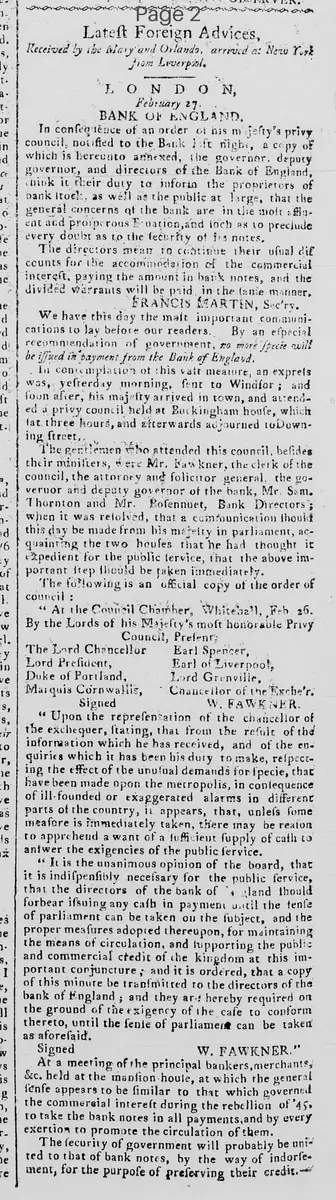
Received by the Mary and Orlando, arrived at New York from Liverpool.
LONDON,
February 27.
BANK OF ENGLAND,
In consequence of an order of his majesty's privy council, notified to the Bank last night, a copy of which is hereunto annexed, the governor, deputy governor, and directors of the Bank of England, think it their duty to inform the proprietors of bank stock, as well as the public at large, that the general concerns of the bank are in the most affluent and prosperous situation, and such as to preclude every doubt as to the security of its notes.
The directors mean to continue their usual discounts for the accommodation of the commercial interest, paying the amount in bank notes, and the dividend warrants will be paid in the same manner.
FRANCIS MARTIN, Sec'ry.
We have this day the most important communications to lay before our readers. By an especial recommendation of government, no more specie will be issued in payment from the Bank of England.
In contemplation of this vast measure, an express was, yesterday morning, sent to Windsor; and soon after, his majesty arrived in town, and attended a privy council held at Buckingham house, which lasted three hours, and afterwards adjourned to Downing street.
The gentlemen who attended this council, besides their ministers, were Mr. Fawkner, the clerk of the council, the attorney and solicitor general, the governor and deputy governor of the bank, Mr. Sam. Thornton and Mr. Bosanquet, Bank Directors;
when it was resolved, that a communication should this day be made from his majesty in parliament, acquainting the two houses that he had thought it expedient for the public service, that the above important step should be taken immediately.
The following is an official copy of the order of council :
" At the Council Chamber. Whitehall, Feb 26.
By the Lords of his Majesty's most honorable Privy Council, Present
The Lord Chancellor
Earl Spencer,
Lord President,
Earl of Liverpool,
Duke of Portland,
Lord Grenville,
Marquis Cornwallis,
Chancellor of the Exchequer.
Signed
W. FAWKNER.
" Upon the representation of the chancellor of the exchequer, stating, that from the result of the information which he has received, and of the inquiries which it has been his duty to make, respecting the effect of the unusual demands for specie, that have been made upon the metropolis, in consequence of ill-founded or exaggerated alarms in different parts of the country, it appears, that, unless some measure is immediately taken, there may be reason to apprehend a want of a sufficient supply of cash to answer the exigencies of the public service.
" It is the unanimous opinion of the board, that it is indispensibly necessary for the public service, that the directors of the bank of England should forbear issuing any cash in payment until the sense of parliament can be taken on the subject, and the proper measures adopted thereupon, for maintaining the means of circulation, and supporting the public and commercial credit of the kingdom at this important conjuncture; and it is ordered, that a copy of this minute be transmitted to the directors of the bank of England; and they are hereby required on the ground of the exigency of the case to conform thereto, until the sense of parliament can be taken as aforesaid.
Signed
W. FAWKNER."
At a meeting of the principal bankers, merchants, &c. held at the mansion-house, at which the general sense appears to be similar to that which governed the commercial interest during the rebellion of '45. to take the bank notes in all payments, and by every exertion to promote the circulation of them.
The security of government will probably be united to that of bank notes, by the way of indorsement, for the purpose of preserving their credit.
Bank of England notes for three and two guineas, it is said, will be issued; and if any person presents a note, or a draft, or a check for payment, no part of it will be paid in cash more than two pounds.
ROYAL MESSAGE
Mr. Pitt delivered from the bar a most gracious message from his majesty, and likewise a copy of the minutes of council, dated the 6th instant.
The message acquaints parliament that his majesty, with the advice of his privy council, has thought it necessary to recommend to the bank of England not to issue cash in payment, until the opinion of parliament has been taken upon the subject.
Mr. Pitt observed, that he did not consider it necessary, at this time, to propose any specific measure. He should content himself merely with moving, that his majesty's message be taken into consideration to-morrow. He conceived it, however, his duty to state, that, in addition to the motion for an address on the royal communication, it would be necessary to proceed to the appointment of a committee, to examine the general state of the affairs of the bank of England. He was confident that it would appear, from a very short examination of the state of the Bank, that not a doubt could be entertained, of its solidity and responsibility being equal to that of any former period, that, not only was the Bank equal to answer the utmost extent of the demands against it, but that there was an abundance far beyond any demand that could be made; yet he was satisfied that every gentleman in the house would agree with him, that under the present circumstances, it would be expedient to declare by law, that the outstanding engagements of the Bank of England should be considered as secured by the national faith of the country; and that an act should be passed, declaring that to be the law which already was the practice viz. that their notes should be received in every branch of public payment! This measure, he was satisfied, would, in addition to the proof which an investigation of the affairs of the Bank would give of the solidity of their resources, necessarily operate as a confirmation of their ability to answer every demand. He did not think it his duty to expatiate farther at present. It was enough that he had apprised the house of his intention to propose those measures which seemed to him to require the most urgent attention. He trusted the house would be induced to enforce: by a law, the restriction which prohibited the Bank from making payment in cash, except in such cases as might be thought necessary to permit. Having explained the nature and tendency of the measures, he concluded by moving, that the message be taken into consideration to-morrow.
What sub-type of article is it?
What keywords are associated?
What entities or persons were involved?
Where did it happen?
Foreign News Details
Primary Location
London
Event Date
February 27
Key Persons
Outcome
bank of england to forbear issuing cash until parliament's sense is taken; plans to secure bank notes with national faith and declare them legal tender for public payments; continuation of discounts in bank notes.
Event Details
Due to unusual demands for specie from ill-founded alarms, the privy council ordered the Bank of England not to issue cash payments. The king attended council, and a message was sent to parliament recommending this measure. Mr. Pitt proposed considering the message, appointing a committee to examine bank affairs, and passing laws to secure bank engagements with national faith and restrict cash payments except in permitted cases. Bank directors affirmed the bank's prosperous situation. Merchants agreed to promote bank note circulation.