Thank you for visiting SNEWPapers!
Sign up free
Editorial
May 29, 1944
Imperial Valley Press
El Centro, Imperial County, California
What is this article about?
Editorial criticizes Roosevelt administration's labor policies for causing strikes, eroding national unity, and reducing war bond purchases amid WWII, linking it to loss of patriotism and calls for a unified effort to shorten the war.
Clipping
OCR Quality
98%
Excellent
Full Text
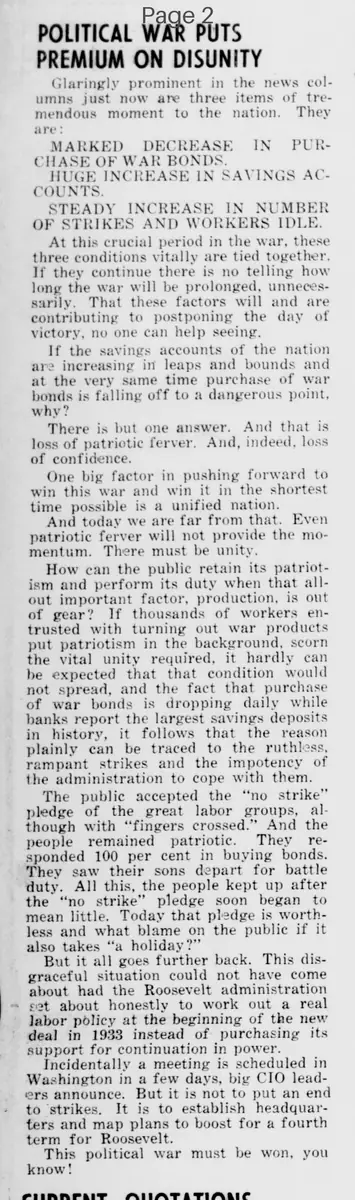
POLITICAL WAR PUTS
PREMIUM ON DISUNITY
Glaringly prominent in the news columns just now are three items of tremendous moment to the nation. They are:
MARKED DECREASE IN PURCHASE OF WAR BONDS.
HUGE INCREASE IN SAVINGS ACCOUNTS.
STEADY INCREASE IN NUMBER OF STRIKES AND WORKERS IDLE.
At this crucial period in the war, these three conditions vitally are tied together. If they continue there is no telling how long the war will be prolonged, unnecessarily. That these factors will and are contributing to postponing the day of victory, no one can help seeing.
If the savings accounts of the nation are increasing in leaps and bounds and at the very same time purchase of war bonds is falling off to a dangerous point, why?
There is but one answer. And that is loss of patriotic fervor. And, indeed, loss of confidence.
One big factor in pushing forward to win this war and win it in the shortest time possible is a unified nation.
And today we are far from that. Even patriotic fervor will not provide the momentum. There must be unity.
How can the public retain its patriotism and perform its duty when that all-out important factor, production, is out of gear? If thousands of workers entrusted with turning out war products put patriotism in the background, scorn the vital unity required, it hardly can be expected that that condition would not spread, and the fact that purchase of war bonds is dropping daily while banks report the largest savings deposits in history, it follows that the reason plainly can be traced to the ruthless, rampant strikes and the impotency of the administration to cope with them.
The public accepted the "no strike" pledge of the great labor groups, although with "fingers crossed." And the people remained patriotic. They responded 100 per cent in buying bonds. They saw their sons depart for battle duty. All this, the people kept up after the "no strike" pledge soon began to mean little. Today that pledge is worthless and what blame on the public if it also takes "a holiday?"
But it all goes further back. This disgraceful situation could not have come about had the Roosevelt administration set about honestly to work out a real labor policy at the beginning of the new deal in 1933 instead of purchasing its support for continuation in power.
Incidentally a meeting is scheduled in Washington in a few days, big CIO leaders announce. But it is not to put an end to strikes. It is to establish headquarters and map plans to boost for a fourth term for Roosevelt.
This political war must be won, you know!
PREMIUM ON DISUNITY
Glaringly prominent in the news columns just now are three items of tremendous moment to the nation. They are:
MARKED DECREASE IN PURCHASE OF WAR BONDS.
HUGE INCREASE IN SAVINGS ACCOUNTS.
STEADY INCREASE IN NUMBER OF STRIKES AND WORKERS IDLE.
At this crucial period in the war, these three conditions vitally are tied together. If they continue there is no telling how long the war will be prolonged, unnecessarily. That these factors will and are contributing to postponing the day of victory, no one can help seeing.
If the savings accounts of the nation are increasing in leaps and bounds and at the very same time purchase of war bonds is falling off to a dangerous point, why?
There is but one answer. And that is loss of patriotic fervor. And, indeed, loss of confidence.
One big factor in pushing forward to win this war and win it in the shortest time possible is a unified nation.
And today we are far from that. Even patriotic fervor will not provide the momentum. There must be unity.
How can the public retain its patriotism and perform its duty when that all-out important factor, production, is out of gear? If thousands of workers entrusted with turning out war products put patriotism in the background, scorn the vital unity required, it hardly can be expected that that condition would not spread, and the fact that purchase of war bonds is dropping daily while banks report the largest savings deposits in history, it follows that the reason plainly can be traced to the ruthless, rampant strikes and the impotency of the administration to cope with them.
The public accepted the "no strike" pledge of the great labor groups, although with "fingers crossed." And the people remained patriotic. They responded 100 per cent in buying bonds. They saw their sons depart for battle duty. All this, the people kept up after the "no strike" pledge soon began to mean little. Today that pledge is worthless and what blame on the public if it also takes "a holiday?"
But it all goes further back. This disgraceful situation could not have come about had the Roosevelt administration set about honestly to work out a real labor policy at the beginning of the new deal in 1933 instead of purchasing its support for continuation in power.
Incidentally a meeting is scheduled in Washington in a few days, big CIO leaders announce. But it is not to put an end to strikes. It is to establish headquarters and map plans to boost for a fourth term for Roosevelt.
This political war must be won, you know!
What sub-type of article is it?
Partisan Politics
Labor
War Or Peace
What keywords are associated?
War Bonds
Strikes
National Unity
Roosevelt Administration
Labor Policy
Patriotic Fervor
New Deal
Cio Meeting
What entities or persons were involved?
Roosevelt Administration
Cio Leaders
Labor Groups
Editorial Details
Primary Topic
Impact Of Strikes And Disunity On Wwii War Effort Under Roosevelt
Stance / Tone
Critical Of Roosevelt Administration And Labor Strikes, Urging National Unity
Key Figures
Roosevelt Administration
Cio Leaders
Labor Groups
Key Arguments
Decrease In War Bond Purchases, Increase In Savings Accounts, And Rising Strikes Indicate Loss Of Patriotic Fervor And Confidence.
These Conditions Prolong The War By Hindering Production And Unity.
Strikes By War Production Workers Undermine National Unity And Spread Disaffection.
Public's Declining Bond Purchases Trace To Administration's Failure To Control Strikes.
Labor's 'No Strike' Pledge Is Now Worthless, Justifying Public Disengagement.
Situation Stems From Roosevelt's 1933 New Deal Labor Policy Prioritizing Political Support Over Honest Policy.
Upcoming Cio Meeting Focuses On Boosting Roosevelt's Fourth Term, Not Ending Strikes.
Political War For Roosevelt's Continuation Must Be Opposed To Restore Unity.