Thank you for visiting SNEWPapers!
Sign up free
The Cairo Daily Bulletin
Cairo, Alexander County, Illinois
What is this article about?
Reports from London and Versailles detail the capitulation of Paris on January 29, 1871, with a three-week armistice signed. Prussian forces occupy forts; Paris to pay 200 million francs and revictual after surrendering arms. Negotiations involve Favre and Bismarck; peace terms include cession of Alsace-Lorraine and indemnity. Related updates on Bourbaki's suicide attempt and troop movements.
Merged-components note: Image overlaps with the foreign news on the Franco-Prussian War; continuation of the article.
Clipping
OCR Quality
Full Text
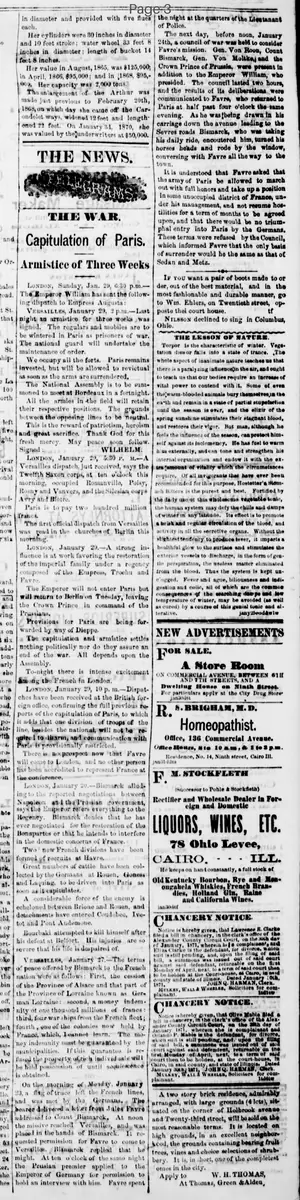
THE WAR
Capitulation of Paris. Armistice of Three Weeks
London, Sunday, Jan. 29, 6:30 p.m.— The Emperor William has sent the following dispatch to Empress Augusta: VERSAILLES, January 29, 2 p.m.—Last night an armistice for three weeks was signed. The regulars and mobiles are to be wintered in Paris as prisoners of war. The national guard will undertake the maintenance of order. We occupy all the forts. Paris remains invested, but will be allowed to revictual as soon as the arms are surrendered. The National Assembly is to be summoned to meet at Bordeaux in a fortnight. All the armies in the field will retain their respective positions. The grounds between the opposing lines to be neutral. This is the reward of patriotism, heroism and great sacrifice. Thank God for this fresh mercy. May peace soon follow.
Signed: WILHELM.
London, January 29, 5:30 P. M.—A Versailles dispatch, just received, says the Twelfth Saxon corps, at ten o'clock this morning, occupied Romanville, Poisy, Rosny and Vanvers, and the Silesian corps Avry and Bietre.
Paris is to pay two hundred million francs. The first official dispatch from Versailles was read in the churches of Berlin this morning.
London, January 29.—A strong influence is at work favoring the restoration of the imperial family under a regency composed of the Empress, Trochu and Favre.
The Emperor will not enter Paris but will return to Berlin on Tuesday, leaving the Crown Prince in command of the Prussians.
Provisions for Paris are being forwarded by way of Dieppe.
The capitulation and armistice settles nothing politically nor do they assure an end of the war. All depends upon the Assembly.
To-night there is intense excitement among the French in London.
London, January 29, 10 p. m.—Dispatches have been received at the British foreign office, confirming the full previous reports of the capitulation of Paris, to which it adds that one division of troops of the line, besides the national, will not be required to disarm, and communication with Paris is provisionally restricted.
There is no prospect now that Favre will come to London, and no other person has been accredited to represent France at the conference.
LONDON, January 29.—Bismarck alluding to the reported negotiations between Napoleon and the Prussian government, says the Emperor refers everything to the Regency. Bismarck denies that he has ever negotiated for the restoration of the Bonapartes or that he intends to interfere in the domestic concerns of France.
Two new French divisions have been formed of recruits at Havre.
Great numbers of cattle have been collected by the Germans at Rouen, Goness and Laquing, to be driven into Paris as soon as it capitulates.
A considerable force of the enemy is echeloned between Brione and Rouen, and detachments have entered Coudabec, Ive- tot and Pont Andemone.
Bourbaki attempted to kill himself after his defeat at Belfort. His injuries are so severe that his life is despaired of.
VERSAILLES, January 27.—The terms of peace offered by Bismarck to the French nation were as follows: First, the cession of the Province of Alsace and that part of the Province of Lorraine known as German Lorraine; second, a money indemnity of one thousand millions of francs; third, four war ships from the French fleet; fourth, one of the colonies now held by France, which, I cannot learn. The money indemnity must be guaranteed by the municipalities. If this guarantee is refused the property of rich individuals will be held possession of until acquiescence is obtained.
On the morning of Monday, January 23, a flag of truce left the French lines, and was met by the Germans. The bearer delivered a letter from Jules Favre addressed to Count Bismarck. At noon the missive reached Versailles, and was placed in the hands of Bismarck. It requested permission for Favre to come to Versailles. Bismarck replied that he might. At ten o'clock of the same night the Prussian premier applied to the Emperor of Germany for permission to hold an interview with him. Favre spent the night at the quarters of the Lieutenant of Police.
The next day, before noon, January 24th, a council of war was held to consider Favre's mission. Gen. Von Roon, Count Bismarck, Gen. Von Moltke, and the Crown Prince of Prussia, were present in addition to the Emperor William, who presided. The council lasted two hours, and the results of its deliberations were communicated to Favre, who returned to Paris at half past four o'clock the same evening. As he was being drawn in his carriage down the avenue leading to the Seyres roads Bismarck, who was taking his daily ride, encountered him, turned his horses heads and rode by the window conversing with Favre all the way to the town.
It is understood that Favre asked that the army of Paris be allowed to march out with full honors and take up a position in some unoccupied district of France, under his management, and not resume hostilities for a term of months to be agreed upon, and that there would be no triumphal entry into Paris by the Germans.
These terms were refused by the Council, which informed Favre that the only basis of surrender would be the same as that of Sedan and Metz.
What sub-type of article is it?
What keywords are associated?
What entities or persons were involved?
Where did it happen?
Foreign News Details
Primary Location
Paris
Event Date
January 29, 1871
Key Persons
Outcome
armistice for three weeks signed; paris capitulated, forts occupied; regulars and mobiles as prisoners; paris to pay 200 million francs; peace terms include cession of alsace and german lorraine, 1,000 million francs indemnity, four warships, one colony; bourbaki's suicide attempt after defeat, life despaired.
Event Details
Dispatch from Emperor William reports armistice signing last night; Prussian occupation of forts and positions like Romanville; National Assembly to meet at Bordeaux; Favre's negotiations with Bismarck refused; council of war decisions; related troop movements and provisions forwarding.