Thank you for visiting SNEWPapers!
Sign up free
Las Vegas Age
Las Vegas, Clark County, Lincoln County, Nevada
What is this article about?
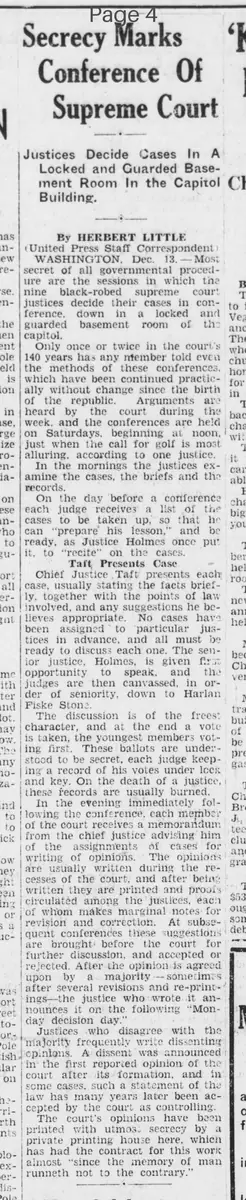
Describes the secretive process of U.S. Supreme Court justices' Saturday conferences in a guarded Capitol basement, including case presentation by Chief Justice Taft, discussions, secret voting, opinion assignments, revisions, and announcements, with notes on dissents.
Clipping
OCR Quality
Full Text
Conference Of
Supreme Court
Justices Decide Cases In A
Locked and Guarded Base-
ment Room In the Capitol
Building.
By HERBERT LITTLE
(United Press Staff Correspondent
WASHINGTON, Dec. 13.—Most secret of all governmental procedure are the sessions in which the nine black-robed supreme court justices decide their cases in conference, down in a locked and guarded basement room of the capitol.
Only once or twice in the court's 140 years has any member told even the methods of these conferences, which have been continued practically without change since the birth of the republic.
Arguments are heard by the court during the week, and the conferences are held on Saturdays, beginning at noon, just when the call for golf is most alluring, according to one justice.
In the mornings the justices examine the cases, the briefs and the records.
On the day before a conference each judge receives a list of the cases to be taken up, so that he can "prepare" his lesson," and be ready, as Justice Holmes once put it, to "recite" on the cases.
Taft Presents Case
Chief Justice Taft presents each case, usually stating the facts briefly, together with the points of law involved, and any suggestions he believes appropriate. No cases have been assigned to particular justices in advance, and all must be ready to discuss each one. The senior justice, Holmes, is given first opportunity to speak, and the judges are then canvassed, in order of seniority, down to Harlan Fiske Stone.
The discussion is of the freest character, and at the end a vote is taken, the youngest members voting first. These ballots are understood to be secret, each judge keeping a record of his votes under lock and key. On the death of a justice, these records are usually burned.
In the evening immediately following the conference, each member of the court receives a memorandum from the chief justice advising him of the assignments of cases for writing of opinions. The opinions are usually written during the recesses of the court, and after being written they are printed and proofs circulated among the justices, each of whom makes marginal notes for revision and correction. At subsequent conferences these suggestions are brought before the court for further discussion, and accepted or rejected. After the opinion is agreed upon by a majority—sometimes after several revisions and re-printings—the justice who wrote it announces it on the following "Monday decision day."
Justices who disagree with the majority frequently write dissenting opinions. A dissent was announced in the first reported opinion of the court after its formation, and in some cases, such a statement of the law has many years later been accepted by the court as controlling.
The court's opinions have been printed with utmost secrecy by a private printing house here, which has had the contract for this work almost "since the memory of man runneth not to the contrary."
What sub-type of article is it?
What themes does it cover?
What keywords are associated?
What entities or persons were involved?
Where did it happen?
Story Details
Key Persons
Location
Locked And Guarded Basement Room Of The Capitol Building, Washington
Event Date
Ongoing Since Birth Of The Republic
Story Details
The Supreme Court justices hold secret Saturday conferences in a locked basement room to discuss and decide cases. Chief Justice Taft presents cases, followed by free discussion starting with senior Justice Holmes, voting by seniority with youngest first, and secret ballot records. Assignments for opinions are made post-conference, written during recesses, revised in subsequent meetings, and announced on Mondays. Dissenting opinions are common and sometimes later adopted.