Thank you for visiting SNEWPapers!
Sign up free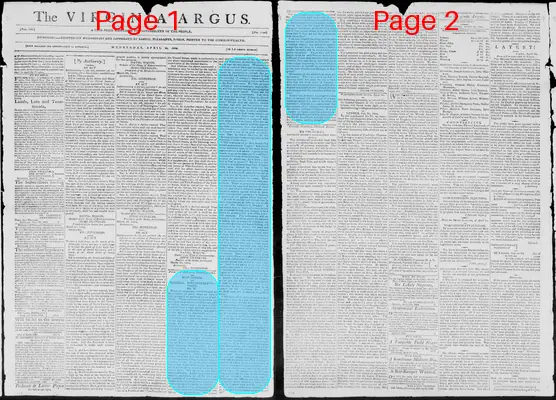
Virginia Argus
Richmond, Virginia
What is this article about?
This editorial from The National Intelligencer defends the Republican government's swift naval reinforcements after the capture of the USS Philadelphia by Barbary forces in 1803, criticizing Federalist publications like the Charleston Courier for misrepresenting the event to attack prior naval reductions and exploit national misfortune for partisan gain.
Merged-components note: Continuation of the same editorial piece across pages based on sequential reading order and text flow.
Clippings
1 of 2
OCR Quality
Full Text
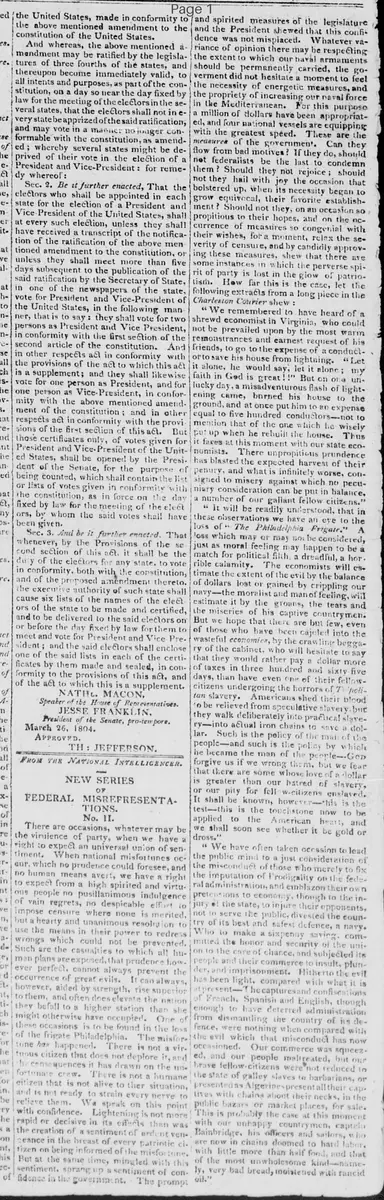
NEW SERIES
OF
FEDERAL MISREPRESENTATIONS.
No. II.
There are occasions, whatever may be the virulence of party, when we have a right to expect an universal union of sentiment. When national misfortunes occur, which no prudence could foresee, and no human means avert, we have a right to expect from a high spirited and virtuous people no pusillanimous indulgence of vain regrets, no despicable effort to impose censure where none is merited, but a hearty and unanimous resolution to use the means in their power to redress wrongs which could not be prevented.
Such are the casualties to which all human plans are exposed, that prudence however perfect, cannot always prevent the occurrence of great evils. It can always, however, aided by strength, rise superior to them, and often does elevate the nation they befall to a higher station than she might otherwise have occupied. One of these occasions is to be found in the loss of the Frigate Philadelphia. The misfortune has happened. There is not a virtuous citizen that does not deplore it, and the consequences it has drawn on the unfortunate crew. There is not a humane citizen that is not alive to their situation, and is not ready to strain every nerve to relieve them. We speak on this point with confidence. Lightening is not more rapid or decisive in its effects than was the creation of a sentiment of ardent vengeance in the breast of every patriotic citizen on being informed of the misfortune. But at the same time, mingled with this sentiment, sprang up a sentiment of confidence in the government. The prompt and spirited measures of the legislature and the President shewed that this confidence was not misplaced. Whatever variance of opinion there may be respecting the extent to which our naval armaments should be permanently carried, the government did not hesitate a moment to feel the necessity of energetic measures, and the propriety of increasing our naval force in the Mediterranean. For this purpose a million of dollars have been appropriated, and four national vessels are equipping with the greatest speed. These are the measures of the government. Can they flow from bad motives? If they do, should not federalists be the last to condemn them? Should they not rejoice; should not they hail with joy the occasion that bolstered up, when its necessity began to grow equivocal, their favorite establishment? Should not they, on an occasion so propitious to their hopes, and on the occurrence of measures so congenial with their wishes, for a moment, relax the severity of censure, and by candidly approving these measures, shew that there are some instances in which the perverse spirit of party is lost in the glow of patriotism. How far this is the case, let the following extracts from a long piece in the Charleston Courier shew:
"We remembered to have heard of a shrewd economist in Virginia, who could not be prevailed upon by the most warm remonstrances and earnest request of his friends, to go to the expense of a conductor to save his house from lightning. 'Let it alone,' he would say, 'let it alone; my faith in God is great!!!' But on one unlucky day, a misadventurous flash of lightning came, burned his house to the ground, and at once put him to an expense equal to five hundred conductors—not to mention that of the one which he wisely put up when he rebuilt the house. Thus it fares at this moment with our state economists. There unpropitious prudence has blasted the expected harvest of their penury, and what is infinitely worse, consigned to misery against which no pecuniary consideration can be put in balance, a number of our gallant fellow citizens."
"It will be readily understood, that in these observations we have an eye to the loss of the Philadelphia Frigate." A loss which may or may not be considered, just as moral feeling may happen to be a match for political filth, a dreadful, a horrible calamity. The economists will estimate the extent of the evil by the balance of dollars lost or gained by crippling our navy—the moralist and man of feeling, will estimate it by the groans, the tears and the miseries of his captive countrymen. But we hope that there are but few, even of those who have been cajoled into the wasteful economies, by the crawling beggary of the cabinet, who will hesitate to say that they would rather pay a dollar more of taxes in three hundred and sixty five days, than have even one of their fellow-citizens undergoing the horrors of Algiers slavery. Americans shed their blood to be relieved from speculative slavery, but they walk deliberately into practical slavery—into actual iron chains to save a dollar. Such is the policy of the man of the people—and such is the policy by which he became the man of the people. God forgive us if we wrong them, but we fear that there are some whose love of a dollar is greater than our hatred of slavery, or our pity for fellow-citizens enslaved. It shall be known, however—this is the test—this is the touchstone now to be applied to the American heart, and we shall soon see whether it be gold or dross."
"We have often taken occasion to lead the public mind to a just consideration of the misconduct of those who merely to fix the imputation of Prodigality on the federal administration, and emblazon their own pretensions to economy, though to the injury of the state, to injure their opponents, not to serve the public, divested the country of its best and safest defence, a navy. Who to make a sixpenny saving, committed the honor and security of the union to the care of chance, and subjected its people and their commerce to insult, plunder, and imprisonment. Hitherto the evil has been light, compared with what it is sty present—The captures and confiscations of French, Spanish and English, though enough to have deterred administration from dismantling the country of its defence, were nothing when compared with the evil which that misconduct has now occasioned. Our commerce was squeezed, and our people maltreated, but our brave fellow-citizens were not reduced to the state of galley slaves to barbarians, or presented as Algerines present all their captives with chains about their necks, in the public bazars or market places, for sale. This is probably the case at this moment with our unhappy countrymen, captain Bainbridge, his officers and sailors, who are now in chains doomed to hard labor, with little more than half food, and that of the most unwholesome kind—namely, very bad bread, moistened with rancid oil."
It may however be worth the while of Mr. Jefferson to send an humble ambassador to the barbarians, to remind them of his good nature in returning their captives ransom free: to bid them do likewise, like good christians, as he and they are; and if they should refuse to do so, to tell them that "they are not the persons he took them for."
In one respect the thing may be considered by our cabinet as fortunate. As a ruinous church was said to be good enough for one born in a stable, a Mahometan Seraglio will be good enough for paltry christians. There they will have ample room for reflection on sacred subjects, and if ever they return to their native country, they may bring over with them some happy improvements in our religion and morals, to furnish an embellishment to the next Presidential Message to Congress."
Comment on the above is, we trust, unnecessary. There are, we hope, few citizens--there are none we are certain, who feel the noble spirit of freemen--that will not resent language so full of indignity and insult to the conduct of their government and the character of their nation.
It may not, however, be altogether useless to expose the falsehood of a statement contained in a part of the piece not extracted, wherein it is represented that the ransom of the captives will amount to one or two millions of dollars. It is not possible to make a precise estimate, but the probable demand will be about 160,000 dollars for the officers, and 180,000 dollars for the men, making altogether 340,000 dollars.
What sub-type of article is it?
What keywords are associated?
What entities or persons were involved?
Editorial Details
Primary Topic
Defense Against Federalist Misrepresentations On The Loss Of The Frigate Philadelphia
Stance / Tone
Supportive Of Government Actions, Critical Of Federalist Partisanship
Key Figures
Key Arguments