Thank you for visiting SNEWPapers!
Sign up free
Editorial
August 24, 1897
Twice A Week Plain Dealer
Cresco, Howard County, Iowa
What is this article about?
Historical review of U.S. money policy from 1814-1840, emphasizing Democratic advocacy for Treasury notes over state bank notes and hard money, critiquing opposition from Wall Street Democrats and Federalists/Whigs. Covers Jefferson, Madison, Jackson, Van Buren, and Benton.
Clipping
OCR Quality
95%
Excellent
Full Text
HARD MONEY.
The History of the United States from the Earliest Period to the Present, and its Legislation Touching the Money Question.
A Brief but Comprehensive Review of Democratic Policy and Action on the Question.
EVIDENCE SHOWING WHAT HAS BEEN
AMERICAN MONEY FOR ONE
HUNDRED YEARS.
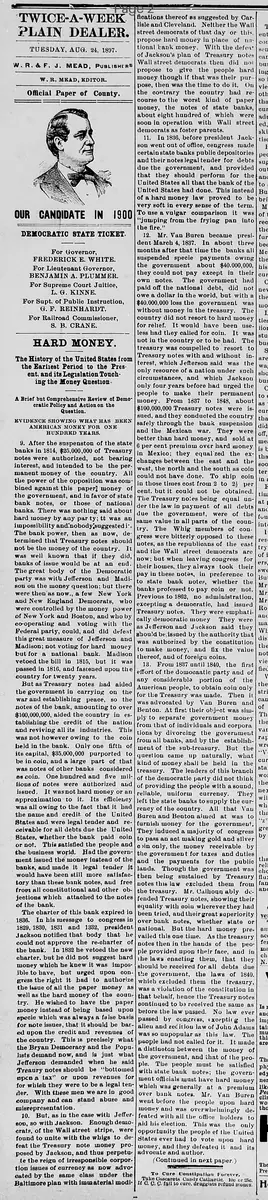
9. After the suspension of the state banks in 1814, $25,000,000 of Treasury notes were authorized, not bearing interest, and intended to be the permanent money of the country. All the power of the opposition was combined against this paper money of the government, and in favor of state bank notes, or those of national banks. There was nothing said about hard money by any party; it was an impossibility and nobody suggested it. The bank power, then as now, determined that Treasury notes should not be the money of the country. It was well known that if they did, banks of issue would be at an end. The great body of the Democratic party was with Jefferson and Madison on the money question; but there were then as now, a few New York and New England Democrats, who were controlled by the money power of New York and Boston, and who by co-operating and voting with the Federal party, could, and did defeat this great measure of Jefferson and Madison; not voting for hard money but for a national bank. Madison vetoed the bill in 1815, but it was passed in 1816, and fastened upon the country for twenty years.
But as Treasury notes had aided the government in carrying on the war and establishing peace, so the notes of the bank, amounting to over $100,000,000, aided the country in establishing the credit of the nation and reviving all its industries. This was not however owing to the coin held in the bank. Only one fifth of its capital, $35,000,000 purported to be in coin, and a large part of that was notes of other banks considered as coin. One hundred and five millions of notes were authorized and issued. It was not hard money or an approximation to it. Its efficiency was allowing to the fact that it had the name and credit of the United States and were legal tender and receivable for all debts due the United States, whether the bank paid coin or not. This satisfied the people and the business world. Had the government issued the money instead of the banks, and made it legal tender it would have been still more satisfactory than these bank notes, and free from all constitutional and other objections which attached to the notes of the bank.
The charter of this bank expired in 1830. In his message to congress in 1829, 1830, 1831 and 1832, president Jackson notified that body that he could not approve the re-charter of the bank. In 1832 he vetoed the new charter, but he did not suggest hard money which he knew it was impossible to have, but urged upon congress the right it had to authorize the issue of all the paper money as well as the hard money of the country. He wished to have the paper money instead of being based upon specie which was always a false basis for note issues, that it should be based upon the credit and revenues of the country. This is precisely what the Bryan Democracy and the Populists demand now, and is just what Jefferson demanded when he said Treasury notes should be "bottomed upon a tax" or upon revenues for which they were to be a legal tender. With these men we are in good company and can stand abuse and misrepresentation.
10. But, as in the case with Jefferson, so with Jackson. Enough democrats, of the Wall street stripe, were found to unite with the whigs to defeat the Treasury note money proposed by Jackson, and thus perpetuate the reign of irresponsible corporation issues of currency as now advocated by the same class under the Baltimore plan with immaterial modifications thereof as suggested by Carlisle and Cleveland. Neither the Wall street democrats of that day or this propose hard money in place of national bank money. With the defeat of Jackson's plan of Treasury notes Wall street democrats then did not propose to give the people hard money though if that was their purpose, then was the time to do it. On the contrary the country had recourse to the worst kind of paper money, the notes of state banks about eight hundred of which were soon in operation with Wall street democrats as foster parents.
11. In 1836, before president Jackson went out of office, congress made certain state banks public depositories and their notes legal tender for debts due the government, and provided that they should perform for the United States all that the bank of the United States had done. This instead of a hard money law proved to be very soft in every sense of the term. To use a vulgar comparison it was "jumping from the frying pan into the fire."
12. Mr. Van Buren became president March 4, 1837. In about three months after that time the banks all suspended specie payments owing the government about $40,000,000 they could not pay except in their own notes. The government had paid off the national debt, did not owe a dollar in the world, but with a $40,000,000 loss the government was without money in the treasury. The country did not resort to hard money for relief. It would have been useless had they called for coin. It was not in the country or to be had. The treasury was compelled to resort to Treasury notes with and without interest, which Jefferson said was the only resource of a nation under such circumstances, and which Jackson only four years before had urged the people to make their permanent money. From 1837 to 1848, about $100,000,000 Treasury notes were issued, and they conducted the country safely through the bank suspension and the Mexican war. They were better than hard money, and sold at 6 per cent premium over hard money in Mexico; they equalized the exchanges between the east and the west, the north and the south as coin could not have done. To ship coin in those times cost from 2 to 2 per cent. but it could not be obtained. The Treasury notes being equal under the law in payment of all debts due the government, were of the same value in all parts of the country. The Whig members of congress were bitterly opposed to these notes, as the republicans of the east and the Wall street democrats are now; but when leaving congress for their homes, they always took their pay in these notes, in preference to state bank notes, whether the banks professed to pay coin or not.
Previous to 1842, no administration excepting a democratic, had issued Treasury notes. They were emphatically democratic money They were as Jefferson and Jackson said they should be. issued by the authority that was authorized by the constitution to make money, and fix the value thereof, and of foreign coins.
13. From 1837 until 1840, the first effort of the democratic party and of any considerable portion of the American people, to obtain coin only for the Treasury was made. Then it was advocated by Van Buren and Benton. At first their object was simply to separate government money from that of individuals and corporations by divorcing the government from all banks, and by the establishment of the sub-treasury. But the question came up naturally, what kind of money shall be held in the treasury. The leaders of this branch of the democratic party did not think of providing the people with a sound, reliable, uniform currency. They left the state banks to supply the currency of the country. All that Van Buren and Benton aimed at was to furnish money for the government They induced a majority of congress to pass an act making gold and silver coin only, the money receivable by the government for taxes and duties and the payments for the public lands. Though the government was then being sustained by Treasury notes this law excluded them from the treasury. Mr. Calhoun ably defended Treasury notes, showing their equality with coin wherever they had been tried, and their great superiority over bank notes, whether state or national. But the hard money prevailed this one time. As the treasury notes then in the hands of the people provided upon their face, and in the laws enacting them, that they should be received for all debts due the government, the laws of 1840, which excluded them the treasury, was a violation of the constitution in that behalf, hence the Treasury notes continued to be received the same as before the law passed. No law ever passed by congress, excepting the alien and sedition law of John Adams was so unpopular as this law. The people had not called for it. It made a distinction between the money of the government, and that of the people. The people must be satisfied with state bank notes; the government officials must have hard money which was generally at a premium over bank notes. Mr. Van Buren went before the people upon hard money and was overwhelmingly defeated with all the office holders to aid his election. This was the only opportunity the people of the United States ever had to vote upon hard money, and they defeated it and its advocate and author.
(Continued in next paper.)
The History of the United States from the Earliest Period to the Present, and its Legislation Touching the Money Question.
A Brief but Comprehensive Review of Democratic Policy and Action on the Question.
EVIDENCE SHOWING WHAT HAS BEEN
AMERICAN MONEY FOR ONE
HUNDRED YEARS.
9. After the suspension of the state banks in 1814, $25,000,000 of Treasury notes were authorized, not bearing interest, and intended to be the permanent money of the country. All the power of the opposition was combined against this paper money of the government, and in favor of state bank notes, or those of national banks. There was nothing said about hard money by any party; it was an impossibility and nobody suggested it. The bank power, then as now, determined that Treasury notes should not be the money of the country. It was well known that if they did, banks of issue would be at an end. The great body of the Democratic party was with Jefferson and Madison on the money question; but there were then as now, a few New York and New England Democrats, who were controlled by the money power of New York and Boston, and who by co-operating and voting with the Federal party, could, and did defeat this great measure of Jefferson and Madison; not voting for hard money but for a national bank. Madison vetoed the bill in 1815, but it was passed in 1816, and fastened upon the country for twenty years.
But as Treasury notes had aided the government in carrying on the war and establishing peace, so the notes of the bank, amounting to over $100,000,000, aided the country in establishing the credit of the nation and reviving all its industries. This was not however owing to the coin held in the bank. Only one fifth of its capital, $35,000,000 purported to be in coin, and a large part of that was notes of other banks considered as coin. One hundred and five millions of notes were authorized and issued. It was not hard money or an approximation to it. Its efficiency was allowing to the fact that it had the name and credit of the United States and were legal tender and receivable for all debts due the United States, whether the bank paid coin or not. This satisfied the people and the business world. Had the government issued the money instead of the banks, and made it legal tender it would have been still more satisfactory than these bank notes, and free from all constitutional and other objections which attached to the notes of the bank.
The charter of this bank expired in 1830. In his message to congress in 1829, 1830, 1831 and 1832, president Jackson notified that body that he could not approve the re-charter of the bank. In 1832 he vetoed the new charter, but he did not suggest hard money which he knew it was impossible to have, but urged upon congress the right it had to authorize the issue of all the paper money as well as the hard money of the country. He wished to have the paper money instead of being based upon specie which was always a false basis for note issues, that it should be based upon the credit and revenues of the country. This is precisely what the Bryan Democracy and the Populists demand now, and is just what Jefferson demanded when he said Treasury notes should be "bottomed upon a tax" or upon revenues for which they were to be a legal tender. With these men we are in good company and can stand abuse and misrepresentation.
10. But, as in the case with Jefferson, so with Jackson. Enough democrats, of the Wall street stripe, were found to unite with the whigs to defeat the Treasury note money proposed by Jackson, and thus perpetuate the reign of irresponsible corporation issues of currency as now advocated by the same class under the Baltimore plan with immaterial modifications thereof as suggested by Carlisle and Cleveland. Neither the Wall street democrats of that day or this propose hard money in place of national bank money. With the defeat of Jackson's plan of Treasury notes Wall street democrats then did not propose to give the people hard money though if that was their purpose, then was the time to do it. On the contrary the country had recourse to the worst kind of paper money, the notes of state banks about eight hundred of which were soon in operation with Wall street democrats as foster parents.
11. In 1836, before president Jackson went out of office, congress made certain state banks public depositories and their notes legal tender for debts due the government, and provided that they should perform for the United States all that the bank of the United States had done. This instead of a hard money law proved to be very soft in every sense of the term. To use a vulgar comparison it was "jumping from the frying pan into the fire."
12. Mr. Van Buren became president March 4, 1837. In about three months after that time the banks all suspended specie payments owing the government about $40,000,000 they could not pay except in their own notes. The government had paid off the national debt, did not owe a dollar in the world, but with a $40,000,000 loss the government was without money in the treasury. The country did not resort to hard money for relief. It would have been useless had they called for coin. It was not in the country or to be had. The treasury was compelled to resort to Treasury notes with and without interest, which Jefferson said was the only resource of a nation under such circumstances, and which Jackson only four years before had urged the people to make their permanent money. From 1837 to 1848, about $100,000,000 Treasury notes were issued, and they conducted the country safely through the bank suspension and the Mexican war. They were better than hard money, and sold at 6 per cent premium over hard money in Mexico; they equalized the exchanges between the east and the west, the north and the south as coin could not have done. To ship coin in those times cost from 2 to 2 per cent. but it could not be obtained. The Treasury notes being equal under the law in payment of all debts due the government, were of the same value in all parts of the country. The Whig members of congress were bitterly opposed to these notes, as the republicans of the east and the Wall street democrats are now; but when leaving congress for their homes, they always took their pay in these notes, in preference to state bank notes, whether the banks professed to pay coin or not.
Previous to 1842, no administration excepting a democratic, had issued Treasury notes. They were emphatically democratic money They were as Jefferson and Jackson said they should be. issued by the authority that was authorized by the constitution to make money, and fix the value thereof, and of foreign coins.
13. From 1837 until 1840, the first effort of the democratic party and of any considerable portion of the American people, to obtain coin only for the Treasury was made. Then it was advocated by Van Buren and Benton. At first their object was simply to separate government money from that of individuals and corporations by divorcing the government from all banks, and by the establishment of the sub-treasury. But the question came up naturally, what kind of money shall be held in the treasury. The leaders of this branch of the democratic party did not think of providing the people with a sound, reliable, uniform currency. They left the state banks to supply the currency of the country. All that Van Buren and Benton aimed at was to furnish money for the government They induced a majority of congress to pass an act making gold and silver coin only, the money receivable by the government for taxes and duties and the payments for the public lands. Though the government was then being sustained by Treasury notes this law excluded them from the treasury. Mr. Calhoun ably defended Treasury notes, showing their equality with coin wherever they had been tried, and their great superiority over bank notes, whether state or national. But the hard money prevailed this one time. As the treasury notes then in the hands of the people provided upon their face, and in the laws enacting them, that they should be received for all debts due the government, the laws of 1840, which excluded them the treasury, was a violation of the constitution in that behalf, hence the Treasury notes continued to be received the same as before the law passed. No law ever passed by congress, excepting the alien and sedition law of John Adams was so unpopular as this law. The people had not called for it. It made a distinction between the money of the government, and that of the people. The people must be satisfied with state bank notes; the government officials must have hard money which was generally at a premium over bank notes. Mr. Van Buren went before the people upon hard money and was overwhelmingly defeated with all the office holders to aid his election. This was the only opportunity the people of the United States ever had to vote upon hard money, and they defeated it and its advocate and author.
(Continued in next paper.)
What sub-type of article is it?
Economic Policy
Partisan Politics
What keywords are associated?
Hard Money
Treasury Notes
Democratic Policy
National Bank
State Banks
Specie Payments
Paper Money
Wall Street Democrats
What entities or persons were involved?
Jefferson
Madison
Jackson
Van Buren
Benton
Calhoun
Wall Street Democrats
Federal Party
Whigs
Bryan Democracy
Populists
Editorial Details
Primary Topic
Democratic Advocacy For Treasury Notes Over Hard Money And Bank Notes In U.S. History
Stance / Tone
Supportive Of Jefferson Jackson Treasury Note Policy, Critical Of Wall Street Democrats And Opponents
Key Figures
Jefferson
Madison
Jackson
Van Buren
Benton
Calhoun
Wall Street Democrats
Federal Party
Whigs
Bryan Democracy
Populists
Key Arguments
Treasury Notes Intended As Permanent Government Money In 1814, Defeated By Bank Interests
National Bank Notes Not Based On Hard Money But U.S. Credit, Effective Due To Legal Tender Status
Jackson Urged Treasury Notes Based On National Credit/Revenues, Not Specie
State Bank Notes Led To Suspensions And Crises, Treasury Notes Provided Stability
Hard Money Policy Of 1840 Unpopular, Defeated Van Buren, Violated Treasury Note Provisions