Thank you for visiting SNEWPapers!
Sign up free
Editorial
December 19, 1800
The National Intelligencer And Washington Advertiser
Washington, District Of Columbia
What is this article about?
An editorial criticizes the Federal party's exclusion of stenographers from House debates, led by the Speaker, as a partisan move to conceal proceedings from the public. It argues for transparency in republican government to maintain constituent accountability and confidence.
Clipping
OCR Quality
98%
Excellent
Full Text
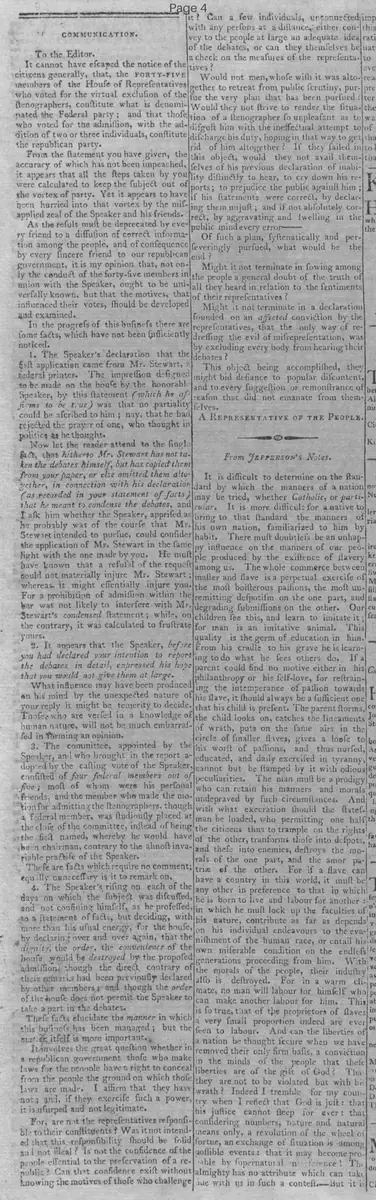
It cannot have escaped the notice of the citizens generally, that, the FORTY-FIVE members of the House of Representatives who voted for the virtual exclusion of the stenographers, constitute what is denominated the Federal party; and that those who voted for the admission, with the addition of two or three individuals, constitute the republican party.
From the statement you have given, the accuracy of which has not been impeached, it appears that all the steps taken by you were calculated to keep the subject out of the vortex of party. Yet it appears to have been hurried into that vortex by the misapplied zeal of the Speaker and his friends.
As the result must be deprecated by every friend to a diffusion of correct information among the people, and of consequence by every sincere friend to our republican government, it is my opinion that, not only the conduct of the forty-five members in union with the Speaker, ought to be universally known, but that the motives, that influenced their votes, should be developed and examined.
In the progress of this business there are some facts, which have not been sufficiently noticed.
1. The Speaker's declaration that the first application came from Mr. Stewart, a federal printer. The impression designed to be made on the house by the honorable Speaker, by this statement (which he affirms to be true) was that no partiality could be ascribed to him; nay, that he had rejected the prayer of one, who thought in politics as he thought.
Now let the reader attend to the single fact, that hitherto Mr. Stewart has not taken the debates himself, but has copied them from your paper, or else omitted them altogether, in connection with his declaration (as recorded in your statement of facts) that he meant to condense the debates, and I ask him whether the Speaker, apprised as he probably was of the course that Mr. Stewart intended to pursue, could consider the application of Mr. Stewart in the same light with the one made by you. He must have known that a refusal of the request could not materially injure Mr. Stewart; whereas- it might essentially injure you.
For a prohibition of admission within the bar was not likely to interfere with Mr. Stewart's condensed statement; while, on the contrary, it was calculated to frustrate yours.
2. It appears that the Speaker, before you had declared your intention to report the debates in detail, expressed his hope that you would not give them at large.
What influence may have been produced on his mind by the unexpected nature of your reply it might be temerity to decide. Those, who are versed in a knowledge of human nature, will not be much embarrassed in forming an opinion.
3. The committee, appointed by the Speaker, and who brought in the report adopted by the casting vote of the Speaker, consisted of four federal members out of five; most of whom were his personal friends, and the member who made the motion for admitting the stenographers, though a federal member, was studiously placed at the close of the committee, instead of being the first named, whereby he would have been chairman, contrary to the almost invariable practice of the Speaker.
These are facts which require no comment; equally unnecessary is it to remark on,
4. The Speaker's rising on each of the days on which the subject was discussed, and not confining himself, as he professed, to a statement of facts, but deciding, with more than his usual energy, for the house, by declaring over and over again, that the dignity, the order, the convenience of the house would be destroyed by the proposed admission, though the direct contrary of these remarks had been previously declared by other members; and though the order of the house does not permit the Speaker to take a part in the debates.
These facts elucidate the manner in which this business has been managed; but the matter itself is more important.
It involves the great question whether in a republican government those who make laws for the people have a right to conceal from the people the ground on which those laws are made. I affirm that they have not; and, if they exercise such a power, it is usurped and not legitimate.
For, are not the representatives responsible to their constituents? Was it not intended that this responsibility should be solid and not ideal? Is not the confidence of the people essential to the preservation of a republic? Can that confidence exist without knowing the motives of those who challenge it? Can a few individuals, unconnected with any persons at a distance, either convey to the people at large an adequate idea of the debates, or can they themselves be a check on the measures of the representatives?
Would not men, whose wish it was altogether to retreat from public scrutiny, pursue the very plan that has been pursued? Would they not strive to render the situation of a stenographer so unpleasant as to disgust him with the ineffectual attempt to discharge his duty, hoping in that way to get rid of him altogether? If they failed in this object, would they not avail themselves of his previous declaration of inability distinctly to hear, to cry down his reports; to prejudice the public against him; if his statements were correct, by declaring them unjust; and if not absolutely correct, by aggravating and swelling in the public mind every error?
Of such a plan, systematically and perseveringly pursued, what would be the end?
Might it not terminate in sowing among the people a general doubt of the truth of all they heard in relation to the sentiments of their representatives?
Might it not terminate in a declaration founded on an affected conviction by the representatives, that the only way of redressing the evil of misrepresentation, was by excluding every body from hearing their debates?
This object being accomplished, they might bid defiance to popular discontent, and to every suggestion or remonstrance of reason that did not emanate from themselves.
A REPRESENTATIVE OF THE PEOPLE.
From the statement you have given, the accuracy of which has not been impeached, it appears that all the steps taken by you were calculated to keep the subject out of the vortex of party. Yet it appears to have been hurried into that vortex by the misapplied zeal of the Speaker and his friends.
As the result must be deprecated by every friend to a diffusion of correct information among the people, and of consequence by every sincere friend to our republican government, it is my opinion that, not only the conduct of the forty-five members in union with the Speaker, ought to be universally known, but that the motives, that influenced their votes, should be developed and examined.
In the progress of this business there are some facts, which have not been sufficiently noticed.
1. The Speaker's declaration that the first application came from Mr. Stewart, a federal printer. The impression designed to be made on the house by the honorable Speaker, by this statement (which he affirms to be true) was that no partiality could be ascribed to him; nay, that he had rejected the prayer of one, who thought in politics as he thought.
Now let the reader attend to the single fact, that hitherto Mr. Stewart has not taken the debates himself, but has copied them from your paper, or else omitted them altogether, in connection with his declaration (as recorded in your statement of facts) that he meant to condense the debates, and I ask him whether the Speaker, apprised as he probably was of the course that Mr. Stewart intended to pursue, could consider the application of Mr. Stewart in the same light with the one made by you. He must have known that a refusal of the request could not materially injure Mr. Stewart; whereas- it might essentially injure you.
For a prohibition of admission within the bar was not likely to interfere with Mr. Stewart's condensed statement; while, on the contrary, it was calculated to frustrate yours.
2. It appears that the Speaker, before you had declared your intention to report the debates in detail, expressed his hope that you would not give them at large.
What influence may have been produced on his mind by the unexpected nature of your reply it might be temerity to decide. Those, who are versed in a knowledge of human nature, will not be much embarrassed in forming an opinion.
3. The committee, appointed by the Speaker, and who brought in the report adopted by the casting vote of the Speaker, consisted of four federal members out of five; most of whom were his personal friends, and the member who made the motion for admitting the stenographers, though a federal member, was studiously placed at the close of the committee, instead of being the first named, whereby he would have been chairman, contrary to the almost invariable practice of the Speaker.
These are facts which require no comment; equally unnecessary is it to remark on,
4. The Speaker's rising on each of the days on which the subject was discussed, and not confining himself, as he professed, to a statement of facts, but deciding, with more than his usual energy, for the house, by declaring over and over again, that the dignity, the order, the convenience of the house would be destroyed by the proposed admission, though the direct contrary of these remarks had been previously declared by other members; and though the order of the house does not permit the Speaker to take a part in the debates.
These facts elucidate the manner in which this business has been managed; but the matter itself is more important.
It involves the great question whether in a republican government those who make laws for the people have a right to conceal from the people the ground on which those laws are made. I affirm that they have not; and, if they exercise such a power, it is usurped and not legitimate.
For, are not the representatives responsible to their constituents? Was it not intended that this responsibility should be solid and not ideal? Is not the confidence of the people essential to the preservation of a republic? Can that confidence exist without knowing the motives of those who challenge it? Can a few individuals, unconnected with any persons at a distance, either convey to the people at large an adequate idea of the debates, or can they themselves be a check on the measures of the representatives?
Would not men, whose wish it was altogether to retreat from public scrutiny, pursue the very plan that has been pursued? Would they not strive to render the situation of a stenographer so unpleasant as to disgust him with the ineffectual attempt to discharge his duty, hoping in that way to get rid of him altogether? If they failed in this object, would they not avail themselves of his previous declaration of inability distinctly to hear, to cry down his reports; to prejudice the public against him; if his statements were correct, by declaring them unjust; and if not absolutely correct, by aggravating and swelling in the public mind every error?
Of such a plan, systematically and perseveringly pursued, what would be the end?
Might it not terminate in sowing among the people a general doubt of the truth of all they heard in relation to the sentiments of their representatives?
Might it not terminate in a declaration founded on an affected conviction by the representatives, that the only way of redressing the evil of misrepresentation, was by excluding every body from hearing their debates?
This object being accomplished, they might bid defiance to popular discontent, and to every suggestion or remonstrance of reason that did not emanate from themselves.
A REPRESENTATIVE OF THE PEOPLE.
What sub-type of article is it?
Press Freedom
Partisan Politics
Constitutional
What keywords are associated?
Stenographers
House Debates
Federal Party
Republican Government
Public Transparency
Speaker Bias
Information Diffusion
What entities or persons were involved?
Federal Party
Republican Party
Speaker
Mr. Stewart
House Of Representatives
Editorial Details
Primary Topic
Exclusion Of Stenographers From House Of Representatives Debates
Stance / Tone
Strongly Opposes Exclusion And Advocates For Public Access To Debates
Key Figures
Federal Party
Republican Party
Speaker
Mr. Stewart
House Of Representatives
Key Arguments
Federal Party Members Voted To Exclude Stenographers To Control Information
Speaker's Actions Show Bias Against Detailed Reporting
Representatives Have No Right To Conceal Debates From The Public In A Republic
Transparency Is Essential For Constituent Accountability And Public Confidence
Exclusion Plan Aims To Undermine Trust In Reported Proceedings