Thank you for visiting SNEWPapers!
Sign up free
Editorial
November 8, 1961
Tabor City Tribune
Tabor City, Columbus County, North Carolina
What is this article about?
Editorial criticizes Dr. Albert C. Edwards' claims that North Carolina's 'quality education' program causes increased drop-outs due to heavy workloads, arguing instead that higher standards reduce drop-outs and provide better opportunities.
Clipping
OCR Quality
95%
Excellent
Full Text
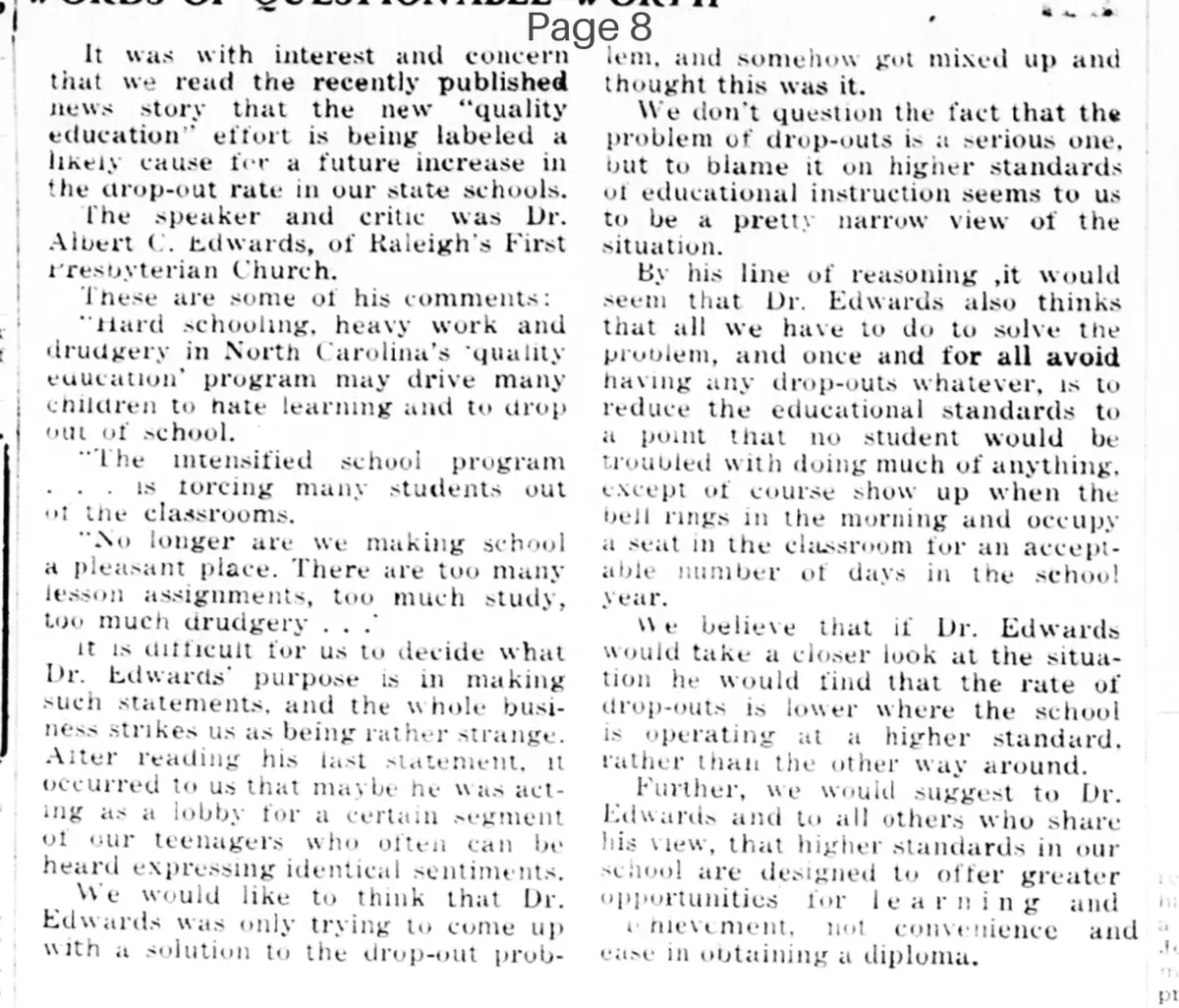
It was with interest and concern that we read the recently published news story that the new "quality education" effort is being labeled a likely cause for a future increase in the drop-out rate in our state schools.
The speaker and critic was Dr. Albert C. Edwards, of Raleigh's First Presbyterian Church.
These are some of his comments:
"Hard schooling, heavy work and drudgery in North Carolina's 'quality education' program may drive many children to hate learning and to drop out of school."
"The intensified school program . . . is forcing many students out of the classrooms."
"No longer are we making school a pleasant place. There are too many lesson assignments, too much study, too much drudgery . . ."
It is difficult for us to decide what Dr. Edwards' purpose is in making such statements, and the whole business strikes us as being rather strange.
After reading his last statement, it occurred to us that maybe he was acting as a lobby for a certain segment of our teenagers who often can be heard expressing identical sentiments.
We would like to think that Dr. Edwards was only trying to come up with a solution to the drop-out problem and somehow got mixed up and thought this was it.
We don't question the fact that the problem of drop-outs is a serious one, but to blame it on higher standards of educational instruction seems to us to be a pretty narrow view of the situation.
By his line of reasoning, it would seem that Dr. Edwards also thinks that all we have to do to solve the problem, and once and for all avoid having any drop-outs whatever, is to reduce the educational standards to a point that no student would be troubled with doing much of anything, except of course show up when the bell rings in the morning and occupy a seat in the classroom for an acceptable number of days in the school year.
We believe that if Dr. Edwards would take a closer look at the situation he would find that the rate of drop-outs is lower where the school is operating at a higher standard, rather than the other way around.
Further, we would suggest to Dr. Edwards and to all others who share his view, that higher standards in our school are designed to offer greater opportunities for learning and achievement, not convenience and ease in obtaining a diploma.
The speaker and critic was Dr. Albert C. Edwards, of Raleigh's First Presbyterian Church.
These are some of his comments:
"Hard schooling, heavy work and drudgery in North Carolina's 'quality education' program may drive many children to hate learning and to drop out of school."
"The intensified school program . . . is forcing many students out of the classrooms."
"No longer are we making school a pleasant place. There are too many lesson assignments, too much study, too much drudgery . . ."
It is difficult for us to decide what Dr. Edwards' purpose is in making such statements, and the whole business strikes us as being rather strange.
After reading his last statement, it occurred to us that maybe he was acting as a lobby for a certain segment of our teenagers who often can be heard expressing identical sentiments.
We would like to think that Dr. Edwards was only trying to come up with a solution to the drop-out problem and somehow got mixed up and thought this was it.
We don't question the fact that the problem of drop-outs is a serious one, but to blame it on higher standards of educational instruction seems to us to be a pretty narrow view of the situation.
By his line of reasoning, it would seem that Dr. Edwards also thinks that all we have to do to solve the problem, and once and for all avoid having any drop-outs whatever, is to reduce the educational standards to a point that no student would be troubled with doing much of anything, except of course show up when the bell rings in the morning and occupy a seat in the classroom for an acceptable number of days in the school year.
We believe that if Dr. Edwards would take a closer look at the situation he would find that the rate of drop-outs is lower where the school is operating at a higher standard, rather than the other way around.
Further, we would suggest to Dr. Edwards and to all others who share his view, that higher standards in our school are designed to offer greater opportunities for learning and achievement, not convenience and ease in obtaining a diploma.
What sub-type of article is it?
Education
What keywords are associated?
Quality Education
Drop Out Rate
Higher Standards
Educational Reform
School Drudgery
What entities or persons were involved?
Dr. Albert C. Edwards
Raleigh's First Presbyterian Church
Editorial Details
Primary Topic
Critique Of Claims That Quality Education Causes School Drop Outs
Stance / Tone
Supportive Of Higher Educational Standards
Key Figures
Dr. Albert C. Edwards
Raleigh's First Presbyterian Church
Key Arguments
Quality Education Program May Drive Children To Hate Learning And Drop Out
Intensified Program Forces Students Out Of Classrooms
School No Longer Pleasant Due To Too Many Assignments And Drudgery
Blaming Drop Outs On Higher Standards Is Narrow View
Drop Out Rates Lower In Schools With Higher Standards
Higher Standards Offer Greater Opportunities For Learning And Achievement