Thank you for visiting SNEWPapers!
Sign up free
Literary
January 11, 1828
Phenix Gazette
Alexandria, Virginia
What is this article about?
Reflective essay on the psychological effects of clock ticks and bell chimes, contrasting their soothing rural sounds in England with intrusive foreign ones, evoking time, memory, and events like births and deaths. References Coleridge, Wordsworth, and literary works.
Clipping
OCR Quality
95%
Excellent
Full Text
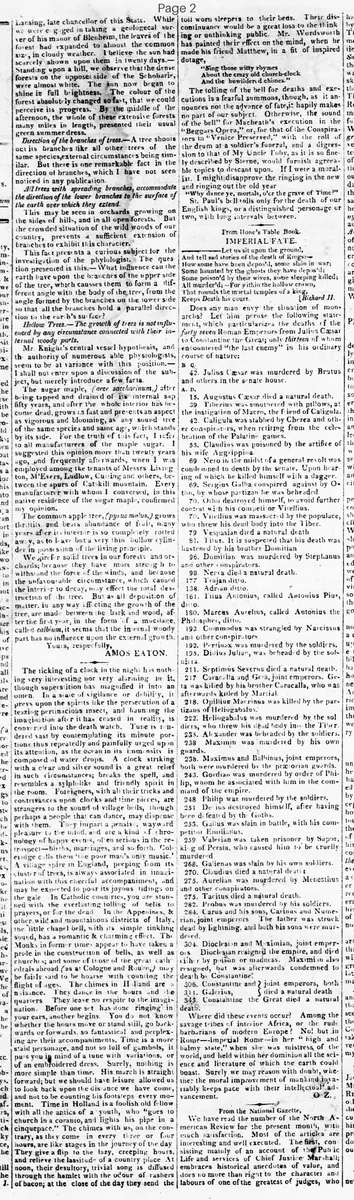
The ticking of a clock in the night has nothing very interesting nor very alarming in it though superstition has magnified it into an omen. In a state of vigilance or debility, it preys upon the spirits like the persecution of a teasing pertinacious insect, and haunting the imagination after it has ceased in reality, is converted into the death watch. Time is rendered vast by contemplating its minute portions thus repeatedly and painfully urged upon its attention, as the ocean in its immensity is composed of water drops. A clock striking with a clear and silver sound is a great relief in such circumstances; breaks the spell, and resembles a sylph-like and friendly spirit in the room. Foreigners, with all their tricks and contrivances upon clocks and time pieces, are strangers to the sound of village bells, though perhaps a people that can dance, may dispense with them. They impart a pensive, wayward pleasure to the mind, and are a kind of chronology of happy events, of ensuing serious in the retrospect—births, marriages, and so forth. Coleridge calls them the poor man's only music.
A village spire in England, peeping from its cluster of trees, is always associated in imagination with this cheerful accompaniment, and may be expected to pour its joyous tidings on the gale. In Catholic countries, you are stunned with the everlasting tolling of bells to prayers, or for the dead. In the Apennines, & other wild and mountainous districts of Italy, the little chapel bell, with its simple tinkling sound, has a romantic & charming effect. The Monks in former times appear to have taken a pride in the construction of bells, as well as churches; and some of those of the great cathedrals abroad (as at Cologne and Rouen,) may be fairly said to be hoarse with counting the flight of ages. The chimes in Holland are a nuisance. They dance in the hours and the quarters. They leave no respite to the imagination. Before one set has done ringing in your ears, another begins. You do not know whether the hours move or stand still, go backwards or forwards, so fantastical and perplexing are their accompaniments. Time is a more sedate personage, and not so full of gambols, it puts you in mind of a tune with variations, or of an embroidered dress. Surely, nothing is more simple than time. His march is straight forward: but we should have leisure allowed us to look back upon the distance we have come, and not to be counting his footsteps every moment. Time in Holland is a foolish old fellow with all the antics of a youth, who "goes to church in a coranto, and lights his pipe in a cinquepace." The chimes with us, on the contrary, as they come in every three or four hours, are like stages in the journey of the day. They give a flip to the lazy, creeping hours, and relieve the lassitude of a country place. At noon, their desultory, trivial song is diffused through the hamlet with the odour of rashers of bacon; at the close of the day they send the toil worn sleepers to their beds. Their continuance would be a great loss to the thinking or unthinking public. Mr. Wordsworth has painted their effect on the mind, when he made his friend Matthew, in a fit of inspired dotage,
"Sing those witty rhymes
About the crazy old church-clock
And the bewildered chimes."
The tolling of the bell for deaths and executions is a fearful summons, though, as it announces not the advance of fate, it happily makes no part of our subject. Otherwise, the sound of the bell for Macheath's execution in the "Beggars Opera," or, for that of the Conspirators in "Venice Preserved," with the roll of the drum at a soldier's funeral, and a digression to that of My Uncle Toby, as it is so finely described by Sterne, would furnish agreeable topics to descant upon. If I were a moralist, I might disapprove the ringing in the new and ringing out the old year
"Why dance ye, mortals, o'er the grave of Time?"
St. Paul's bell tolls only for the death of our English kings, or a distinguished personage or two, with long intervals between.
A village spire in England, peeping from its cluster of trees, is always associated in imagination with this cheerful accompaniment, and may be expected to pour its joyous tidings on the gale. In Catholic countries, you are stunned with the everlasting tolling of bells to prayers, or for the dead. In the Apennines, & other wild and mountainous districts of Italy, the little chapel bell, with its simple tinkling sound, has a romantic & charming effect. The Monks in former times appear to have taken a pride in the construction of bells, as well as churches; and some of those of the great cathedrals abroad (as at Cologne and Rouen,) may be fairly said to be hoarse with counting the flight of ages. The chimes in Holland are a nuisance. They dance in the hours and the quarters. They leave no respite to the imagination. Before one set has done ringing in your ears, another begins. You do not know whether the hours move or stand still, go backwards or forwards, so fantastical and perplexing are their accompaniments. Time is a more sedate personage, and not so full of gambols, it puts you in mind of a tune with variations, or of an embroidered dress. Surely, nothing is more simple than time. His march is straight forward: but we should have leisure allowed us to look back upon the distance we have come, and not to be counting his footsteps every moment. Time in Holland is a foolish old fellow with all the antics of a youth, who "goes to church in a coranto, and lights his pipe in a cinquepace." The chimes with us, on the contrary, as they come in every three or four hours, are like stages in the journey of the day. They give a flip to the lazy, creeping hours, and relieve the lassitude of a country place. At noon, their desultory, trivial song is diffused through the hamlet with the odour of rashers of bacon; at the close of the day they send the toil worn sleepers to their beds. Their continuance would be a great loss to the thinking or unthinking public. Mr. Wordsworth has painted their effect on the mind, when he made his friend Matthew, in a fit of inspired dotage,
"Sing those witty rhymes
About the crazy old church-clock
And the bewildered chimes."
The tolling of the bell for deaths and executions is a fearful summons, though, as it announces not the advance of fate, it happily makes no part of our subject. Otherwise, the sound of the bell for Macheath's execution in the "Beggars Opera," or, for that of the Conspirators in "Venice Preserved," with the roll of the drum at a soldier's funeral, and a digression to that of My Uncle Toby, as it is so finely described by Sterne, would furnish agreeable topics to descant upon. If I were a moralist, I might disapprove the ringing in the new and ringing out the old year
"Why dance ye, mortals, o'er the grave of Time?"
St. Paul's bell tolls only for the death of our English kings, or a distinguished personage or two, with long intervals between.
What sub-type of article is it?
Essay
What themes does it cover?
Nature
Death Mortality
What keywords are associated?
Village Bells
Clock Ticks
Chimes
Time Perception
Rural Sounds
Death Watch
Literary References
Literary Details
Form / Style
Reflective Prose On Sounds And Time
Key Lines
Coleridge Calls Them The Poor Man's Only Music.
"Sing Those Witty Rhymes
About The Crazy Old Church Clock
And The Bewildered Chimes."
"Why Dance Ye, Mortals, O'er The Grave Of Time?"