Thank you for visiting SNEWPapers!
Sign up free
The National Intelligencer And Washington Advertiser
Washington, District Of Columbia
What is this article about?
In October 1804, Connecticut House representatives protested a General Assembly resolve revoking commissions of five justices of the peace, contending the state lacks a formal constitution of civil government, allowing unlimited legislative power.
Clipping
OCR Quality
Full Text
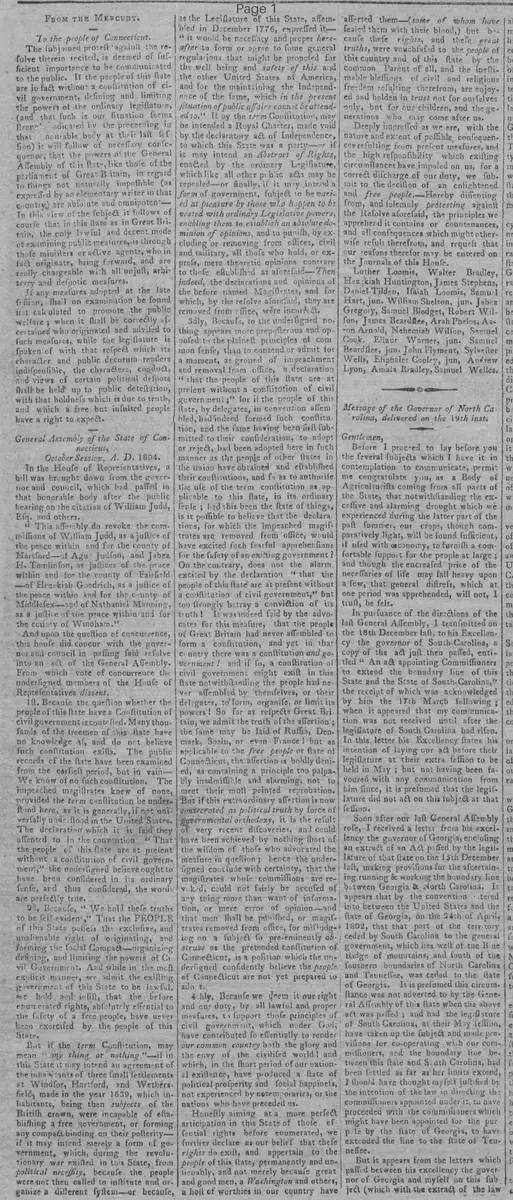
To the people of Connecticut.
The subjoined protest against the resolve therein recited, is deemed of sufficient importance to be communicated to the public. If the people of this state are in fact without a constitution of civil government, defining and limiting the powers of the ordinary legislature, (and that such is our situation seems strongly indicated by the proceedings in that honorable body at their last session) it will follow of necessary consequence, that the powers of the General Assembly of this state, like those of the parliament of Great Britain, in regard to things not naturally impossible (as expressed by an elementary writer in that country) are absolute and omnipotent.
In this view of the subject it follows of course that in this state as in Great Britain, the only lawful and decent mode of examining public measures, is through those ministers or active agents, who in fact originate, bring forward, and are really chargeable with all unjust, arbitrary and despotic measures.
If any measures adopted at the late session, shall on examination be found not calculated to promote the public welfare; when it shall be correctly ascertained who originated and advised to such measures, while the legislature is spoken of with that respect which its character and public decorum renders indispensable, the characters, conduct, and views of certain political despots shall be held up to public detestation, with that boldness which is due to truth, and which a free but insulted people have a right to expect.
General Assembly of the State of Connecticut,
October Session, A. D. 1804.
In the House of Representatives, a bill was brought down from the governor and council, which had passed in that honorable body after the public hearing on the citation of William Judd, Esq. and others.
"This assembly do revoke the commissions of William Judd, as a justice of the peace within and for the county of Hartford—of Agur Judson, and Jabez H. Tomlinson, as justices of the peace within and for the county of Fairfield—of Hezekiah Goodrich, as a justice of the peace within and for the County of Middlesex—and of Nathaniel Manning, as a justice of the peace within and for the county of Windham."
And upon the question of concurrence, this house did concur with the governor and council in passing said resolve into an act of the General Assembly.
From which vote of concurrence the undersigned members of the House of Representatives dissent.
1st. Because the question whether the people of this state have a Constitution of civil government is contested. Many thousands of the freemen of this state have no knowledge of, and do not believe such constitution exists. The public records of the state have been examined from the earliest period, but in vain—We know of no such constitution. The impeached magistrates knew of none, provided the term constitution be understood here, as it is generally, if not universally understood in the United States.
The declaration which it is said they assented to in the convention "That the people of this state are at present without a constitution of civil government," the undersigned believe ought to have been considered in its ordinary sense, and thus considered, the words are perfectly true.
2d, Because. "We hold these truths to be self-evident" That the PEOPLE of this State possess the exclusive, and unalienable right of originating, and forming the social Compact—organizing, defining, and limiting the powers of Civil Government. And while in the most explicit manner, we admit the existing government of this State to be lawful, we hold and insist, that the before enumerated rights, absolutely essential to the safety of a free people, have never been exercised by the people of this State.
But if the term Constitution, may mean "any thing or nothing."—if in this State it may intend an agreement of the inhabitants of three small settlements at Windsor, Hartford, and Wethersfield, made in the year 1639, which inhabitants, being then subjects of the British crown, were incapable of establishing a free government, or forming any compact binding on their posterity—if it may intend merely a form of government, which, during the revolutionary war existed in this State, from political necessity, because the people were not then called to institute and organize a different system—or because, as the Legislature of this State, assembled in December 1776, expressed it—"it would be necessary and proper hereafter to form or agree to some general regulations that might be proposed for the well being and safety of this and the other United States of America, and for the maintaining the Independence of the same, which in the present situation of public affairs cannot be attended to." It by the term Constitution, may be intended a Royal Charter, made void by the declaratory act of Independence, to which this State was a party—or if it may intend an Abstract of Rights, enacted by the ordinary Legislature, which like all other public acts may be repealed—or finally, if it in'ty intend a form of government, subject to be varied at pleasure by those who happen to be invested with ordinary Legislative powers, enabling them to establish an absolute dominion of opinions, and to punish, by excluding or removing from offices, civil and military, all those who hold, or express, mere theoretic opinions contrary to those established as aforesaid—Then indeed, the declarations and opinions of the before named Magistrates, and for which, by the resolve aforesaid, they are removed from office, were incorrect.
3dly, Because, to the undersigned nothing appears more preposterous and opposed to the plainest principles of common sense, than to contend or admit for a moment, as ground of impeachment and removal from office, a declaration "that the people of this state are at present without a constitution of civil government;" for if the people of this state, by delegates, in convention assembled, had indeed formed such constitution, and the same having been first submitted to their consideration, to adopt or reject, had been adopted here in such manner as the people of other states in the union have obtained and established their constitutions, and as to authorize the use of the term constitution as applicable to this state, in its ordinary sense ; had this been the state of things, is it possible to believe that the declarations, for which the impeached magistrates are removed from office, would have excited such fearful apprehensions for the safety of an existing government ?
On the contrary, does not the alarm excited by the declaration "that the people of this state are at present without a constitution of civil government," but too strongly betray a conviction of its truth! It was indeed said by the advocates for this measure, that the people of Great Britain had never assembled to form a constitution, and yet in that Country there was a constitution and government ! and if so, a constitution of civil government might exist in this state notwithstanding the people had never assembled by themselves, or their delegates, to form, organize, or limit its powers! So far as respects Great Britain, we admit the truth of the assertion : the same may be said of Russia, Denmark, Spain, or even France! but as applicable to the free people or state of Connecticut, the assertion is boldly denied, as containing a principle too palpably inadmissible and alarming, not to meet their most pointed reprobation.
But if this extraordinary assertion is now consecrated as political truth by force of governmental orthodoxy, it is the result of very recent discoveries, and could have been achieved by nothing short of the wisdom of those who advocated the measure in question; hence the undersigned conclude with certainty, that the magistrates whose commissions are revoked, could not fairly be accused of any thing more than want of information, or mere error of opinion—and that men shall be punished, or magistrates removed from office, for misjudging on a subject so pre-eminently abstruse as the pretended constitution of Connecticut, is a position which the undersigned consistently believe the people of Connecticut are not yet prepared to adopt.
4thly: Because we deem it our right and our duty, by all lawful and proper measures, to support those principles of civil government, which under God, have contributed so essentially to render our common country both the glory and the envy of the civilized world! and which, in the short period of our national existence, have produced a state of political prosperity and social happiness, not experienced by cotemporaries, or the nations who have preceded us.
Honestly aiming at a more perfect participation in this State of those e ssential rights before enumerated, we further declare as our belief that these rights do exist, and appertain to the people of this state, permanently and unalienably, and not merely because great and good men, as Washington and others, a host of worthies in our country have asserted them——(some of whom have sealed them with their blood,) but because these rights, and these great truths, were vouchsafed to the people of this country and of this state by the common Parent of all. and the inestimable blessings of civil and religious freedom resulting therefrom, are enjoyed and holden in trust not for ourselves only, but for our children, and the generations who may come after us.
Deeply impressed as we are, with the nature and extent of possible consequences resulting from present measures, and the high responsibility which existing circumstances have imposed on us, for a correct discharge of our duty. we submit to the decision of an enlightened and free people.—Hereby dissenting from, and solemnly protesting against the Resolve aforesaid, the principles we apprehend it contains or countenances, and all consequences which might otherwise result therefrom, and request that our reasons therefor may be entered on the Journals of this House.
Luther Loomis, Walter Bradley, Hezekiah Huntington, James Stephens, Daniel Tilden, Isaiah Loomis, Samuel Hart, jun. William Shelton, jun. Jabez Gregory, Samuel Blodget, Robert Wilson, James Beardslee, Arah Phelps, Aaron Arnold, Nehemiah Wilson, Samuel Cook. Elizur Warner, jun. Samuel Beardslee, jun. John Flynt, Sylvester Wells, Eliphalet Cooley, jun, Andrew Lyon, Amasa Bradley, Samuel Welles.
What sub-type of article is it?
What keywords are associated?
What entities or persons were involved?
Where did it happen?
Domestic News Details
Primary Location
Connecticut
Event Date
October Session, A. D. 1804
Key Persons
Outcome
revocation of commissions for five justices of the peace; formal protest and dissent by 27 house members entered on journals.
Event Details
The General Assembly revoked commissions of justices William Judd (Hartford County), Agur Judson and Jabez H. Tomlinson (Fairfield County), Hezekiah Goodrich (Middlesex County), and Nathaniel Manning (Windham County) for declaring Connecticut lacks a constitution of civil government. Twenty-seven representatives dissented, arguing the state has no formal constitution, legislative powers are unlimited, and removal punishes opinion.