Thank you for visiting SNEWPapers!
Sign up free
Daily Ohio Statesman
Columbus, Franklin County, Ohio
What is this article about?
Publication of Mr. Sayler's eloquent speech in the Ohio House opposing hasty action on resolutions for executing Southern conspirators, emphasizing constitutional justice, Union preservation without revenge, amid Civil War tensions. (187 characters)
Merged-components note: Introduction to the full speech of Mr. Sayler; the introductory text explicitly references the printing of the speech that follows.
Clipping
OCR Quality
Full Text
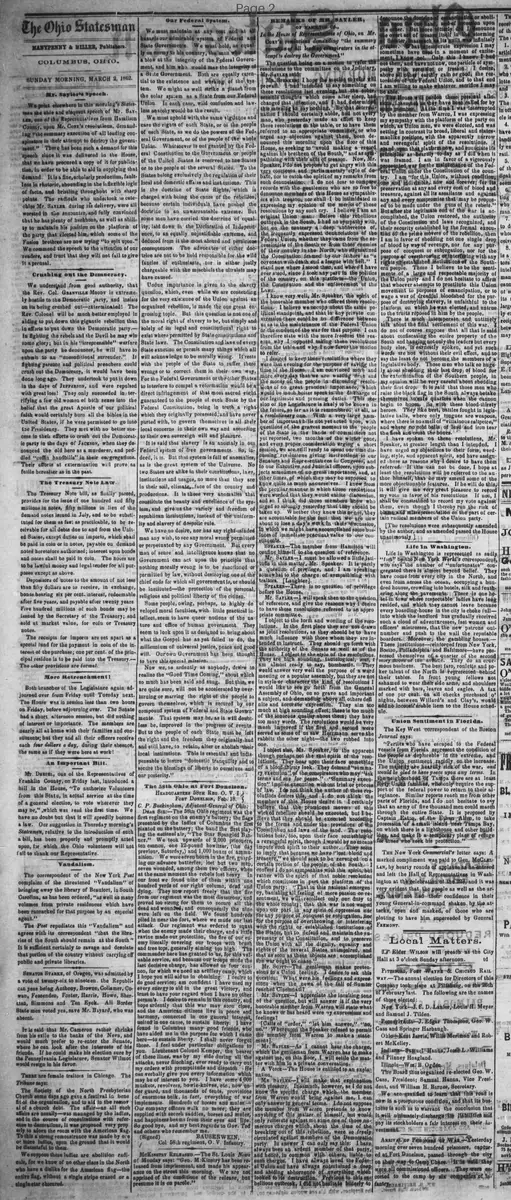
We print elsewhere in this morning's Statesman the able and eloquent speech of Mr. Sayler, one of the Representatives from Hamilton County, upon Mr. Cox's resolutions, demanding "the summary execution of all leading conspirators in their attempt to destroy the government." There has been such a demand for this speech since it was delivered in the House, that we have procured a copy of it for publication, in order to be able to aid in supplying that demand. It is a fine, scholarly production, faultless in rhetoric, abounding in the inflexible logic of facts, and bristling throughout with sharp points. The radicals who undertook to catechize Mr. Sayler during its delivery, were all worsted in the encounter, and fully convinced that he has plenty of backbone, as well as ability to maintain his position on the platform of the party that elected him, which some of the Fusion brethren are now trying "to spit upon."
We commend the speech to the attention of our readers, and trust that they will not fail to give it a perusal.
REMARKS OF MR. SAYLER, OF HAMILTON CO.,
In the House of Representatives of Ohio, on Mr. Cox's resolutions demanding "the summary execution of all leading conspirators in the attempt to destroy the Government."
The question being on a motion to refer the resolutions to the committee on the Judiciary,
Mr. Sayler said:
Mr. Speaker: I hope the motion to refer will prevail. I had intended to say something on these resolutions last evening, but the sober, sensible thoughts which come after sleep, had changed that intention, and I had determined this morning to say nothing. By that determination I should certainly abide, had not every man, who yesterday made an effort to keep these resolutions on the table, or to have them referred to an appropriate committee, or who urged any objection against them, been denounced this morning upon the floor of this House, as seeking to 'avoid making a record against his brethren of the South,' and as sympathizing with their acts of treason. Now, Mr. Speaker, I do not propose to get angry with this very courteous and parliamentary style of debate, nor to catch the spirit of my remarks from such denunciation. I do not fear to compare records with the gentlemen who are so free to denounce members of this House as sympathizers with treason; nor shall I be intimidated in expressing my opinion of the merits of these resolutions by any such cry. I believe I am an original Union man. Before this rebellious outbreak in the South, I had no sympathy with, but on the contrary a deep abhorrence of, the frequently expressed denunciations of the Federal Union, whether they came from the secessionists of the South or from those enemies of their country in the North, who stigmatized the Constitution framed by our fathers as "a covenant with death and a league with hell." I stand now where I stood then, and where I have ever stood, since I took any part in the politics of the country. On this platform—the Union, the Constitution and the enforcement of the Laws.
I know very well, Mr. Speaker, the spirit of the honorable member who offered these resolutions. I believe we occupy about the same political standpoint and that in any private conversation there could be no difference between us as to the maintenance of the Federal Union or the conduct of the war for that purpose. I can therefore state with the more freedom the reasons why I opposed taking these resolutions from the table and why I now favor the motion to refer.
I desired to keep these resolutions where they were last evening for the purpose of saving the time of the House. I am convinced more and more every day that we are wasting time and the money of the people in discussing resolutions of no great practical importance, which would be much better spent in the discharge of our legitimate and pressing duties. This session of the Legislature is likely to be known in the future, so far as it is remembered at all, as a resolutionary one. With a very large number of important bills not yet acted upon, with questions of the gravest moment to the people of the State in the hands of committees not yet reported, two months of the winter gone, and every proper consideration urging a short session, we are still ready to spend our time discussing resolutions giving instructions to our Senators and Representatives in Congress, and to our Executive and Judicial officers, upon subjects sometimes of no great importance, and, at other times, of which they may be supposed to know quite as much as ourselves. I knew from the peculiar manner in which these resolutions were worded that they would excite discussion, and so I think did those members know who urged so strongly yesterday that they should be taken up. Whether they knew this or not, they are accountable for the fact that we are now about to lose a day's work in their discussion, in which we might have accomplished some business of immediate practical value to our constituents.
Speaker—The member from Hamilton will confine himself to the question of reference.
Mr. Sayler— I must be allowed a little latitude in this matter, Mr. Speaker. It is partly a question of privilege, and I am speaking somewhat to the charge of sympathizing with traitors. [Laughter].
Speaker—There is no question of privilege before the House.
Mr. Sayler—I will speak then to the question of reference, and give the reasons why I desire to have these resolutions referred to an appropriate committee.
"I object to the form and wording of the resolutions. In the first place they are not drawn as joint resolutions, as they should be to have much influence with those whom they are intended to instruct. They should go forth with the authority of the Senate as well as of the House. I object to the style of the resolutions. They are high sounding, tautological, and, I am almost ready to say, bombastic. They would answer very well the purpose of a ward meeting or a popular assembly, but they are not in style or character the kind of resolutions I would like to see go forth from the General Assembly of Ohio, on so grave and important a subject, and demanding above all others definite and accurate expression. They aim too much at high sounding effect; there is too much of the sonorous quality about them; they have too many words. The resolutions would be very much improved if the first and second were served as some of us saw Herrmann serve the rabbits the other night—the two rubbed into one.
I object also, Mr. Speaker, to the apparent though perhaps not the real spirit of the resolutions. They bear upon their face something of a blood-thirsty look. They demand "summary execution" of the conspirators who may "ask terms and sue for peace." "Summary execution" implies execution without trial or process of law. I do not think the author of these resolutions desires this, and I do not think the members of this House desire it. I certainly believe that the prominent movers of this wicked rebellion should be executed, but I believe that they should be executed according to the forms and under the provisions of the Constitution and laws of the land. The resolutions bear, too, upon their face something of a revengeful spirit, though I would by no means impute such spirit to their author. They seem to imply that because we have 'lost blood and treasure' we should seek to be revenged on a certain portion of the people of the South. I confess I do not sympathize with this spirit, but rather with the spirit of that noble resolution which constitutes in part the platform of the Union party: "That in this national emergency, banishing all feeling of mere passion or resentment, we will recollect only our duty to the whole country: that this war is not waged upon our part in any spirit of oppression nor for any purpose of conquest or subjugation, nor for the purpose of overthrowing or interfering with the rights or established institutions of the States, but to defend and maintain the supremacy of the Constitution, and to preserve the Union with all the dignity, equality and rights of the several States unimpaired, and that as soon as these objects are accomplished the war ought to cease."
Mr. Scott—The gentleman makes pretensions to a Union feeling. I desire to ask this question: What were his feelings and expressions when the news of the fall of Sumter reached Cincinnati?
Mr. Sayler—I appreciate the insulting tone of the question, but will answer it if the very honorable member from Warren will state what he knows or has heard were my expressions and feelings?
[Calls of "order," "Let him answer," "no, no." Whereupon the Speaker refused to permit the member from Warren to make a statement.]
Mr. Sayler—As I cannot hear the charge, which the gentleman from Warren has to make against me, on this floor, I will settle the matter with him in a private conversation.
A Voice—The House is entitled to an explanation.
Mr. Sayler—I will make that explanation with pleasure. Inasmuch, however, as I do not know the specific charge which the member from Warren would bring against me, I can only answer in general terms. I do not suppose the member from Warren pretends to know anything of this matter of himself, but would only reiterate against me some one of those numerous charges which, about the time of the breaking out of this rebellion, were so freely circulated against members of the Democratic party. In answer I can only say this: I have always been an ardent member of that party, and hence, in common with others, liable to such charges. I have always loved the Federal Union and have always entertained a deep and abiding abhorrence of everything which looked to its destruction. Previous to this rebellious outbreak, I did not hesitate bitterly to denounce the doctrine of secession upon the one hand; and the doctrine of abolition or fanaticism upon the other. But more bitterly, did I denounce the overt act of treason itself in the storming of Sumter, inasmuch as its guilt was infinitely greater. Whatever intemperate expression I may sometime have used in a moment of excitement, I know as certainly then as I know now, I had not, and have not now, one particle of sympathy with secession, or "treason." (I desire, above all other things, the restoration of the Federal Union, and to that end I am willing to make whatever sacrifice I may be called upon to make.
The House was interrupted by the member from Warren, I was expressing my sympathy with the platform of the party on which we were elected, and was setting in contrast its broad, liberal and statesmanlike positions, with the apparently narrow and revengeful spirit of the resolutions, upon that platform I now, and enunciate its principles as heartily to-day as I did when it was framed. I am in favor of a vigorously conducted war for the maintenance of the Federal Union under the Constitution of the country. I am "for this Union, without condition; one and indivisible, now and forever; for its preservation at any and every cost of blood and treasure, against all its assailants and against any and every compromise that may be proposed to be made under the guns of the rebel." But after the legitimate end of the war is accomplished, the Union restored, the authority of the Constitution and laws recognized, and their security established by the formal submission of the prime movers of the rebellion, then I am in favor of shedding not one single drop of blood by way of revenge, nor for any purpose of conquest or subjugation, nor for "the purpose of overthrowing or interfering with any rightful established institutions of the Southern people."
These I believe to be the sentiments of a large and respectable majority of the Union party, and I do not hesitate to affirm that whoever attempts to prostitute this Union movement to purposes of emancipation, or to wage a war of dreadful bloodshed for the purpose of destroying slavery, is unfaithful to the platform on which he was elected, and untrue to the trusts reposed in him by the people.
There is much intemperate and untimely talk about the final settlement of this war. I do not of course suppose that all that is said about confiscating the entire property of the South and hanging not only the leaders but everybody else, is earnestly spoken, and yet such words are not without their evil effect, and to say the least do not become the members of a legislative body. Those men who talk so hugely about shedding their last drop of blood for the extermination of the Southern people, in my opinion will be very careful about shedding their first drop. It is said that those men who raise the black flag in the South always betake themselves to safe quarters when the cannon begin to boom. So with these blood-thirsty heroes. They like best, battles fought in legislative halls, where only tongues are weapons, where there is no smell of "villainous saltpetre," and where no cold balls of lead and iron tear the flesh and crush the bones.
I have spoken on these resolutions, Mr. Speaker, at greater length than I intended. I have urged my objections to their form, wording, style, and apparent spirit, and have assigned these as reasons why I desire to have them referred. If this can not be done, I hope at least the resolutions will be referred to the author himself, that he may amend some of the more objectionable features. If he will do this, it will give me very great pleasure to record my vote in favor of his resolutions. If not, I shall be constrained to record my vote against them, even though I thereby run the risk of blame and misrepresentation on the part of certain radical members of the Union party.
[The resolutions were subsequently amended by the author, and as amended passed the House unanimously.]
What sub-type of article is it?
What themes does it cover?
What keywords are associated?
What entities or persons were involved?
Where did it happen?
Story Details
Key Persons
Location
House Of Representatives Of Ohio
Story Details
Mr. Sayler delivers a speech opposing the immediate consideration of Mr. Cox's resolutions demanding summary execution of leading conspirators against the government. He argues for referral to committee, criticizes the resolutions' wording and vengeful tone, affirms his Union loyalty, and supports war for Union preservation without revenge or emancipation motives. The resolutions are later amended and pass unanimously.