Thank you for visiting SNEWPapers!
Sign up free
The Wheeling Daily Register
Wheeling, Ohio County, West Virginia
What is this article about?
An article from the Chicago Evening Post contrasts the rarity of women performing farm labor in the East with its commonality in the West, where thousands of women from various backgrounds work in fields during harvest, earning more than domestic wages and performing skilled tasks like reaping and shearing.
Clipping
OCR Quality
Full Text
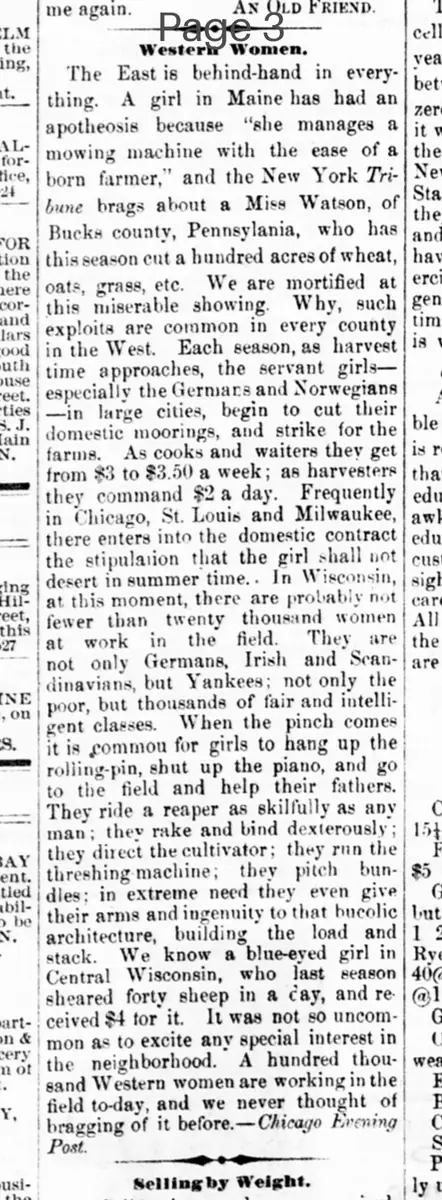
The East is behind-hand in everything. A girl in Maine has had an apotheosis because "she manages a mowing machine with the ease of a born farmer," and the New York Tribune brags about a Miss Watson, of Bucks county, Pennsylvania, who has this season cut a hundred acres of wheat, oats, grass, etc. We are mortified at this miserable showing. Why, such exploits are common in every county in the West. Each season, as harvest time approaches, the servant girls— especially the Germans and Norwegians -in large cities, begin to cut their domestic moorings, and strike for the farms. As cooks and waiters they get from $3 to $3.50 a week; as harvesters they command $2 a day. Frequently in Chicago, St. Louis and Milwaukee, there enters into the domestic contract the stipulation that the girl shall not desert in summer time. In Wisconsin, at this moment, there are probably not fewer than twenty thousand women at work in the field. They are not only Germans, Irish and Scandinavians, but Yankees; not only the poor, but thousands of fair and intelligent classes. When the pinch comes it is common for girls to hang up the rolling-pin, shut up the piano, and go to the field and help their fathers. They ride a reaper as skilfully as any man; they rake and bind dexterously: they direct the cultivator; they run the threshing machine; they pitch bundles: in extreme need they even give their arms and ingenuity to that bucolic architecture, building the load and stack. We know a blue-eyed girl in Central Wisconsin, who last season sheared forty sheep in a day, and received $4 for it. It was not so uncommon as to excite any special interest in the neighborhood. A hundred thousand Western women are working in the field to-day, and we never thought of bragging of it before. Chicago Evening Post.
What sub-type of article is it?
What themes does it cover?
What keywords are associated?
What entities or persons were involved?
Where did it happen?
Story Details
Key Persons
Location
Western United States, Wisconsin, Chicago, St. Louis, Milwaukee
Event Date
Harvest Season
Story Details
The article highlights the commonplace nature of Western women engaging in skilled farm labor during harvest, contrasting it with Eastern admiration for similar feats, noting thousands of women from diverse backgrounds earning higher wages in fields than in domestic service.