Thank you for visiting SNEWPapers!
Sign up free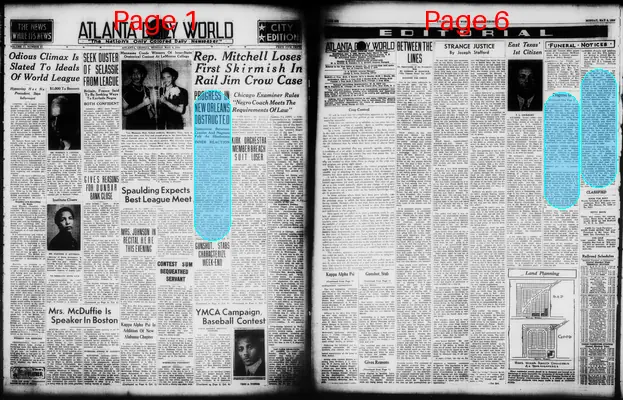
Atlanta Daily World
Atlanta, Fulton County, Georgia
What is this article about?
In New Orleans, a traditional division between Creoles and Negroes, rooted in post-Civil War social standards, undermines racial solidarity, political influence, and economic benefits for the 160,000 Black population, preventing unified action against white dominance.
Merged-components note: Continuation of Progress in New Orleans story from page 1 to page 6.
Clippings
1 of 2
OCR Quality
Full Text
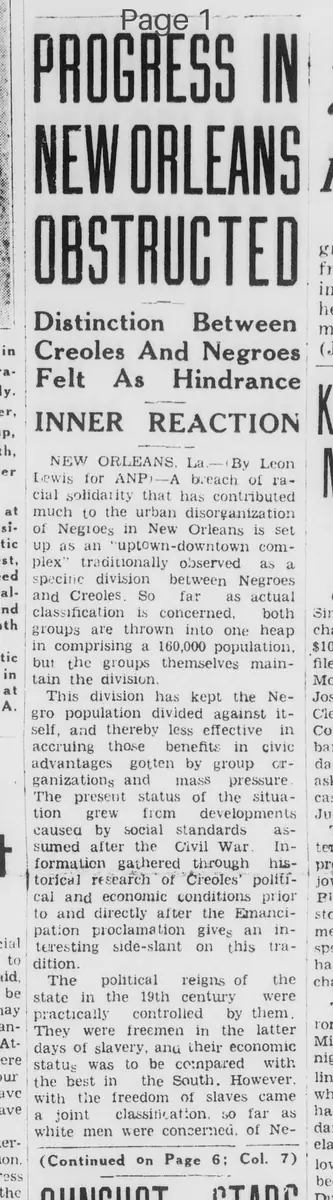
Distinction Between Creoles And Negroes Felt As Hindrance
INNER REACTION
NEW ORLEANS, La.—By Leon Lewis for ANP)—A breach of racial solidarity that has contributed much to the urban disorganization of Negroes in New Orleans is set up as an 'uptown-downtown complex' traditionally observed as a specific division between Negroes and Creoles. So far as actual classification is concerned, both groups are thrown into one heap in comprising a 160,000 population, but the groups themselves maintain the division.
This division has kept the Negro population divided against itself, and thereby less effective in accruing those benefits in civic advantages gotten by group organizations and mass pressure.
The present status of the situation grew from developments caused by social standards assumed after the Civil War.
Information gathered through historical research of Creoles' political and economic conditions prior to and directly after the Emancipation proclamation gives an interesting side-slant on this tradition.
The political reigns of the state in the 19th century were practically controlled by them. They were freemen in the latter days of slavery, and their economic status was to be compared with the best in the South. However, with the freedom of slaves came a joint classification, so far as white men were concerned, of Negroes and Creoles. Creole owners of plantations, officials of city and state governments, became classified as Negroes. The Creoles themselves felt this a travesty upon their social complex, and refuted the idea of being forced into the classification of Negroes.
The white man, on seeing this, took advantage of the situation in getting the political power that he has today, by agitating the claims of this "mid-element" that was neither white nor Negro. He could see a chance there to gain power economically and politically by keeping these two factors at daggers-points toward each other.
A superiority complex developed in the Creoles against Negroes that caused them to lose their power and influence in political and economic circles, by refusing to accept the Negroes' support.
The Negroes, on the other hand, because of this bigotry of the Creoles, chose to support the white man instead of his half-brother. Out of this grew the present "lily-white" executive, legislative, and judicial governmental set-up. 'Tis a fascinating perspective to know the tendency of those of the first generation to hold on to the tradition and do all they can to check those of the third generation from crossing the line which is figuratively set up as Canal street, dividing the up-town and downtown section.
Within these respective areas, there are clubs and various organizations doing the same type of work, to attain the same results and yet no cooperative offer is seen in their activity. In some cases, the line has been crossed, and marriages have resulted. 'Tis peculiarly strange that resulting from this, families and blood-kin do not associate in any degree because of the differences developed between the two groups; that although the lines are definitely drawn, the two groups are forced into the same social strata but are not related economically because of the assumed differences existing between them which is not determined by color.
Invasions of Negroes into the downtown area and Creoles into the uptown area have failed to eliminate the old traditional stand, and the cry is still heard in both circles, "Downtown is downtown, uptown is uptown, and never the twain shall meet," but until 160,000 persons with a combined economic status of hundreds of thousands of dollars per week and a voting population comprising one-third of the city's total unite, they will be kept below the status of any other Southern city. To date, no force has been able to correlate the powers of each group into a working mass for their own benefits.
What sub-type of article is it?
What keywords are associated?
Where did it happen?
Domestic News Details
Primary Location
New Orleans, La.
Outcome
divisions lead to loss of political and economic power, resulting in a 'lily-white' government and hindered civic benefits for the black population.
Event Details
A traditional 'uptown-downtown complex' divides Creoles and Negroes in New Orleans, stemming from post-Civil War classifications that lumped free Creoles with freed slaves, causing internal conflict exploited by whites to maintain dominance. This prevents unified action despite shared population and economic potential.