Thank you for visiting SNEWPapers!
Sign up free
The Camden Journal
Camden, Kershaw County, South Carolina
What is this article about?
In the U.S. Senate on June 21 in Washington, Mr. Clay introduced a report favoring a new Bank of the United States modeled on the previous one, rejecting aspects of Secretary Ewing's plan. Mr. Calhoun critiqued the Treasury report, exposing its flaws. Debate ensued with Messrs. Clay, Woodbury, and Buchanan, leading to the report's printing.
Clipping
OCR Quality
Full Text
WASHINGTON, June 21.
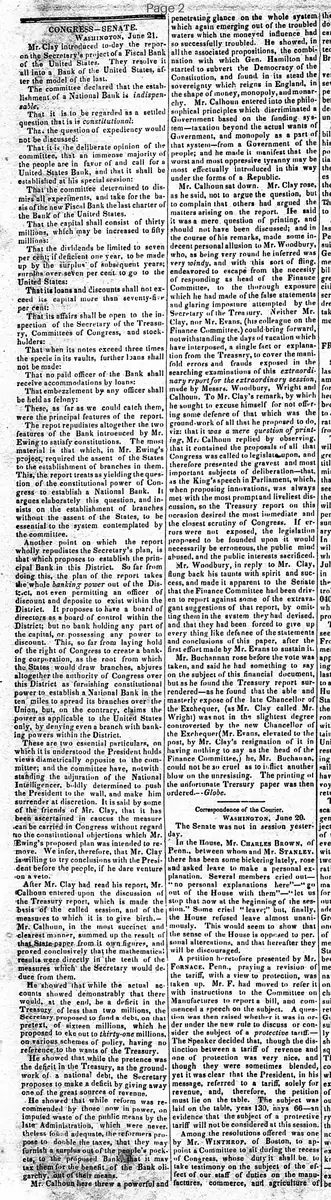
Mr. Clay introduced to-day the report on the Secretary's project of a Fiscal Bank of the United States. They resolve it all into a Bank of the United States, after the model of the last. The committee declared that the establishment of a National Bank is indispensable, that it is to be regarded as a settled question that it is constitutional; that the question of expediency would not be discussed; that it is the deliberate opinion of the committee, that an immense majority of the people are in favor of and call for a United States Bank, and that it shall be established at this special session; that the committee determined to dismiss all experiments, and take for the basis of the new Fiscal Bank the last charter of the Bank of the United States. That the capital shall consist of thirty millions, which may be increased to fifty millions; that the dividends be limited to seven per cent; if deficient one year, to be made up by the surplus of subsequent years; profits over seven per cent. to go to the United States; that its loans and discounts shall not exceed its capital more than seventy-five per cent; that its affairs shall be open to the inspection of the Secretary of the Treasury, Committees of Congress, and stockholders; that when its notes exceed three times the specie in its vaults, further loans shall not be made; that no paid officer of the Bank shall receive accommodations by loans; that embezzlement by any officer shall be held as felony. These, as far as we could catch them, were the principal features of the report. The report repudiates altogether the two features of the Bank introduced by Mr. Ewing to satisfy constitutionalists. The most material is that which, in Mr. Ewing's project, required the assent of the States to the establishment of branches in them. This, the report treats as yielding the question of the constitutional power of Congress to establish a National Bank. It argues elaborately this question, and insists on the establishment of branches without the assent of the States, to be essential to the system contemplated by the committee. Another point on which the report wholly repudiates the Secretary's plan, is that which proposes to establish the principal Bank in this District. So far from doing this, the plan of the report takes the whole banking power out of the District, not even permitting an officer of discount and deposit to exist within the District. It proposes to have a board of directors as a board of control within the District; but no bank holding any part of the capital, or possessing any power to discount. This, so far from laying hold of the right of Congress to create a banking corporation, as the root from which the States would draw branches, abjures altogether the authority of Congress over this District as furnishing constitutional power to establish a National Bank in the ten miles to spread its branches over the Union, but, on the contrary, claims the power as applicable to the United States only, by denying even a branch with banking powers within the District. These are two essential particulars, on which it is understood the President holds views diametrically opposite to the committee; and the committee have, notwithstanding the adjuration of the National Intelligencer, boldly determined to push the President to the wall, and make him surrender at discretion. It is said by some of the friends of Mr. Clay, that it has been ascertained in caucus the measure can be carried in Congress without regard to the constitutional objections which Mr. Ewing's proposed plan was intended to remove. We infer, therefore, that Mr. Clay is willing to try conclusions with the President before the people, if he dare venture on a veto. After Mr. Clay had read his report, Mr. Calhoun entered upon the discussion of the Treasury report, which is made the basis of the called session, and of the measures to which it is to give birth. Mr. Calhoun, in the most succinct and clearest manner, summed up the result of that State paper. From it only figures, and proved conclusively that the mathematical results were directly in the teeth of the measures which the Secretary would deduce from them. He showed that while the actual accounts showed demonstrably that there would, at the end, be a deficit in the Treasury of less than two millions, the Secretary proposed to fund a debt, on that pretext, of sixteen millions, which he proposed to eke out to thirty-one millions, on various schemes of policy, having no reference to the wants of the Treasury. He showed that while the pretence was the deficit in the Treasury, as the groundwork of a national debt, the Secretary proposes to make a deficit by giving away one of the great sources of revenue. He showed that while reform was recommended by those now in power, on imputed waste of the public means by the late Administration, which were nevertheless found adequate, the reformers propose to double the taxes, that they may furnish a surplus out of the people's pockets, to the proposed Bank, that it may tax them for the benefit of the Bank oligarchy, out of their means. Mr. Calhoun here threw a powerful and penetrating glance on the whole system which again emerging out of the troubled waters which the monied influence had so successfully troubled. He showed, in all the associated propositions, the combination with which Gen. Hamilton had started to subvert the Democracy of the Constitution, and found in its stead the sovereignty which reigns in England, in the shape of money, monopoly, and monarchy. Mr. Calhoun entered into the philosophical principles which discriminated a Government based on the funding system—taxation beyond the actual wants of Government, and monopoly as a part of that system—from a Government of the people; and he made it manifest that the worst and most oppressive tyranny may be most effectually introduced in this way under the forms of a Republic. Mr. Calhoun sat down. Mr. Clay rose, as he said, not to argue the question, but to complain that others had argued the matters arising on the report. He said it was a mere question of printing, and should not have been discussed; and in the course of his remarks, made some indecent personal allusion to Mr. Woodbury, who, as being very round he inferred was very wordy, and with this sort of fling endeavored to escape from the necessity of responding as head of the Finance Committee, to the thorough exposure which he had made of the false statements and glaring imposture attempted by the Secretary of the Treasury. Neither Mr. Clay, nor Mr. Evans, (his colleague on the Finance Committee,) could bring forward, notwithstanding the days of vacation which have interposed, a single fact or explanation from the Treasury, to cover the manifold errors and frauds exposed in the searching examinations of this extraordinary report for the extraordinary session, made by Messrs. Woodbury, Wright and Calhoun. To Mr. Clay's remark, by which he sought to excuse himself for not offering some defence of that which was the groundwork of all that he proposed to do, viz: that it was a mere question of printing, Mr. Calhoun replied by observing, that it contained the proposals of all that Congress was called to legislate upon, and therefore presented the gravest and most important subjects of deliberation—that as the King's speech in Parliament, which, when proposing innovations, was always met with the most prompt and liveliest discussion, so the Treasury report on this occasion desired the most immediate and the closest scrutiny of Congress. If errors were not exposed, the legislation proposed to be founded upon it would necessarily be erroneous, the public mind abused, and the public interests sacrificed. Mr. Woodbury, in reply to Mr. Clay, flung back his taunts with spirit and success, and made it apparent to the Senate that the Finance Committee had been driven to report against some of the extravagant suggestions of that report, by omitting them in the system they had devised, and that they had been forced to give up everything like defence of the statements and conclusions of this paper, after the first effort made by Mr. Evans to sustain it. Mr. Buchanan rose before the vote was taken, and said he had something to say on the subject of this financial document, but as he found the Treasury report surrendered—as he found that the able and masterly exposé of the late Chancellor of the Exchequer, (as Mr. Clay called Mr. Wright) was not in the slightest degree controverted by the new Chancellor of the Exchequer (Mr. Evans, elevated to the post, by Mr. Clay's resignation of it in having nothing to say as the head of the Finance Committee,) he, Mr. Buchanan, could not be so cruel as to inflict another blow on the unresisting. The printing of the unfortunate Treasury paper was then ordered.—Globe.
What sub-type of article is it?
What keywords are associated?
What entities or persons were involved?
Where did it happen?
Domestic News Details
Primary Location
Washington
Event Date
June 21
Key Persons
Outcome
the report on the fiscal bank was introduced and discussed; the treasury report was critiqued and ordered printed without defense from its supporters.
Event Details
Mr. Clay introduced a Senate committee report advocating a new Bank of the United States with specific features like $30-50 million capital, 7% dividend limit, and inspections. It rejected Secretary Ewing's constitutional concessions and placement in the District. Mr. Calhoun criticized the Treasury report for false deficits and proposed funding. Debate involved complaints, personal allusions, and exposés by Messrs. Woodbury and Buchanan.