Thank you for visiting SNEWPapers!
Sign up free
Morning Herald
New York, New York County, New York
What is this article about?
In 1837, correspondent Moliere visits Dolley Madison in Washington, D.C., describing her gracious reception, reflections on societal changes over 20 years, political shifts, and the influx of foreign attaches preferred in high society over American citizens.
Merged-components note: Continuation of the same letter from Washington correspondent, with sequential reading order and coherent narrative flow.
Clipping
OCR Quality
Full Text
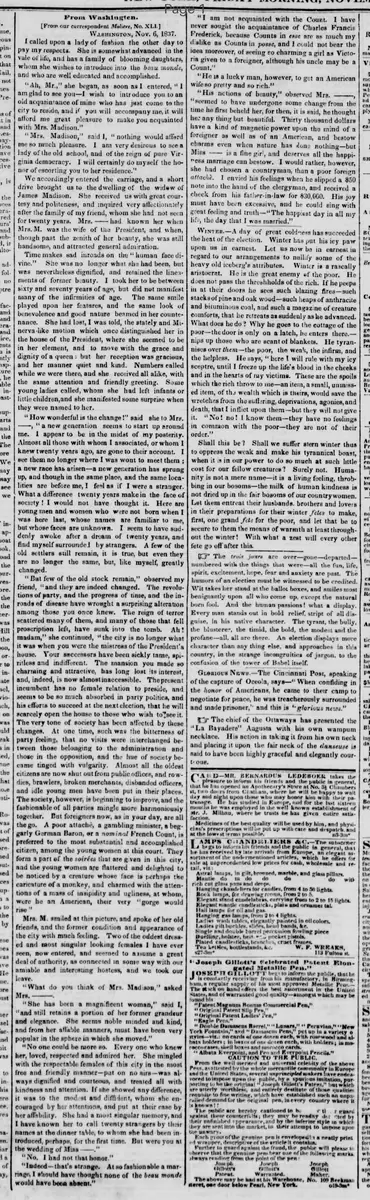
[From our correspondent Moliere, No. XLII.]
Washington, Nov. 6, 1837.
I called upon a lady of fashion the other day to pay my respects. She is somewhat advanced in the vale of life, and has a family of blooming daughters, whom she wishes to introduce into the beau monde, and who are well educated and accomplished.
"Ah, Mr.," she began, as soon as I entered, "I am glad to see you—I wish to introduce you to an old acquaintance of mine who has just come to the city to reside, and if you will accompany me, it will afford me great pleasure to make you acquainted with Mrs. Madison."
"Mrs. Madison," said I, "nothing would afford me so much pleasure. I am very desirous to see a lady of the old school, and of the reign of pure Virginia democracy. I will certainly do myself the honor of escorting you to her residence."
We accordingly entered the carriage, and a short drive brought us to the dwelling of the widow of James Madison. She received us with great courtesy and politeness, and inquired very affectionately after the family of my friend, whom she had not seen for twenty years. Mrs. -- had known her when Mrs. M. was the wife of the President, and when, though past the zenith of her beauty, she was still handsome, and attracted general admiration.
Time makes sad inroads on the "human face divine." She was no longer what she had been, but was nevertheless dignified, and retained the lineaments of former beauty. I took her to be between sixty and seventy years of age, but did not manifest many of the infirmities of age. The same smile played upon her features, and the same look of benevolence and good nature beamed in her countenance. She had lost, I was told, the stately and Minerva-like motion which once distinguished her in the house of the President, where she seemed to be in her element, and to move with the grace and dignity of a queen; but her reception was gracious, and her manner quiet and kind. Numbers called while we were there, and she received all alike, with the same attention and friendly greeting. Some young ladies called, whom she had left infants or little children, and she manifested some surprise when they were named to her.
"How wonderful is the change!" said she to Mrs. "a new generation seems to start up around me. I appear to be in the midst of my posterity. Almost all those with whom I associated, or whom I knew twenty years ago, are gone to their account. I see them no longer where I was wont to meet them; a new race has arisen—a new generation has sprung up, and though in the same place, and the same localities are before me, I feel as if I were a stranger. What a difference twenty years make in the face of society! I would not have thought it. Here are young men and women who were not born when I was here last, whose names are familiar to me, but whose faces are unknown. I seem to have suddenly awoke after a dream of twenty years, and find myself surrounded by strangers. A few of the old settlers still remain, it is true, but even they are no longer the same, but, like myself, greatly changed."
"But few of the old stock remain," observed my friend, "and they are indeed changed. The revolutions of party, and the progress of time, and the inroads of disease have wrought a surprising alteration among those you once knew. The reign of terror scattered many of them, and many of those that fell proscription left, have sunk into the tomb. Ah! madam," she continued, "the city is no longer what it was when you were the mistress of the President's house. Your successors have been sickly tame, spiritless and indifferent. The mansion you made so charming and attractive, has long lost its interest, and, indeed, is now almost inaccessible. The present incumbent has no female relation to preside, and seems to be so much absorbed in party politics, and his efforts to succeed at the next election, that he will scarcely open the house to those who wish to see it. The very tone of society has been affected by these changes. At one time, such was the bitterness of party feeling, that no visits were interchanged between those belonging to the administration and those in the opposition, and the hue of society became tinged with vulgarity. Almost all the oldest citizens are now shut out from public offices, and rowdies, brawlers, broken merchants, disbanded officers, and idle young men have been put in their places. The society, however, is beginning to improve, and the fashionable of all parties mingle more harmoniously together. But foreigners now, as in your day, are all the go. A poor attache, a gambling minister, a beggarly German Baron, or a nominal French Count, is preferred to the most substantial and accomplished citizen, among the young women at this court. They form a part of the soirees that are given in this city, and the young women are flattered and delighted to be noticed by a creature whose face is perhaps the caricature of a monkey, and charmed with the attentions of a mass of insipidity and ugliness, at whom, were he an American, their very "gorge would rise".
Mrs. M. smiled at this picture, and spoke of her old friends, and the former condition and appearance of the city with much feeling. Two of the oddest dressed and most singular looking females I have ever seen, now entered, and seemed to assume a great deal of authority, as connected in some way with our amiable and interesting hostess, and we took our leave.
"What do you think of Mrs. Madison," asked Mrs.
"She has been a magnificent woman," said I, "and still retains a portion of her former grandeur and elegance. She seems noble minded and kind, and from her affable manners, must have been very popular in the sphere in which she moved."
"No one could be more so. Every one who knew her, loved, respected and admired her. She mingled with the respectable females of this city in the most free and friendly manner—put on no airs—was always dignified and courteous, and treated all with kindness and attention. If she showed any difference, it was to the modest and diffident, whom she encouraged by her attentions, and put at their ease by her affability. She had a most singular memory, and I have known her to call twenty strangers by their names at the dinner table, to whom she had been introduced, perhaps, for the first time. But were you at the wedding of Miss—?
"No. I had not that honor."
"Indeed—that's strange. At so fashionable a marriage, I should have thought none of the beau monde would have been absent."
"I am not acquainted with the Count. I have never sought the acquaintance of Charles Francis Frederick, because Counts in esse are as much my dislike as Counts in posse, and I could not bear the idea moreover, of seeing so charming a girl as Victoria given to a foreigner, although his uncle may be a Count."
"He is a lucky man, however, to get an American wife so pretty and so rich."
"His notions of beauty," observed Mrs. "seemed to have undergone some change from the time he first beheld her, for then, it is said, he thought her any thing but beautiful. Thirty thousand dollars have a kind of magnetic power upon the mind of a foreigner as well as of an American, and bestow charms even when nature has done nothing—but Miss -- is a fine girl, and deserves all the happiness marriage can bestow. I would rather, however, she had chosen a countryman, than a poor foreign attache. I envied his feelings when he slipped a $50 note into the hand of the clergyman, and received a check from his father-in-law for $30,000. His joy must have been excessive, and he could sing with great feeling and truth—'The happiest day in all my life, the day that I was married.'"
What sub-type of article is it?
What themes does it cover?
What keywords are associated?
What entities or persons were involved?
Letter to Editor Details
Author
Moliere, No. Xlii
Main Argument
the letter narrates a visit to dolley madison, highlighting her enduring grace amid profound societal and political changes in washington over two decades, including party bitterness, decline in social standards, and preference for foreign elites.
Notable Details