Thank you for visiting SNEWPapers!
Sign up free
Literary
September 4, 1874
Staunton Vindicator
Staunton, Virginia
What is this article about?
Account of the 1822 exhumation and cremation of Percy Bysshe Shelley's drowned body on an Italian beach by poets Byron, Leigh Hunt, and Trelawny, following ancient rites. Trelawny's vivid description details the ceremony, preservation of Shelley's heart, and youthful ages of participants.
Clipping
OCR Quality
95%
Excellent
Full Text
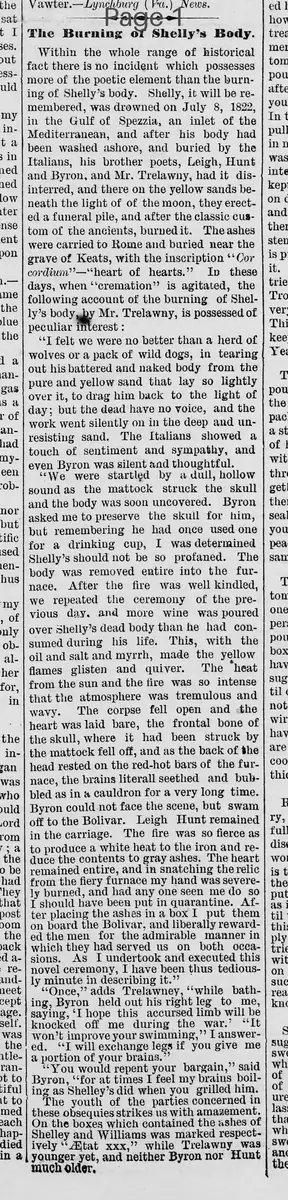
The Burning of Shelly's Body.
Within the whole range of historical fact there is no incident which possesses more of the poetic element than the burning of Shelly's body. Shelly, it will be remembered, was drowned on July 8, 1822, in the Gulf of Spezzia, an inlet of the Mediterranean, and after his body had been washed ashore, and buried by the Italians, his brother poets, Leigh, Hunt and Byron, and Mr. Trelawny, had it disinterred, and there on the yellow sands beneath the light of the moon, they erected a funeral pile, and after the classic custom of the ancients, burned it. The ashes were carried to Rome and buried near the grave of Keats, with the inscription "Cor cordium""heart of hearts." In these days, when "cremation" is agitated, the following account of the burning of Shelly's body, by Mr. Trelawny, is possessed of peculiar interest:
"I felt we were no better than a herd of wolves or a pack of wild dogs, in tearing out his battered and naked body from the pure and yellow sand that lay so lightly over it, to drag him back to the light of day; but the dead have no voice, and the work went silently on in the deep and unresisting sand. The Italians showed a touch of sentiment and sympathy, and even Byron was silent and thoughtful.
We were startled by a dull, hollow sound as the mattock struck the skull and the body was soon uncovered. Byron asked me to preserve the skull for him, but remembering he had once used one for a drinking cup, I was determined Shelly's should not be so profaned. The body was removed entire into the furnace. After the fire was well kindled, we repeated the ceremony of the previous day. and more wine was poured over Shelly's dead body than he had consumed during his life. This, with the oil and salt and myrrh, made the yellow flames glisten and quiver. The heat from the sun and the fire was so intense that the atmosphere was tremulous and wavy.
The corpse fell open and the heart was laid bare, the frontal bone of the skull, where it had been struck by the mattock fell off, and as the back of the head rested on the red-hot bars of the furnace, the brains literally seethed and bubbled as in a cauldron for a very long time.
Byron could not face the scene, but swam off to the Bolivar. Leigh Hunt remained in the carriage. The fire was so fierce as to produce a white heat to the iron and reduce the contents to gray ashes. The heart remained entire, and in snatching the relic from the fiery furnace my hand was severely burned, and had any one seen me do so I should have been put in quarantine. After placing the ashes in a box I put them on board the Bolivar, and liberally rewarded the men for the admirable manner in which they had served us on both occasions. As I undertook and executed this novel ceremony, I have been thus tediously minute in describing it."
"Once," adds Trelawney, "while bathing, Byron held out his right leg to me, saying, 'I hope this accursed limb will be knocked off me during the war.' "It won't improve your swimming," I answered. "I will exchange legs if you give me a portion of your brains.
"You would repent your bargain," said Byron, "for at times I feel my brains boiling as Shelly's did when you grilled him."
The youth of the parties concerned in these obsequies strikes us with amazement. On the boxes which contained the ashes of Shelley and Williams was marked respectively "AEtat xxx." while Trelawny was younger yet, and neither Byron nor Hunt much older.
Within the whole range of historical fact there is no incident which possesses more of the poetic element than the burning of Shelly's body. Shelly, it will be remembered, was drowned on July 8, 1822, in the Gulf of Spezzia, an inlet of the Mediterranean, and after his body had been washed ashore, and buried by the Italians, his brother poets, Leigh, Hunt and Byron, and Mr. Trelawny, had it disinterred, and there on the yellow sands beneath the light of the moon, they erected a funeral pile, and after the classic custom of the ancients, burned it. The ashes were carried to Rome and buried near the grave of Keats, with the inscription "Cor cordium""heart of hearts." In these days, when "cremation" is agitated, the following account of the burning of Shelly's body, by Mr. Trelawny, is possessed of peculiar interest:
"I felt we were no better than a herd of wolves or a pack of wild dogs, in tearing out his battered and naked body from the pure and yellow sand that lay so lightly over it, to drag him back to the light of day; but the dead have no voice, and the work went silently on in the deep and unresisting sand. The Italians showed a touch of sentiment and sympathy, and even Byron was silent and thoughtful.
We were startled by a dull, hollow sound as the mattock struck the skull and the body was soon uncovered. Byron asked me to preserve the skull for him, but remembering he had once used one for a drinking cup, I was determined Shelly's should not be so profaned. The body was removed entire into the furnace. After the fire was well kindled, we repeated the ceremony of the previous day. and more wine was poured over Shelly's dead body than he had consumed during his life. This, with the oil and salt and myrrh, made the yellow flames glisten and quiver. The heat from the sun and the fire was so intense that the atmosphere was tremulous and wavy.
The corpse fell open and the heart was laid bare, the frontal bone of the skull, where it had been struck by the mattock fell off, and as the back of the head rested on the red-hot bars of the furnace, the brains literally seethed and bubbled as in a cauldron for a very long time.
Byron could not face the scene, but swam off to the Bolivar. Leigh Hunt remained in the carriage. The fire was so fierce as to produce a white heat to the iron and reduce the contents to gray ashes. The heart remained entire, and in snatching the relic from the fiery furnace my hand was severely burned, and had any one seen me do so I should have been put in quarantine. After placing the ashes in a box I put them on board the Bolivar, and liberally rewarded the men for the admirable manner in which they had served us on both occasions. As I undertook and executed this novel ceremony, I have been thus tediously minute in describing it."
"Once," adds Trelawney, "while bathing, Byron held out his right leg to me, saying, 'I hope this accursed limb will be knocked off me during the war.' "It won't improve your swimming," I answered. "I will exchange legs if you give me a portion of your brains.
"You would repent your bargain," said Byron, "for at times I feel my brains boiling as Shelly's did when you grilled him."
The youth of the parties concerned in these obsequies strikes us with amazement. On the boxes which contained the ashes of Shelley and Williams was marked respectively "AEtat xxx." while Trelawny was younger yet, and neither Byron nor Hunt much older.
What sub-type of article is it?
Essay
What themes does it cover?
Death Mortality
What keywords are associated?
Shelley Cremation
Trelawny Account
Byron Hunt
Gulf Of Spezzia
Poetic Obsequies
What entities or persons were involved?
Mr. Trelawny
Literary Details
Title
The Burning Of Shelly's Body.
Author
Mr. Trelawny
Subject
Cremation Of Shelley's Body
Form / Style
Prose Narrative Account
Key Lines
I Felt We Were No Better Than A Herd Of Wolves Or A Pack Of Wild Dogs, In Tearing Out His Battered And Naked Body From The Pure And Yellow Sand That Lay So Lightly Over It, To Drag Him Back To The Light Of Day;
The Heart Remained Entire, And In Snatching The Relic From The Fiery Furnace My Hand Was Severely Burned,
The Youth Of The Parties Concerned In These Obsequies Strikes Us With Amazement.