Thank you for visiting SNEWPapers!
Sign up free
New Orleans Republican
New Orleans, Orleans County, Louisiana
What is this article about?
The 1871 Report of the Commissioner of Agriculture, to be distributed in late August 1872, details reduced U.S. crop production compared to 1870, especially corn, with state-by-state statistics on cereals, livestock, wool, farm lands, plant diseases, fruit growing, jute cultivation, dairies, irrigation, industrial colleges, and more, highlighting agricultural progress and challenges.
Merged-components note: Continuation of the same article on the report of the Commissioner of Agriculture; text flows directly from the end of the first component to the start of the second.
Clipping
OCR Quality
Full Text
OFFICIAL JOURNAL OF THE UNITED STATES,
OFFICIAL JOURNAL OF NEW ORLEANS
Report of the Commissioner
of
Washington, August 6, 1872.
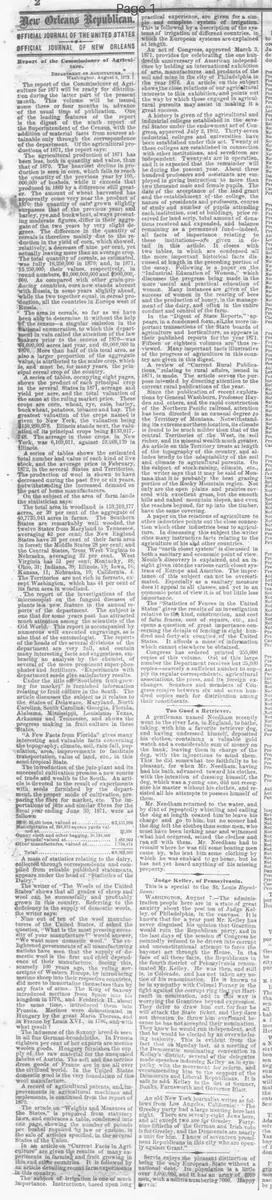
The report of the Commissioner of Agriculture for 1871 will be ready for distribution during the latter part of the present month. This volume will be issued some three or four months in advance of the usual time of publication. One of the leading features of the report is the digest of the ninth report of the Superintendent of the Census, with the addition of material facts from sources attainable only through the correspondence of the department. Of the agricultural productions of 1871, the report says:
The agricultural production of 1871 has been less, both in quantity and value, than that of 1870. The heaviest decline in production is seen in corn, which fails to reach the quantity of the previous year by 100,000,000 of bushels, while it exceeds that produced in 1869 by a difference still greater. The amount of wheat harvested has apparently come very near the product of 1870: the quantity of oats grown slightly surpasses that of the previous year; and barley, rye and buckwheat, always presenting moderate figures, differ in their aggregates. The difference in the quantity of cereals is therefore mainly due to the reduction in the yield of corn, which showed, relatively, a decrease of nine per cent, yet actually leaving more than an average crop. The total quantity of cereals, as estimated, was fully 1,625,000,000 in 1870; and, in 1871, 1,525,000,000; their values, respectively, in round numbers, $1,000,000,000 and $900,000,000. As compared with other grain-producing countries, ours now stands abreast with Russia, in some years slightly ahead, while the two together equal, in cereal production, all the countries in Europe west of Russia.
The area in cereals, so far as we have been able to determine it without the help of the census—a singular omission in the national enumeration, to which this department in vain called the attention of the law makers prior to the census of 1870—was 54,000,000 acres last year, and 69,000,000 in 1870. More than half of this total area, as also a larger proportion of the aggregate value, is attributed to the maize crop, which is, and must be, for many years, the principal cereal crop of the country.
A series of tables, occupying eight pages, shows the product of each principal crop in the several States in 1871, acreage and yield per acre, and the total valuation of the same at the ruling market price. These crops are corn, wheat, rye, oats, barley, buckwheat, potatoes, tobacco and hay. The greatest valuation of the crops named is given to New York, the valuation being $150,290,578. Illinois stands next, the valuation of its principal crops being $133,017,748. The acreage in these crops, in New York, was 6,169,011, against 10,268,139 in Illinois.
A series of tables shows the estimated total number and value of each kind of live stock, and the average price in February, 1872, in the several States and Territories. The production of wool is shown to have decreased during the past five or six years, notwithstanding the increased demand on the part of home manufacturers.
On the subject of the area of farm lands the statistician says:
The total area in woodland is 159,310,177 acres, or 39 per cent of the aggregate of 407,735,041 acres in farms. The Southern States are remarkably well wooded, the twelve States from Maryland to Tennessee, averaging 52 per cent; the New England States have 32 per cent of their farm area in forest; the Middle States 28 per cent; and the Central States, from West Virginia to Nebraska, averaging 32 per cent. West Virginia has 51 per cent; Kentucky, 48; Ohio, 31; Indiana, 39; Illinois, 19; Iowa, 16; Kansas, 11; Nebraska, 10; California, 4. The Territories are not rich in forests, except Washington, which has 44 per cent of its farm area in woodland.
The report of the investigations of the microscopist on the fungoid diseases of plants is a new feature in the annual reports of the department. The subject is one that for some years past has attracted much attention among the scientists of the Old World. This report is accompanied by numerous well executed engravings, as is also that of the entomologist. The reports of the heads of the several divisions of the department are very full, and contain many interesting facts and suggestions, embracing an analysis by the chemist, of several of the more prominent super-phosphates and fertilizers. Experiments with department seeds give satisfactory results.
Under the title of "Southern fruit-growing for market" is furnished information relating to fruit culture in the South. The article discusses the subject as it relates to the States of Delaware, Maryland, North Carolina, South Carolina, Georgia, Florida, Alabama, Mississippi, Louisiana, Texas, Arkansas and Tennessee, and shows the progress making in fruit culture in these States.
"A Few Facts from Florida" gives many interesting and valuable facts concerning the topography, climate, soil, rain-fall, population, area, improvements to facilitate transportation, value of land, etc., in this semi-tropical State.
The introduction of the jute-plant and its successful cultivation promise a new source of trade and wealth to the South. An article is devoted to the result of experiments with seeds furnished by the department, the proper mode of cultivation, preparing the fibre for market, etc. The importations of jute and similar fibres for the fiscal year ending June 30, 1871, were as follows:
Raw, 26,450 tons, valued at $2,131,056
Manufactures of, 228,873 square yards valued at $28,556
Gunny cloth and other bagging, 30,124,466 pounds, valued at $1,468,902
Other manufactures, valued at $1,734,474
Total: $5,362,988
A mass of statistics relating to the dairy, collected through correspondents and compiled from reliable published statements, appears under the head of "Statistics of the Dairy."
The writer of "The Wools of the United States" shows that all grades of sheep and wool can be successfully and profitably grown in this country. Referring to the deficiency in the supply of domestic wools, the writer says:
Nine out of ten of the wool manufacturers of the United States, if asked the question, "What is the most pressing necessity of your manufacture?" would answer, "We want more domestic wool." The enlightened governments of all manufacturing nations have seen that the supply of domestic wool is the first and chief dependence of their manufacture. Seeing this, scarcely 100 years ago, the ruling sovereigns of Western Europe, by introducing merino sheep into their respective countries, did more to immortalize themselves than by any feats of arms. The King of Saxony introduced merinos from Spain into his kingdom in 1776, and Frederick II., about the same time, introduced them into Prussia. Merinos were domesticated in Hungary by the great Maria Theresa, and in France by Louis XVI., in 1786, and with what result?
The influence of the Saxony breed is seen in all fine German broadcloths. In Prussia eighteen per cent of her exports are merino woolen goods. Hungary furnishes the supply of the raw material for the unequaled fabrics of Austria. The soft and fine merino dress goods of France are in use all over the civilized world. In the United States domestic wool is the very foundation of the wool manufacture.
A record of agricultural patents, and improvements in agricultural machines and implements, is continued from the report of 1870.
The article on "Weights and Measures of the States," is prepared from statutory laws, and embraces a table, condensed into one page, showing the number of pounds per bushel required by law or custom, in the sale of articles specified, in the several States of the Union.
In an article on "Current Facts in Agriculture" are given the results of many experiments in farming and fruit growing in this and other countries. It is followed by an article detailing recent farm experiments in this country.
The subject of irrigation is one of much importance. Instructions, based upon long practical experience, are given for a simple and complete system of irrigation.
This is followed by a description of the systems of irrigation of different countries, in which the European systems are explained at length.
An act of Congress, approved March 3, 1871, provides for celebrating the one hundredth anniversary of American independence by holding an international exhibition of arts, manufactures and products of the soil and mine in the city of Philadelphia in the year 1876. An article on this subject shows the close relations of our agricultural interests to this exhibition, and points out the way by which those engaged in agricultural pursuits may assist in making it a great success.
A history is given of the agricultural and industrial colleges established in the several States under the endowment act of Congress, approved July 2, 1862. Thirty-seven industrial colleges and universities have been established under this act. Twenty of these colleges are established in connection with other institutions, and seventeen are independent. Twenty-six are in operation, and it is expected that the remainder will be during the present year. About three hundred professors and assistants are employed in giving instruction to more than two thousand male and female pupils. The date of the acceptance of the land grant and the establishment of the college, the names of presidents and professors, course of study and number of pupils attending each institution, cost of buildings, price received for land scrip, total amount of donations received and expended, and balance remaining as a permanent fund—indeed, all facts of importance relating to these institutions—are given in detail in this article. It closes with two tables, in which are condensed all the more important historical facts discussed at length in the preceding portion of the essay. Following is a paper on the "Industrial Education of Women," which discusses the progress being made in the more useful and practical education of women. Many instances are given of the success of women in the rearing of bees and the production of honey, in the management of the dairy, and often in the entire conduct and control of the farm.
In the "Digest of State Reports," appears, in a condensed form, all the more important transactions of the State boards of agriculture and horticulture, as appears in their published reports for the year 1871. Fifteen or eighteen volumes are thus reviewed. Many important facts illustrative of the progress of agriculture in this country are given in this digest.
A review of "Current Rural Publications," relating to rural affairs, issued in 1871, is made. The article serves the purpose intended by directing attention to the current rural publications of the year.
Since the publication of recent explorations by General Washburn, Professor Hayden and others, and the rapid construction of the Northern Pacific railroad, attention has been directed in an unusual degree to the Territory of Montana. Notwithstanding its extreme northern location, its climate is found to be much milder than that of the central Territories of the West, its soil richer, and its mineral wealth much greater. An article on this Territory treats at length of the topography of the country, and alludes briefly to the adaptability of the soil and climate to agricultural pursuits. On the subject of stock-raising, climate, etc., the writer says that it may be said of Montana that it is probably the best grazing portion of the Rocky Mountain region. Not only are the open plains and prairies covered with excellent grass, but the smooth hills and naked mountain slopes, and even the reaches beyond, far up into the timber have the same covering.
A paper on the relations of agriculture to other industries points out the close connection which other industries bear to agriculture. In discussing this subject the writer cites many instructive facts relating to the agriculture of his and other countries.
The "earth closet system" is discussed in both a sanitary and economic point of view. Moule's discovery is explained, and an insight given into the various earth closet systems of Europe and America. The importance of this subject can not be overestimated. Especially as a sanitary measure does it appeal to all classes, and yet in an economic point of view it is of but little less importance.
The "Statistics of Fences in the United States" gives the results of an investigation relative to the kind, construction, and cost of farm fences, cost of repairs, etc., and opens a question of great importance concerning the details of fencing in eight hundred and forty-six counties of the United States. It affords a mass of information which cannot elsewhere be obtained.
Congress has ordered printed 255,000 copies of this volume. Out of this large number the Department receives but 25,000 copies—scarcely a sufficient number to supply its regular correspondents, agricultural associations, the press, and its foreign exchanges. Senators and members of Congress receive between six and seven hundred copies each for distribution among their constituents.
What sub-type of article is it?
What keywords are associated?
Where did it happen?
Domestic News Details
Primary Location
Washington
Event Date
August 6, 1872
Outcome
report ready for distribution in late august 1872; highlights reduced 1871 crop production, especially corn by 100 million bushels; total cereals 1,525,000,000 bushels valued at $900,000,000; state crop valuations led by new york ($150m) and illinois ($133m); decreased wool production; 37 industrial colleges established.
Event Details
Summary of the 1871 Commissioner of Agriculture report, covering cereal production declines, state-by-state crop statistics for corn, wheat, etc., livestock values, woodland areas, plant diseases, Southern fruit growing, Florida facts, jute cultivation imports, dairy statistics, wool production history, agricultural patents, weights/measures, farm experiments, irrigation systems, 1876 exhibition ties, industrial colleges history and women's education, state reports digest, rural publications review, Montana agriculture, industry relations, earth closet system, and fence statistics.