Thank you for visiting SNEWPapers!
Sign up free
The Enquirer
Richmond, Henrico County, Virginia
What is this article about?
On October 12, 1806 (inferred from context), Earl Stanhope's innovative shuttle-like vessel was launched and tested in Kensington Gardens pond, London. The 50-foot vessel featured unique gills for steering, elastic composition covering, and demonstrated advantages in navigation and cost-saving for naval use.
Clipping
OCR Quality
Full Text
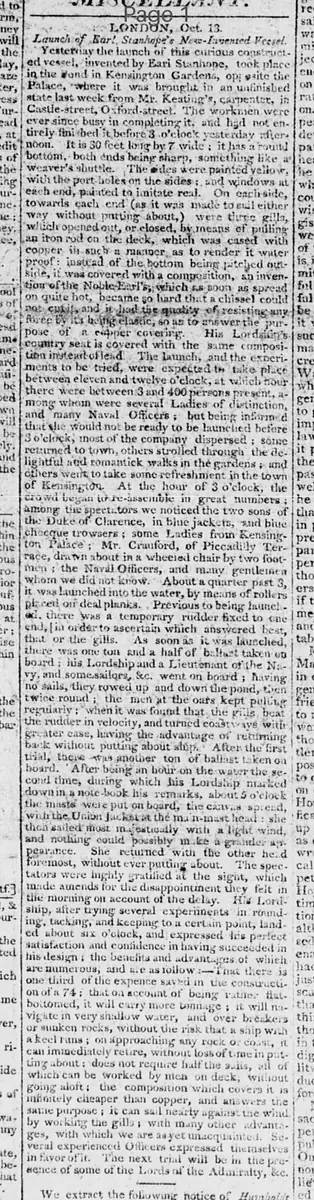
Launch of Earl Stanhope's Near-Invented Vessel.
Yesterday the launch of this curious constructed vessel, invented by Earl Stanhope, took place in the Pond in Kensington Gardens, opposite the Palace, where it was brought in an unfinished state last week from Mr. Keating's, carpenter, in Castle-street, Oxford-street. The workmen were ever since busy in completing it, and had not entirely finished it before 3 o'clock yesterday afternoon. It is 50 feet long by 7 wide: it has a rounded bottom, both ends being sharp, something like a weaver's shuttle. The sides were painted yellow, with the port-holes on the sides and windows at each end, painted to imitate real. On each side, towards each end (as it was made to sail either way without putting about,) were three gills, which opened out, or closed, by means of pulling an iron rod on the deck, which was cased with copper in such a manner as to render it water proof: instead of the bottom being pitched outside, it was covered with a composition, an invention of the Noble Earl's; which as soon as spread on quite hot, became so hard that a chisel could not cut it, and it had this quality of resisting any force by its being elastic, so as to answer the purpose of a copper covering. His Lordship's country seat is covered with the same composition instead of lead. The launch, and the experiments to be tried, were expected to take place between eleven and twelve o'clock, at which hour there were between 3 and 400 persons present, among whom were several Ladies of distinction, and many Naval Officers; but being informed that it would not be ready to be launched before 3 o'clock, most of the company dispersed; some returned to town, others strolled through the delightful and romantick walks in the gardens; and others went to take some refreshment in the town of Kensington. At the hour of 3 o'clock, the crowd began to re-assemble in great numbers; among the spectators we noticed the two sons of the Duke of Clarence, in blue jackets, and blue checque trowsers; some Ladies from Kensington Palace; Mr. Crauford, of Piccadilly Terrace, drawn about in a wheeled chair by two footmen; the Naval Officers, and many gentlemen whom we did not know. About a quarter past 3, it was launched into the water, by means of rollers placed on deal planks. Previous to being launched, there was a temporary rudder fixed to one end, in order to ascertain which answered best, that or the gills. As soon as it was launched, there was one ton and a half of ballast taken on board; his Lordship and a Lieutenant of the Navy, and some sailors, &c. went on board; having no sails, they rowed up and down the pond, then twice round; the men at the oars kept pulling regularly: when it was found that the gills beat the rudder in velocity, and turned coastwise with greater ease, having the advantage of returning back without putting about ship. After the first trial, there was another ton of ballast taken on board. After being an hour on the water the second time, during which his Lordship marked down in a note-book his remarks, about 5 o'clock the masts were put on board, the canvas spread, with the Union jack at the main-mast head: she then sailed most majestically with a light wind, and nothing could possibly make a grander appearance. She returned with the other head foremost, without ever putting about. The spectators were highly gratified at the sight, which made amends for the disappointment they felt in the morning on account of the delay. His Lordship, after trying several experiments in rounding, tacking, and keeping to a certain point, landed about six o'clock, and expressed his perfect satisfaction and confidence in having succeeded in his design; the benefits and advantages of which are numerous, and are as follow:—that there is one third of the expense saved in the construction of a 74: that on account of being ratine flat-bottomed, it will carry more tonnage: it will navigate in very shallow water, and over breakers or sunken rocks, without the risk that a ship with a keel runs; on approaching any rock or coast, it can immediately retire, without loss of time in putting about: does not require half the sails, all of which can be worked by men on deck, without going aloft: the composition which covers it is infinitely cheaper than copper, and answers the same purpose; it can sail nearly against the wind by working the gills: with many other advantages, with which we are as yet unacquainted. Several experienced Officers expressed themselves in favor of it. The next trial will be in the presence of some of the Lords of the Admiralty, &c.
What sub-type of article is it?
What keywords are associated?
What entities or persons were involved?
Where did it happen?
Foreign News Details
Primary Location
Kensington Gardens, London
Event Date
Yesterday (Oct. 12)
Key Persons
Outcome
successful launch and trials; vessel demonstrated superior steering with gills over rudder, cost savings, and navigational advantages; earl stanhope expressed satisfaction; next trial planned with admiralty lords.
Event Details
The 50-foot shuttle-like vessel, invented by Earl Stanhope, was launched in Kensington Gardens pond at 3:15 PM. It featured sharp ends, gills for bidirectional sailing, and elastic composition covering. Tested with ballast, rowing, and sails; performed well in velocity, turning, and sailing against wind. Attended by naval officers, ladies, and spectators including Duke of Clarence's sons.