Thank you for visiting SNEWPapers!
Sign up free
Foreign News
February 12, 1780
The Virginia Gazette
Richmond, Williamsburg, Richmond County, Virginia
What is this article about?
Eulogistic sketch of Earl Temple's character, highlighting his political acumen, independence, role in the late war cabinet under Lord Chatham, opposition to current ministers, and recent death as a public loss.
Clipping
OCR Quality
95%
Excellent
Full Text
LONDON
SKETCH of the CHARACTER of EARL TEMPLE.
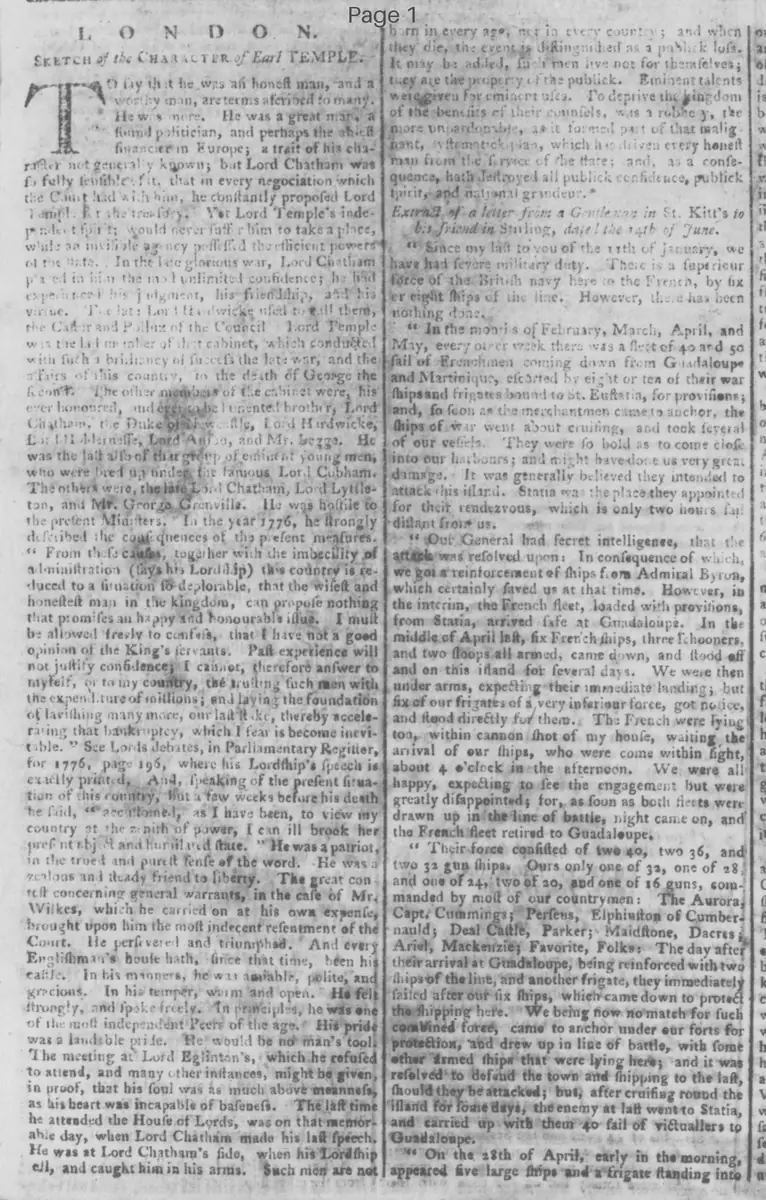
They say that he was an honest man, and a worthy man, are terms ascribed to many. He was more. He was a great man, a sound politician, and perhaps the ablest financier in Europe; a trait of his character not generally known; but Lord Chatham was fully sensible of it, that in every negociation which the Court had with him, he constantly proposed Lord Temple for the treasury. Yet Lord Temple's independent spirit would never suffer him to take a place, while an imbecile ministry possessed sufficient powers of the state. In the glorious war, Lord Chatham placed him in the cabinet with unlimited confidence; he had perfect his judgment, his friendship, and his truth. Lord Bute and Mr. Grenville used to call them, the Corner Stone and Plumb Line of the Council. Lord Temple was the last member of that cabinet, which conducted with such brilliancy of success the late war, and the fates of his country, to the death of George the Second. The other members of the cabinet were, his ever honoured, and ever to be lamented brother, Lord Chatham, the Duke of Grafton, Lord Hardwicke, Lord Egmont, Lord Anslow, and Mr. George. He was the last of that group of eminent young men, who were bred up under the famous Lord Cobham. The others were, the late Lord Chatham, Lord Lyttleton, and Mr. George Grenville. He was hostile to the present Ministers. In the year 1770, he strongly described the consequences of the present measures. "From these causes, together with the imbecility of a bad ministry (Says his Lordship) this country is reduced to a situation so deplorable, that the wisest and honestest man in the kingdom, can propose nothing that promises a happy and honourable issue. I must be allowed freely to confess, that I have not a good opinion of the King's servants. Past experience will not justify confidence; I cannot, therefore answer to myself, or to my country, the trusting such men with the expenditure of millions; and laying the foundation of lavishing many more, our last stake, thereby accelerating that bankruptcy, which I fear is become inevitable." See Lords debates, in Parliamentary Register, for 1770, page 196, where his Lordship's speech is exactly printed. And, speaking of the present situation of this country, but a few weeks before his death he said, "Accustomed, as I have been, to view my country at the zenith of power, I can ill brook her present abject and humbled state." He was a patriot, in the true and purest sense of the word. He was a zealous and steady friend to liberty. The great contest concerning general warrants, in the case of Mr. Wilkes, which he carried on at his own expense, brought upon him the most indecent resentment of the Court. He persevered and triumphed. And every Englishman's house hath, since that time, been his castle. In his manners, he was amiable, polite, and gracious. In his temper, warm and open. He felt strongly, and spoke freely. In principles, he was one of the most independent Peers of the age. His pride was a laudable pride. He would be no man's tool. The meeting at Lord Eglinton's, which he refused to attend, and many other instances, might be given, in proof, that his soul was as much above meanness, as his heart was incapable of baseness. The last time he attended the House of Lords, was on that memorable day, when Lord Chatham made his last speech. He was at Lord Chatham's side, when his Lordship fell, and caught him in his arms. Such men are not born in every age, not in every court; and when they die, the event is distinguished as a public loss. It may be added, such men live not for themselves; they are the property of the public. Eminent talents were given for eminent uses. To deprive the kingdom of the benefits of their counsels, was a robbery, the more unpardonable, as it sprung out of that malignant, destructive plan, which has driven every honest man from the service of the state: and, as a consequence, hath destroyed all public confidence, public spirit, and national grandeur.
SKETCH of the CHARACTER of EARL TEMPLE.
They say that he was an honest man, and a worthy man, are terms ascribed to many. He was more. He was a great man, a sound politician, and perhaps the ablest financier in Europe; a trait of his character not generally known; but Lord Chatham was fully sensible of it, that in every negociation which the Court had with him, he constantly proposed Lord Temple for the treasury. Yet Lord Temple's independent spirit would never suffer him to take a place, while an imbecile ministry possessed sufficient powers of the state. In the glorious war, Lord Chatham placed him in the cabinet with unlimited confidence; he had perfect his judgment, his friendship, and his truth. Lord Bute and Mr. Grenville used to call them, the Corner Stone and Plumb Line of the Council. Lord Temple was the last member of that cabinet, which conducted with such brilliancy of success the late war, and the fates of his country, to the death of George the Second. The other members of the cabinet were, his ever honoured, and ever to be lamented brother, Lord Chatham, the Duke of Grafton, Lord Hardwicke, Lord Egmont, Lord Anslow, and Mr. George. He was the last of that group of eminent young men, who were bred up under the famous Lord Cobham. The others were, the late Lord Chatham, Lord Lyttleton, and Mr. George Grenville. He was hostile to the present Ministers. In the year 1770, he strongly described the consequences of the present measures. "From these causes, together with the imbecility of a bad ministry (Says his Lordship) this country is reduced to a situation so deplorable, that the wisest and honestest man in the kingdom, can propose nothing that promises a happy and honourable issue. I must be allowed freely to confess, that I have not a good opinion of the King's servants. Past experience will not justify confidence; I cannot, therefore answer to myself, or to my country, the trusting such men with the expenditure of millions; and laying the foundation of lavishing many more, our last stake, thereby accelerating that bankruptcy, which I fear is become inevitable." See Lords debates, in Parliamentary Register, for 1770, page 196, where his Lordship's speech is exactly printed. And, speaking of the present situation of this country, but a few weeks before his death he said, "Accustomed, as I have been, to view my country at the zenith of power, I can ill brook her present abject and humbled state." He was a patriot, in the true and purest sense of the word. He was a zealous and steady friend to liberty. The great contest concerning general warrants, in the case of Mr. Wilkes, which he carried on at his own expense, brought upon him the most indecent resentment of the Court. He persevered and triumphed. And every Englishman's house hath, since that time, been his castle. In his manners, he was amiable, polite, and gracious. In his temper, warm and open. He felt strongly, and spoke freely. In principles, he was one of the most independent Peers of the age. His pride was a laudable pride. He would be no man's tool. The meeting at Lord Eglinton's, which he refused to attend, and many other instances, might be given, in proof, that his soul was as much above meanness, as his heart was incapable of baseness. The last time he attended the House of Lords, was on that memorable day, when Lord Chatham made his last speech. He was at Lord Chatham's side, when his Lordship fell, and caught him in his arms. Such men are not born in every age, not in every court; and when they die, the event is distinguished as a public loss. It may be added, such men live not for themselves; they are the property of the public. Eminent talents were given for eminent uses. To deprive the kingdom of the benefits of their counsels, was a robbery, the more unpardonable, as it sprung out of that malignant, destructive plan, which has driven every honest man from the service of the state: and, as a consequence, hath destroyed all public confidence, public spirit, and national grandeur.
What sub-type of article is it?
Political
Court News
What keywords are associated?
Earl Temple
Lord Chatham
British Cabinet
Political Independence
Wilkes Case
House Of Lords
What entities or persons were involved?
Earl Temple
Lord Chatham
Lord Bute
Mr. Grenville
Duke Of Grafton
Lord Hardwicke
Lord Egmont
Lord Anslow
Mr. George
Lord Cobham
Lord Lyttleton
Mr. George Grenville
Mr. Wilkes
Lord Eglinton
Where did it happen?
London
Foreign News Details
Primary Location
London
Key Persons
Earl Temple
Lord Chatham
Lord Bute
Mr. Grenville
Duke Of Grafton
Lord Hardwicke
Lord Egmont
Lord Anslow
Mr. George
Lord Cobham
Lord Lyttleton
Mr. George Grenville
Mr. Wilkes
Lord Eglinton
Outcome
death of earl temple as a public loss
Event Details
Sketch of Earl Temple's character as a great politician, financier, independent peer, last surviving member of the war cabinet under Lord Chatham, opponent of current ministers, defender of liberty in Wilkes case, and recent death.