Thank you for visiting SNEWPapers!
Sign up free
Kentucky Gazette And General Advertiser
Lexington, Fayette County, Kentucky
What is this article about?
Paris dispatch analyzes Europe's political contradictions: England's mixed peace-war signals, Russia's stalled peace refusal, Prussia's ambiguous war preparations and doubtful alliances against France, rooted in historical deceptions and strategic risks.
Clipping
OCR Quality
Full Text
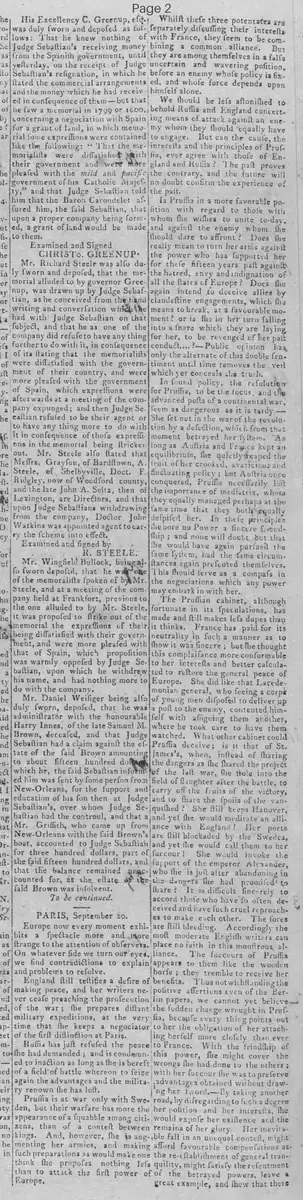
Europe now every moment exhibits a spectacle more and more strange to the attention of observers. On whatever side we turn our eyes, we find contradictions to explain and problems to resolve.
England still testifies a desire of making peace, and her writers never cease preaching the prosecution of the war; she prepares distant military expeditions, at the very time that she keeps a negotiator of the first distinction at Paris.
Russia has just refused the peace she had demanded; and is condemned to inaction as long as she is bereft of a field of battle whereon to seize again the advantages and the military renown she has lost.
Prussia is at war only with Sweden, but their warfare has more the appearance of a quarrel among citizens, than of a contest between kings. And, however, she is augmenting her armies, and making such preparations as would make one think she proposes nothing less than to attack the first power of Europe.
Whilst these three potentates are separately pursuing their interests with France, they seem to be combining a common alliance. But they are among themselves in a false uncertain and wavering position, before an enemy whose policy is fixed, and whose force depends upon himself alone.
We should be less astonished to behold Russia and England concerting means of attack against an enemy whom they should equally have to engage. But can the cause, the interests and the principles of Prussia, ever agree with those of England and Russia? The past proves the contrary, and the future will no doubt confirm the experience of the past.
Is Prussia in a more favorable position with regard to those with whom she wishes to unite to-day. and against the enemy whom she should dare to affront? Does she really mean to turn her arms against the power who has supported her for these fifteen years past against the hatred, envy and indignation of all the states of Europe? Does she again intend to deceive allies by clandestine engagements, which she means to break, at a favourable moment? or is she in her turn falling into a snare which they are laying for her, to be revenged of her past conduct...? Public opinion has only the alternative of this double sentiment until time removes the veil which yet conceals the truth.
In sound policy, the resolution for Prussia, to be the focus, and the advanced posts of a continental war, seem as dangerous as it is tardy.—She set out in the war of the revolution by a defection, which from that moment betrayed her item. As long as Austria and France kept an equilibrium, she quietly reaped the fruit of her crooked, avaricious and fluctuating policy; but Austria once conquered, Prussia necessarily lost the importance of mediatrix, whom they equally managed perhaps at the same time that they both equally despised her. In these principles she bore no Power a sincere friendship; and none will doubt but that she would have again pursued the same system, had the same circumstances again presented themselves.
This should serve as a compass in the negotiations which any power may embark in with her.
The Prussian cabinet, although fortunate in its speculations, has made and still makes less dupes than it thinks. France has paid for its neutrality in such a manner as to show it was sincere; but she thought this complaisance more conformable to her interests and better calculated to restore the general peace of Europe. She did like that Lacedemonian general, who seeing a corps of young men disposed to deliver up a post to the enemy, contented himself with assigning them another, where he took care to have them watched. What other cabinet could Prussia deceive; is it that of St. James's, when, instead of sharing the dangers as she shared the project of the last war, she stole into the field of slaughter after the battle, to carry off the fruits of the victory, and to share the spoils of the vanquished? She still keeps Hanover, and yet she would meditate an alliance with England? Her ports are still blockaded by the Swedes. and yet she would call them to her succour! She would invoke the support of the emperor Alexander, who she is just after abandoning in the dangers she had promised to share? It is difficult sincerely to accord those who have so often deceived and have such cruel reproaches to make each other. The sores are still bleeding. Accordingly the most moderate English writers can place no faith in this monstrous alliance. The succours of Prussia appears to them like the wooden horse; they tremble to receive her benefits. Thus notwithstanding the positive assertions even of the Berlin papers, we cannot yet believe the sudden change wrought in Prussia, because every thing points out to her the obligation of attaching herself more closely than ever to France. With the friendship of this power, she might cover the wrongs she had done to the others: with her succour she was to preserve advantages obtained without drawing her sword.—By taking another road, by disregarding to such a degree her position and her interests, she would expose her existence and the remains of her glory. Her inevitable fall in an unequal contest, might no doubt afford favourable compensations at the re-establishment of general tranquillity, might satisfy the resentment for the betrayed powers, leave a great example, and shew that there is no safety but in the faithful observance of treaties.
What sub-type of article is it?
What keywords are associated?
What entities or persons were involved?
Where did it happen?
Foreign News Details
Primary Location
Europe
Event Date
September 20
Key Persons
Event Details
Europe exhibits strange contradictions: England desires peace but prepares for war and keeps a negotiator in Paris; Russia refuses demanded peace and remains inactive; Prussia wars with Sweden like a citizen quarrel but augments armies as if to attack Europe's first power. These three pursue interests with France but seem to form a common alliance while in uncertain positions against fixed French policy. Doubts arise on Prussia aligning with England and Russia given past deceptions; her policy seen as dangerous, historically treacherous, and unlikely to deceive others again. France's past neutrality was sincere but strategic; Prussia's potential shift from France risks her existence.