Thank you for visiting SNEWPapers!
Sign up free
Daily National Democrat
Marysville, Yuba County, California
What is this article about?
Article details controversy over Gen. James A. McDougall's election as U.S. Senator from California, focusing on legislative committee reports disputing vote tally in joint convention, legal debates on certificates, and calls for a new convention amid accusations of motive and error.
Clipping
OCR Quality
Full Text
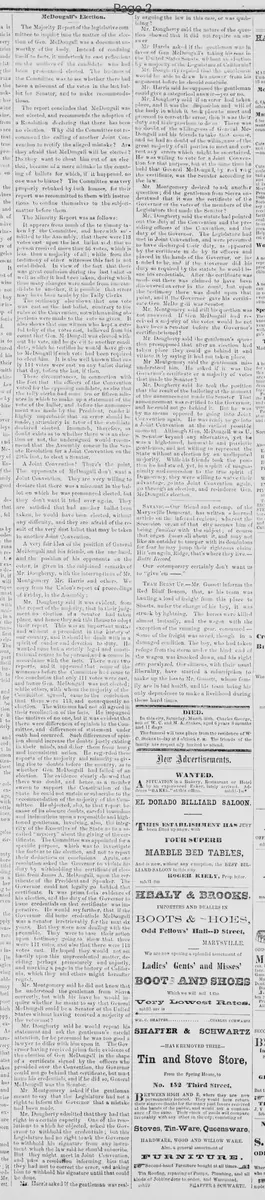
The Majority Report of the legislative committee to inquire into the matter of the election of Gen. McDougall was a document unworthy of the body. Instead of confining itself to facts, it undertook to cast reflections on the motives of the candidate who had been pronounced elected. The business of the Committee was to see whether there had been a miscount of the votes in the last ballot for Senator, and to make recommendations.
The report concludes that McDougall was not elected, and recommends the adoption of a Resolution declaring that there has been no election. Why did the Committee not recommend the calling of another Joint Convention to rectify the alleged mistake? Are they afraid that McDougall will be elected? Do they want to cheat him out of an election, because of a mere mistake in the counting of ballots for which, if it happened, no one was to blame? The Committee was very properly rebuked by both houses, for their report was recommitted to them with instructions to confine themselves to the subject-matter before them.
The Minority Report was as follows:
It appears from much of the testimony taken by the Committee, and herewith submitted to the Assembly, that there were 113 votes cast upon the last ballot and that no person received more than 56 votes, which is less than a majority of all; while from the testimony of other witnesses this fact is not established. In view of the fact that there was great confusion during the last ballot as well as after it had been taken, during which time many changes were made from one candidate to another, it is possible that errors may have been made by the Tally Clerks. The testimony also shows that one vote was cast on the last ballot, contrary to the rules of the Convention, notwithstanding objections were made to the vote so given. It also shows that one witness who kept a careful tally of the votes cast, believed from his count that Gen. McDougall was elected without his vote, and he gave it to another candidate, which he testifies he would have given to McDougall if such vote had been required to elect him. It is also well known that only 111 votes were cast on any ballot during that day, before the last, if then.
These circumstances, in connection with the fact that the officers of the Convention voted for the opposing candidate, as also that the tally clerks had some ten or fifteen minutes in which to make up a statement of the vote of the ballot, and before the announcement was made by the President, render it highly improbable that an error should be made, particularly in favor of the candidate declared elected. Inasmuch, therefore, as doubt exists as to whether there was an election or not, the undersigned would recommend that the Assembly concur in the Senate Resolution for a Joint Convention on the 20th inst., to elect a Senator.
A Joint Convention! There's the point. The opponents of McDougall don't want a Joint Convention. They are very willing to declare that there was a miscount in the ballot on which he was pronounced elected, but they don't want it tried over again. They are satisfied that had another ballot been taken, he would have been elected, without any difficulty, and they are afraid of the result of the very first ballot that may be taken in another Joint Convention.
A very fair idea of the position of General McDougall and his friends, on the one hand, and the position of his opponents on the other, is given in the subjoined remarks of Mr. Dougherty, with the interruptions of Mr. Montgomery, Mr. Harris and others. We copy from the Union's report of proceedings of Friday, in the Assembly:
Mr. Dougherty said it was evident, from the report of the majority, that in their judgment no election of a senator had taken place, and hence they ask this House to adopt their report. This was an important matter and without a precedent in the history of our country, and it should be dealt with in a spirit of candor and devotion to duty. He wanted none but a strictly legal and constitutional course to be pursued, and a course in accordance with the facts. There were two reports, and it appeared that some of the witnesses before the Committee had come to the conclusion that only 111 votes were cast, and hence Gen. McDougall was not elected; while others, with whom the majority of the Committee agreed, came to the conclusion that there were 113, and consequently no election. The witnesses had not all agreed in their recollection of the facts. He impugned the motives of no one, but it was evident that there were differences of opinion in the Committee, and differences of statement under oath had occurred. Such differences of opinion should increase the doubts justly existing in their minds, and debar them from hasty and inconsistent action. He regarded these reports of the majority and minority as giving rise to doubts before the country, as to whether Gen. McDougall had failed of an election. The evidence clearly showed that there was doubt, and hence, as a member sworn to support the Constitution of the State he could not sustain or subscribe to the recommendation of the majority of the Committee. He objected, also, to that report because of its obscure doubts, careful innuendoes and insinuations upon a responsible and high-toned gentleman, involving, also, the integrity of the Executive of the State as to a so-called "mystery" about the giving of the certificate. The Committee was appointed for a specific purpose, which was to investigate the facts as to the election, and not to report their deductions or conclusions. Again, one resolution asked the Governor to violate his duty by withholding the certificate of election from James A. McDougall, upon the certificate of the President and Speaker. The Governor could not legally go behind that certificate. It was prima facie evidence of his election, and the duty of the Governor to issue credentials on that certificate was imperative. He would say further, that if the Governor did issue credentials McDougall was a senator irretrievably for the next six years. But they were now dealing with the preamble. They were to base their action upon testimony going to show that there were 111 votes, and also that there were 113 votes cast. He hoped they would not act hastily upon this unprecedented matter, deciding perhaps prematurely and unjustly, and marking a page in the history of California, which they and others might hereafter regret.
Mr. Montgomery said he did not know that he understood the gentleman from Sierra correctly, but with his leave he would inquire whether he meant to say that General McDougall could be a Senator of the United States without having received a majority of the votes cast?
Mr. Dougherty said he would repeat his statement and ask the gentleman's careful attention, for he presumed he was too good a lawyer to differ with him upon it. The Governor having received prima facie evidence of the election of Gen. McDougall in the shape of a certificate signed by the officers who presided over the Convention, the Governor could not go behind that certificate, but must issue his credentials, and if he did so, General McDougall was the Senator.
Mr. Montgomery asked if the gentleman meant to say that the Legislature had not a right to inform the Governor that a mistake had been made?
Mr. Dougherty admitted that they had that right in a certain capacity. One of the resolutions to which he objected, asked the Governor to withhold the credentials; but this Legislature had no right to ask the Governor to withhold his signature from any instrument which the law said he should subscribe. But they might meet in Joint Convention, and pass a resolution informing him that they had met to correct the error, and asking him to withhold his signature until that could be done.
Mr. Harris asked if the gentleman was really arguing the law in this case, or was quibbling?
Mr. Dougherty said the nature of the question showed that it did not require an answer.
Mr. Harris asked if the gentleman was in favor of Gen. McDougall's taking his seat in the United States Senate, without an election by a majority of the Legislature of California?
Mr. Dougherty replied that the gentleman would be able to draw his answer from his argument before he should conclude.
Mr. Harris said he supposed the gentleman could give a categorical answer—yes or no.
Mr. Dougherty said if an error had taken place, and it was the disposition and will of the body in which it took place to meet and proceed to correct the error, then it was their duty and their province to do so. There was no doubt of the willingness of General McDougall and his friends to take that course, and he had no doubt of the willingness of the great majority of all parties to meet and correct any errors which might be ascertained. He was willing to vote for a Joint Convention for that purpose, but at the same time he held that General McDougall, by receiving the certificate, was the Senator according to the law.
Mr. Montgomery desired to ask another question; did the gentleman from Sierra understand that it was the certificate of the Governor or the votes of the members of the Legislature that made the Senator?
Mr. Dougherty said the statute had pointed out the duty of the Convention and the presiding officers of the Convention, and the duty of the Governor. The Legislature had met in Joint Convention, and were presumed to have discharged their duty, as appeared by the certificate made out by its officers and placed in the hands of the Governor, or intended to be, and if the Governor did his duty as required by the statute he would issue his credentials. After the certificate was made out there was claimed to have been discovered an error in the count, but upon the testimony there was doubt upon that point, and if the Governor gave his certificate Gen. McDougall was Senator.
Mr. Montgomery said still his question was not answered. If Gen. McDougall had received a majority of the votes, would he not have been a senator before the Governor's certificate issued?
Mr. Dougherty said the gentleman's question presupposed that after an election had taken place they could go behind it and vitiate it by saying it had not taken place.
Mr. Montgomery said the gentleman misunderstood him. He asked if it was the Governor's certificate or a majority of votes that made the Senator?
Mr. Dougherty said he took the position that the result of the balloting at the moment of the announcement made the Senator. That announcement was certified to the Governor, and he could not go behind it. But he was by no means opposed to going into Joint Convention again. He was ready to go into a Joint Convention at the earliest possible moment. Although Gen. McDougall was U. S. senator beyond any alternative, yet he was a high-toned, honorable and patriotic gentleman, and not willing to represent the State without an election by an undisputed majority. While his friends took the position he had stated, yet, in a spirit of magnanimity and concession to the true spirit of Democracy, they were willing to waive their advantage, go into Joint Convention again, go through an election, and re-indorse Gen. McDougall's election.
What sub-type of article is it?
What themes does it cover?
What keywords are associated?
What entities or persons were involved?
Where did it happen?
Story Details
Key Persons
Location
California
Event Date
20th Inst.
Story Details
Legislative committee investigates election of Gen. McDougall as Senator due to disputed vote count in joint convention. Majority report claims no election and casts aspersions; minority recommends new joint convention. Debate in Assembly highlights legal arguments over certificate and governor's duty, with opponents fearing re-election.