Thank you for visiting SNEWPapers!
Sign up free
Orangeburg News And Times
Orangeburg, Orangeburg County, South Carolina
What is this article about?
Opinion piece arguing for withdrawal of federal troops from South Carolina and Louisiana, supporting Governors Hampton and Nicholls over Chamberlain and Packard, emphasizing local self-determination and constitutional principles amid Reconstruction disputes.
Clipping
OCR Quality
Full Text
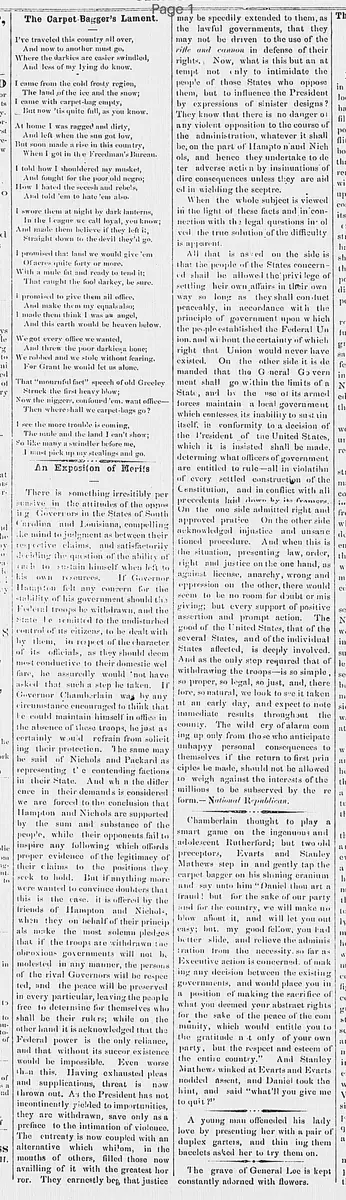
There is something irresistibly persuasive in the attitudes of the opposing Governors in the States of South Carolina and Louisiana, compelling the mind to judgment as between their respective claims, and satisfactorily deciding the question of the ability of each to sustain himself when left to his own resources.
If Governor Hampton felt any concern for the stability of his government should the Federal troops be withdrawn, and the State be remitted to the undisturbed control of its citizens, to be dealt with by them, in respect of the character of its officials, as they should deem most conducive to their domestic welfare, he assuredly would not have asked that such a step be taken. If Governor Chamberlain was by any circumstance encouraged to think that he could maintain himself in office in the absence of these troops, he just as certainly would refrain from soliciting their protection. The same may be said of Nicholls and Packard as representing the contending factions in their State. And when the difference in their demands is considered we are forced to the conclusion that Hampton and Nicholls are supported by the sum and substance of the people, while their opponents fail to inspire any following which affords proper evidence of the legitimacy of their claims to the positions they seek to hold. But if anything more were wanted to convince doubters that this is the case, it is offered by the friends of Hampton and Nicholls, when they on behalf of their principals make the most solemn pledges that if the troops are withdrawn the obnoxious governments will not be molested in any manner, the persons of the rival Governors will be respected, and the peace will be preserved in every particular, leaving the people free to determine for themselves who shall be their rulers; while on the other hand it is acknowledged that the Federal power is the only reliance, and that without its succor existence would be impossible. Even worse than this. Having exhausted pleas and supplications, threat is now thrown out. As the President has not incontinently yielded to importunities, they are withdrawn, save only as a preface to the intimation of violence. The entreaty is now coupled with an alternative which whilom, in the mouths of others, filled those now availing of it with the greatest horror. They earnestly beg that justice may be speedily extended to them, as the lawful governments, that they may not be driven to the use of the rifle and cannon in defense of their rights. Now, what is this but an attempt not only to intimidate the people of those States who oppose them, but to influence the President by expressions of sinister designs? They know that there is no danger of any violent opposition to the course of the administration, whatever it shall be, on the part of Hampton and Nicholls, and hence they undertake to deter adverse action by insinuations of dire consequences unless they are aided in wielding the sceptre.
When the whole subject is viewed in the light of these facts and in connection with the legal questions involved the true solution of the difficulty is apparent.
All that is asked on the one side is that the people of the States concerned shall be allowed their privilege of settling their own affairs in their own way so long as they shall conduct peaceably, in accordance with the principle of government upon which the people established the Federal Union, and without the certainty of which right that Union would never have existed. On the other side it is demanded that the General Government shall go within the limits of a State, and by the use of its armed forces maintain a local government which confesses its inability to sustain itself, in conformity to a decision of the President of the United States, which it is insisted shall be made determining what officers of government are entitled to rule-all in violation of every settled construction of the Constitution, and in conflict with all precedents laid down by its framers.
On the one side admitted right and approved practice. On the other side acknowledged injustice and unsanctioned procedure. And when this is the situation, presenting law, order, right and justice on the one hand, as against license, anarchy, wrong and oppression on the other, there would seem to be no room for doubt or misgiving; but every support of positive assertion and prompt action. The good of the United States, that of the several States, and of the individual States affected, is deeply involved. And as the only step required that of withdrawing the troops-is so simple, so proper, so legal, so just, and, therefore, so natural, we look to see it taken at an early day, and expect to note immediate results throughout the country. The wild cry of alarm coming up only from those who anticipate unhappy personal consequences to themselves if the return to first principles be made, should not be allowed to weigh against the interests of the millions to be subserved by the reform.-National Republican.
Chamberlain thought to play smart game on the ingenuous and adolescent Rutherford; but two old preceptors, Evarts and Stanley Mathews step in and gently tap the carpet bagger on his shining cranium and say unto him "Daniel thou art a fraud! but for the sake of our party and for the country, we will make no blow about it, and will let you out easy; but, my good fellow, you had better slide, and relieve the administration from the necessity, so far as Executive action is concerned, of making any decision between the existing governments, and would place you in a position of making the sacrifice of what you deemed your abstract rights for the sake of the peace of the community, which would entitle you to the gratitude not only of your own party, but the respect and esteem of the entire country." And Stanley Mathews winked at Evarts and Evarts nodded assent, and Daniel took the hint, and said "what'll you give me to quit?"
What sub-type of article is it?
What themes does it cover?
What keywords are associated?
What entities or persons were involved?
Where did it happen?
Story Details
Key Persons
Location
South Carolina, Louisiana
Story Details
Editorial argues that Governors Hampton and Nicholls represent the true will of the people in South Carolina and Louisiana, advocating for federal troop withdrawal to allow peaceful local resolution of disputed elections, contrasting their confidence with opponents' reliance on military support and threats; includes satirical anecdote on Chamberlain's dealings with administration figures.