Thank you for visiting SNEWPapers!
Sign up free
Portland Gazette, And Maine Advertiser
Portland, Cumberland County, Maine
What is this article about?
A Federalist letter criticizes Thomas Jefferson's foreign policy toward Britain, arguing that demands to revise the Jay Treaty on issues like impressment and free ships risk provoking an unnecessary war that would ruin American commerce and interests, urging citizens to prioritize peace over party loyalty.
Clipping
OCR Quality
Full Text
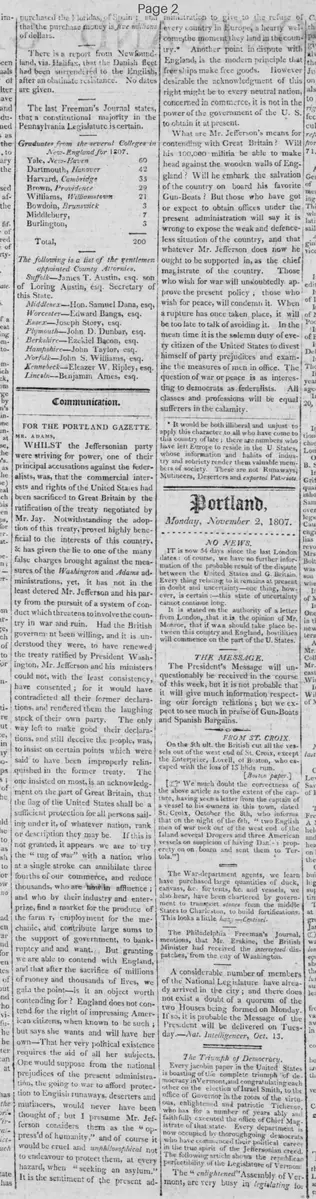
FOR THE PORTLAND GAZETTE.
MR. ADAMS,
WHILST the Jeffersonian party were striving for power, one of their principal accusations against the federalists, was, that the commercial interests and rights of the United States had been sacrificed to Great Britain by the ratification of the treaty negotiated by Mr. Jay. Notwithstanding the adoption of this treaty, proved highly beneficial to the interests of this country, & has given the lie to one of the many false charges brought against the measures of the Washington and Adams administrations, yet, it has not in the least deterred Mr. Jefferson and his party from the pursuit of a system of conduct which threatens to involve the country in war and ruin. Had the British government been willing, and it is understood they were, to have renewed the treaty ratified by President Washington, Mr. Jefferson and his ministers could not, with the least consistency, have consented; for it would have contradicted all their former declarations, and rendered them the laughing stock of their own party. The only way left to make good their declarations, and still deceive the people, was, to insist on certain points which were said to have been improperly relinquished in the former treaty. The one insisted on most, is an acknowledgment on the part of Great Britain, that the flag of the United States shall be a sufficient protection for all persons sailing under it, of whatever nation, rank or description they may be. If this is not granted, it appears we are to try the "tug of war" with a nation who at a single stroke can annihilate three fourths of our commerce, and reduce thousands, who are now in affluence; and who by their industry and enterprise, find a market for the produce of the farmer, employment for the mechanic, and contribute large sums to the support of government, to bankruptcy and want. But granting we are able to contend with England, and that after the sacrifice of millions of money and thousands of lives, we gain the point—is it an object worth contending for? England does not contend for the right of impressing American citizens, when known to be such; but says she wants and will have her own—That her very political existence requires the aid of all her subjects. One would suppose from the national prejudices of the present administration, the going to war to afford protection to English runaways, deserters and mutineers, would never have been thought of; but I presume Mr. Jefferson considers them as the "oppressed of humanity," and of course it would be cruel and unphilosophical not to endeavour to protect them, at every hazard, when "seeking an asylum." It is the sentiment of the present administration to give to the refuse of every country in Europe, a hearty welcome, the moment they land in the country. Another point in dispute with England, is the modern principle that free ships make free goods. However desirable the acknowledgment of this right might be to every neutral nation, concerned in commerce, it is not in the power of the government of the U. S. to obtain it at present. What are Mr. Jefferson's means for contending with Great Britain? Will his 100,000 militia be able to make head against the wooden walls of England? Will he embark the salvation of the country on board his favorite Gun-Boats? But those who have got or expect to obtain offices under the present administration will say it is wrong to expose the weak and defenceless situation of the country, and that whatever Mr. Jefferson does now he ought to be supported in, as the chief magistrate of the country. Those who wish for war will undoubtedly approve the present policy; those who wish for peace, will condemn it. When a rupture has once taken place, it will be too late to talk of avoiding it. In the mean time it is the solemn duty of every citizen of the United States to divest himself of party prejudices and examine the measures of men in office. The question of war or peace is as interesting to democrats as federalists. All classes and professions will be equal sufferers in the calamity.
*It would be both illiberal and unjust to apply this character to all who have come to this country of late; there are numbers who have left Europe to reside in the U. States, whose information and habits of industry and sobriety render them valuable members of society. These are not Runaways, Mutineers, Deserters and exported Patriots.
What sub-type of article is it?
What themes does it cover?
What keywords are associated?
What entities or persons were involved?
Letter to Editor Details
Recipient
Mr. Adams
Main Argument
jefferson's insistence on revising the jay treaty to protect foreign sailors under the us flag and affirm free ships make free goods risks provoking a devastating war with britain that would destroy american commerce, despite the original treaty's benefits; citizens should examine policies beyond party lines to preserve peace.
Notable Details