Thank you for visiting SNEWPapers!
Sign up free
Story
November 24, 1939
The Gary American
Gary, Lake County, Indiana
What is this article about?
Walter A. Shead critiques a Republican party event in Indianapolis, highlighting the parade, meager food, and speeches by leaders like Homer E. Capehart, Dr. Glenn Frank, Assemblyman Wadsworth, and Publisher Gannett, who offered criticism of the New Deal but no alternative program or clear principles.
Clipping
OCR Quality
98%
Excellent
Full Text
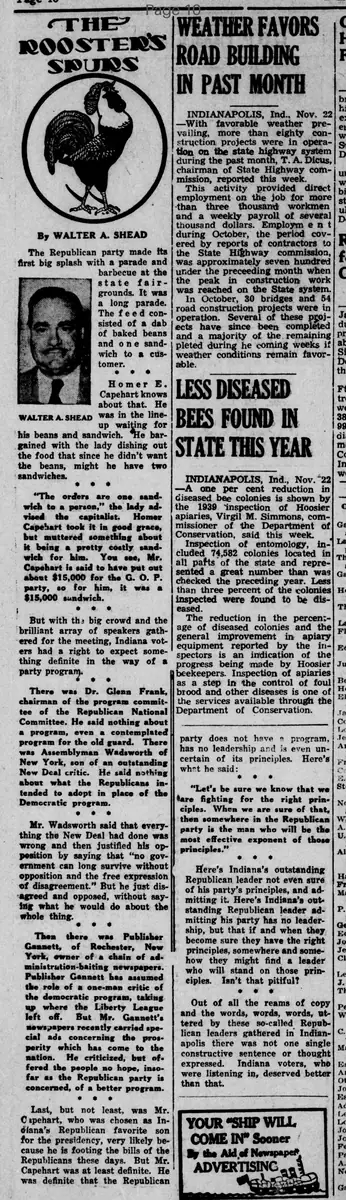
THE BOOSTERS SPURN
By WALTER A. SHEAD
The Republican party made its first big splash with a parade and barbecue at the state fairgrounds. It was a long parade. The feed consisted of a dab of baked beans and one sandwich to a customer.
Homer E. Capehart knows about that. He was in the lineup waiting for his beans and sandwich. He bargained with the lady dishing out the food that since he didn't want the beans, might he have two sandwiches.
"The orders are one sandwich to a person," the lady advised the capitalist. Homer Capehart took it in good grace, but muttered something about it being a pretty costly sandwich for him. You see, Mr. Capehart is said to have put out about $15,000 for the G.O.P. party, so for him, it was a $15,000 sandwich.
But with the big crowd and the brilliant array of speakers gathered for the meeting, Indiana voters had a right to expect something definite in the way of a party program.
There was Dr. Glenn Frank, chairman of the program committee of the Republican National Committee. He said nothing about a program, even a contemplated program for the old guard. There was Assemblyman Wadsworth of New York, son of an outstanding New Deal critic. He said nothing about what the Republicans intended to adopt in place of the Democratic program.
Mr. Wadsworth said that everything the New Deal had done was wrong and then justified his opposition by saying that "no government can long survive without opposition and the free expression of disagreement." But he just disagreed and opposed, without saying what he would do about the whole thing.
Then there was Publisher Gannett, of Rochester, New York, owner of a chain of administration-baiting newspapers. Publisher Gannett has assumed the role of a one-man critic of the democratic program, taking up where the Liberty League left off. But Mr. Gannett's newspapers recently carried special ads concerning the prosperity which has come to the nation. He criticized, but offered the people no hope, insofar as the Republican party is concerned, of a better program.
Last, but not least, was Mr. Capehart, who was chosen as Indiana's Republican favorite son for the presidency, very likely because he is footing the bills of the Republicans these days. But Mr. Capehart was at least definite. He was definite that the Republican party does not have a program, has no leadership and is even uncertain of its principles. Here's what he said:
"Let's be sure we know that we are fighting for the right principles. When we are sure of that, then somewhere in the Republican party is the man who will be the most effective exponent of those principles."
Here's Indiana's outstanding Republican leader not even sure of his party's principles, and admitting it. Here's Indiana's outstanding Republican leader admitting his party has no leadership, but that if and when they become sure they have the right principles, somewhere and somehow they might find a leader who will stand on those principles. Isn't that pitiful?
Out of all the reams of copy and the words, words, words uttered by these so-called Republican leaders gathered in Indianapolis there was not one single constructive sentence or thought expressed. Indiana voters, who were listening in, deserved better than that.
By WALTER A. SHEAD
The Republican party made its first big splash with a parade and barbecue at the state fairgrounds. It was a long parade. The feed consisted of a dab of baked beans and one sandwich to a customer.
Homer E. Capehart knows about that. He was in the lineup waiting for his beans and sandwich. He bargained with the lady dishing out the food that since he didn't want the beans, might he have two sandwiches.
"The orders are one sandwich to a person," the lady advised the capitalist. Homer Capehart took it in good grace, but muttered something about it being a pretty costly sandwich for him. You see, Mr. Capehart is said to have put out about $15,000 for the G.O.P. party, so for him, it was a $15,000 sandwich.
But with the big crowd and the brilliant array of speakers gathered for the meeting, Indiana voters had a right to expect something definite in the way of a party program.
There was Dr. Glenn Frank, chairman of the program committee of the Republican National Committee. He said nothing about a program, even a contemplated program for the old guard. There was Assemblyman Wadsworth of New York, son of an outstanding New Deal critic. He said nothing about what the Republicans intended to adopt in place of the Democratic program.
Mr. Wadsworth said that everything the New Deal had done was wrong and then justified his opposition by saying that "no government can long survive without opposition and the free expression of disagreement." But he just disagreed and opposed, without saying what he would do about the whole thing.
Then there was Publisher Gannett, of Rochester, New York, owner of a chain of administration-baiting newspapers. Publisher Gannett has assumed the role of a one-man critic of the democratic program, taking up where the Liberty League left off. But Mr. Gannett's newspapers recently carried special ads concerning the prosperity which has come to the nation. He criticized, but offered the people no hope, insofar as the Republican party is concerned, of a better program.
Last, but not least, was Mr. Capehart, who was chosen as Indiana's Republican favorite son for the presidency, very likely because he is footing the bills of the Republicans these days. But Mr. Capehart was at least definite. He was definite that the Republican party does not have a program, has no leadership and is even uncertain of its principles. Here's what he said:
"Let's be sure we know that we are fighting for the right principles. When we are sure of that, then somewhere in the Republican party is the man who will be the most effective exponent of those principles."
Here's Indiana's outstanding Republican leader not even sure of his party's principles, and admitting it. Here's Indiana's outstanding Republican leader admitting his party has no leadership, but that if and when they become sure they have the right principles, somewhere and somehow they might find a leader who will stand on those principles. Isn't that pitiful?
Out of all the reams of copy and the words, words, words uttered by these so-called Republican leaders gathered in Indianapolis there was not one single constructive sentence or thought expressed. Indiana voters, who were listening in, deserved better than that.
What sub-type of article is it?
Historical Event
What keywords are associated?
Republican Party
Indiana Politics
Capehart
New Deal Criticism
Political Rally
Party Program
What entities or persons were involved?
Homer E. Capehart
Dr. Glenn Frank
Assemblyman Wadsworth
Publisher Gannett
Walter A. Shead
Where did it happen?
Indianapolis, Indiana
Story Details
Key Persons
Homer E. Capehart
Dr. Glenn Frank
Assemblyman Wadsworth
Publisher Gannett
Walter A. Shead
Location
Indianapolis, Indiana
Story Details
At a Republican parade and barbecue in Indiana, speakers criticized the New Deal but offered no alternative program; Capehart admitted the party lacks principles and leadership.