Thank you for visiting SNEWPapers!
Sign up free
Editorial
September 25, 1790
Gazette Of The United States
New York, New York County, New York
What is this article about?
Editorial critiques misuse of 'evidence' for 'witness' and 'testimony' in courts, suggests revised oath wording, and laments varying state meanings of 'court', urging uniform language in America.
Clipping
OCR Quality
95%
Excellent
Full Text
REMARKS ON THE ENGLISH LANGUAGE.
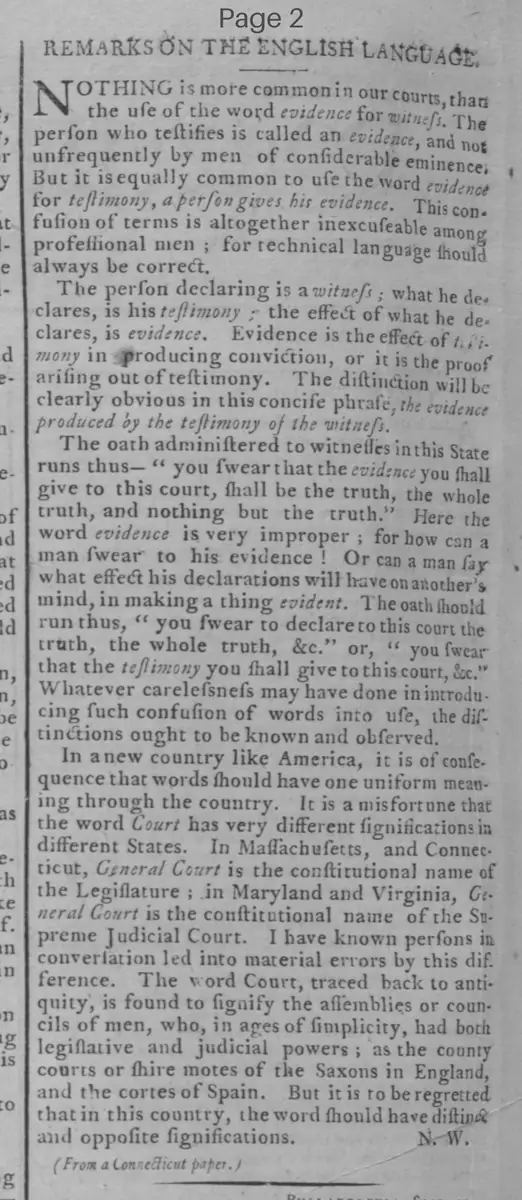
Nothing is more common in our courts, than the use of the word evidence for witness. The person who testifies is called an evidence, and not unfrequently by men of considerable eminence. But it is equally common to use the word evidence for testimony, a person gives his evidence. This confusion of terms is altogether inexcusable among professional men; for technical language should always be correct.
The person declaring is a witness; what he declares, is his testimony; the effect of what he declares, is evidence. Evidence is the effect of testimony in producing conviction, or it is the proof arising out of testimony. The distinction will be clearly obvious in this concise phrase, the evidence produced by the testimony of the witness.
The oath administered to witnesses in this State runs thus—"you swear that the evidence you shall give to this court, shall be the truth, the whole truth, and nothing but the truth." Here the word evidence is very improper; for how can a man swear to his evidence! Or can a man say what effect his declarations will have on another's mind, in making a thing evident. The oath should run thus, "you swear to declare to this court the truth, the whole truth, &c." or, "you swear that the testimony you shall give to this court, &c."
Whatever carelessness may have done in introducing such confusion of words into use, the distinctions ought to be known and observed.
In a new country like America, it is of consequence that words should have one uniform meaning through the country. It is a misfortune that the word Court has very different significations in different States. In Massachusetts, and Connecticut, General Court is the constitutional name of the Legislature; in Maryland and Virginia, General Court is the constitutional name of the Supreme Judicial Court. I have known persons in conversation led into material errors by this difference. The word Court, traced back to antiquity, is found to signify the assemblies or councils of men, who, in ages of simplicity, had both legislative and judicial powers; as the county courts or shire motes of the Saxons in England, and the cortes of Spain. But it is to be regretted that in this country, the word should have distinct and opposite significations.
N.W.
(From a Connecticut paper.)
Nothing is more common in our courts, than the use of the word evidence for witness. The person who testifies is called an evidence, and not unfrequently by men of considerable eminence. But it is equally common to use the word evidence for testimony, a person gives his evidence. This confusion of terms is altogether inexcusable among professional men; for technical language should always be correct.
The person declaring is a witness; what he declares, is his testimony; the effect of what he declares, is evidence. Evidence is the effect of testimony in producing conviction, or it is the proof arising out of testimony. The distinction will be clearly obvious in this concise phrase, the evidence produced by the testimony of the witness.
The oath administered to witnesses in this State runs thus—"you swear that the evidence you shall give to this court, shall be the truth, the whole truth, and nothing but the truth." Here the word evidence is very improper; for how can a man swear to his evidence! Or can a man say what effect his declarations will have on another's mind, in making a thing evident. The oath should run thus, "you swear to declare to this court the truth, the whole truth, &c." or, "you swear that the testimony you shall give to this court, &c."
Whatever carelessness may have done in introducing such confusion of words into use, the distinctions ought to be known and observed.
In a new country like America, it is of consequence that words should have one uniform meaning through the country. It is a misfortune that the word Court has very different significations in different States. In Massachusetts, and Connecticut, General Court is the constitutional name of the Legislature; in Maryland and Virginia, General Court is the constitutional name of the Supreme Judicial Court. I have known persons in conversation led into material errors by this difference. The word Court, traced back to antiquity, is found to signify the assemblies or councils of men, who, in ages of simplicity, had both legislative and judicial powers; as the county courts or shire motes of the Saxons in England, and the cortes of Spain. But it is to be regretted that in this country, the word should have distinct and opposite significations.
N.W.
(From a Connecticut paper.)
What sub-type of article is it?
Legal Reform
What keywords are associated?
English Language
Legal Terminology
Witness Testimony Evidence
Court Meanings
American Uniformity
What entities or persons were involved?
Massachusetts
Connecticut
Maryland
Virginia
Editorial Details
Primary Topic
Proper Usage Of Legal Terms And Uniform Meanings In America
Stance / Tone
Advocacy For Linguistic Precision In Legal And Governmental Contexts
Key Figures
Massachusetts
Connecticut
Maryland
Virginia
Key Arguments
Distinguish Witness (Person), Testimony (Declaration), Evidence (Effect/Proof)
Current Oath Uses 'Evidence' Improperly; Suggest 'Testimony' Or 'Declare'
Uniform Word Meanings Essential In New Country Like America
Varying State Uses Of 'Court' Cause Confusion And Errors