Thank you for visiting SNEWPapers!
Sign up free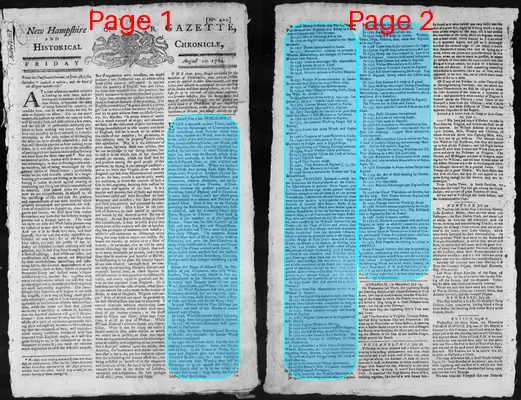
Literary
August 10, 1764
The New Hampshire Gazette And Historical Chronicle
Portsmouth, Greenland, Rockingham County, New Hampshire
What is this article about?
An historical essay reflecting on the ancient deification of inventors in agriculture, manufacturing, and navigation, contrasting early primitive England with its modern flourishing state, and chronicling key inventions, trade developments, and social improvements from the 13th to 16th centuries.
Merged-components note: Continuation of the historical extract on inventions, commerce, and development of England; text flows directly from one to the next.
Clippings
1 of 2
OCR Quality
95%
Excellent
Full Text
Extract from a late PUBLICATION
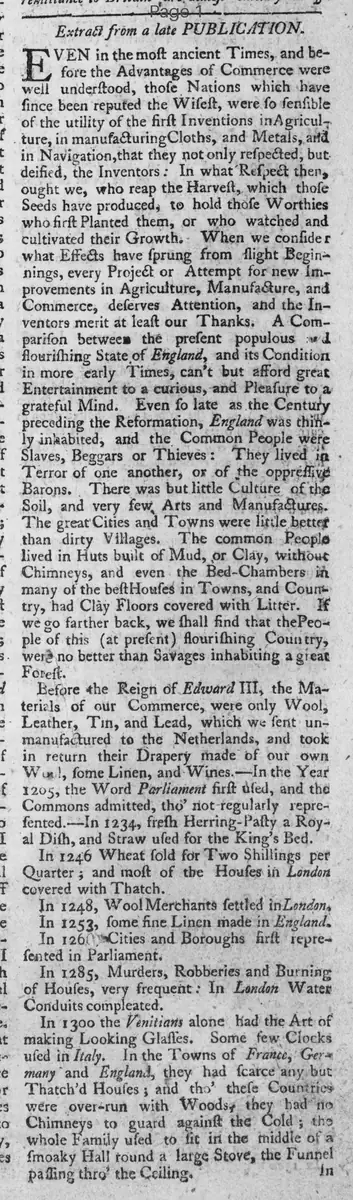
EVEN in the most ancient Times, and before the Advantages of Commerce were well understood, those Nations which have since been reputed the Wisest, were so sensible of the utility of the first Inventions in Agriculture, in manufacturing Cloths, and Metals, and in Navigation, that they not only respected, but deified, the Inventors: In what Respect then, ought we, who reap the Harvest, which those Seeds have produced, to hold those Worthies who first Planted them, or who watched and cultivated their Growth. - When we consider what Effects have sprung from light Beginnings, every Project or Attempt for new Improvements in Agriculture, Manufacture, and Commerce, deserves Attention, and the Inventors merit at least our Thanks. A Comparison between the present populous and flourishing State of England, and its Condition in more early Times, can't but afford great Entertainment to a curious, and Pleasure to a grateful Mind. Even so late as the Century preceding the Reformation, England was thinly inhabited, and the Common People were Slaves, Beggars or Thieves: They lived in Terror of one another, or of the oppressive Barons. There was but little Culture of the Soil, and very few Arts and Manufactures. The great Cities and Towns were little better than dirty Villages. The common People lived in Huts built of Mud, or Clay, without Chimneys, and even the Bed-Chambers in many of the best Houses in Towns, and Country, had Clay Floors covered with Litter. If we go farther back, we shall find that the People of this (at present) flourishing Country, were no better than Savages inhabiting a great Forest.
Before the Reign of Edward III. the Materials of our Commerce, were only Wool. Leather, Tin, and Lead, which we sent unmanufactured to the Netherlands, and took in return their Drapery made of our own Wool, some Linen, and Wines.-In the Year 1205, the Word Parliament first used, and the Commons admitted, tho' not regularly represented.--In 1234, fresh Herring-Pasties a Royal Dish, and Straw used for the King's Bed. In 1246 Wheat sold for Two Shillings per Quarter; and most of the Houses in London covered with Thatch. In 1248, Wool Merchants settled in London. In 1253, some fine Linen made in England. In 126 Cities and Boroughs first represented in Parliament. In 1285, Murders, Robberies and Burning of Houses, very frequent: In London Water Conduits completed. In 1300 the Venetians alone had the Art of making Looking Glasses. Some few Clocks used in Italy. In the Towns of France, Germany and England, they had scarce any but Thatch'd Houses: and tho' these Countries were over-run with Woods, they had no Chimneys to guard against the Cold; the whole Family used to sit in the middle of a smoky Hall round a large Stove, the Funnel passing thro the Ceiling.
In 1206 Money was so scarce that One Shilling per Day defrayed the Expence of a Bishop in Prison, with a Chaplain and Two Servants.
In 1307 Bills of Exchange first in use.
In 1323 no English Ships Traded to the Mediterranean.
In 1327 Trades incorporated in London.
In 1331, Edward III, resolved to promote a Woollen Manufactory, and brought 70 Families of Walloons into England.
In 1337 Laws to encourage this Manufacture.
In 1338 Looms set up in Bristol.
In 1344 Gold first Coined in England.
In 1348, Norwich eminent in Worsted Manufacture.
In 1351 Foreign Weavers numerous in London. Groats and Half groats the largest Silver Coin.
In 1352, no Trade to the Mediterranean.
In 1353, a little Village at Charing-Cross, Gauging Wine, &c. introduced.
In 1354 Exported to the value £294,134; Imported £38,970: Coarse Cloths exported.
In 1360, Leather Money Coined in France.
In 1362 Sumptuary Laws passed in England.
In 1365 Boroughs in Lancashire so poor they could not afford to send Members to Parliament.
In 1368 the first Clock Maker in England.
In 1375. the common Working People still in Slavery.
In 1379 London had many Woods and Copes about it.
In 1386 a Company of Linen Weavers in London.
In 1390 Coarse Cloths made at Kendal. English Merchants to Freight only in English Ships.
In 1397 Gilling and Pickling Herrings invented.
In 1399. French Woollen Cloths prohibited:
In 1412 the English Fish on the Coast of Ireland.
In 1417 PAPER made.
In 1418 Gun Powder made.
In 1421, Total Revenue of England : 55,754.
In 1424 Free Masonry prohibited.
In 1436 Coventry eminent for Woollen and Cap Manufactures.
In 1440 PRINTING Invented,--which has put Books into the Hand of almost all the World; the Establishment of political News Papers, give Individuals a Knowledge of the general Interest, sufficient enough to instruct them in all the private Transactions.--Before this Art was found out, there were but few Authors in Comparison to the great Increase of Learned Men Since.- Books in the most early Ages of the World were looked upon as curious Repositories of the Sentiments and Actions of Men, a real Treasure,and the happy Possessors. who well understood the subjects they contained. were caressed by the Wise and Favour'd by the Great.--In the Time of Cicero and Atticus, they would often sell their Houses and Lands to procure Books, transcribed from the Athenian Libraries. which could not be procured under a vast Expence. --The Works of Titus Livius were sold in those Times, (as Walton in his History of Printing tells us,). for 120 Crowns each Book.--And a Folio Manuscript in French were cost .. 33 6 8 Sterling. -Those of our Ancestors. who flourished about 300 Years ago, when there was no Printing, will readily acknowledge, that this curious Art hath not a little contributed to the Benefit and Improvement of Mankind.--It had no small share in the glorious Reformation.--The holy Scriptures were printed in our mother Tongue, and the People themselves saw the Impositions of the Monks, &c.
In 1441 Leaden Hall first erected For a Public Granary.
In 1455 some Silk-Manufacture carried on by Women in England.
In 1458 an English Ship traded to the Levant Seas.
In 1470 so destitute was England of Naval Power that the Hanse Confederacy compelled the King to make Peace upon advantageous Terms to them.
In 1482. Water Conduits brought into several Cities in England.
In 1488, Woollen Cloth not to be Exported till fully Dressed.
In 1492 England Traded to Morocco.
In 1496 the first Law to relieve impotent Beggars.
In 1502 the first Shilling coined in England.
In 1509 very few Stone or Brick Buildings. No Salads, Carrots, Turnips, or Cabbages, but from the Netherlands.
In 1512 established a Navy Office, Royal Docks, Wharfs. Storehouses. &c. Corporations erected for regulating Pilots, Beacons, Light houses, Buoys, &c.
In 1516 an English Voyage along the Coast of South America.
In 1517 Newfoundland Fishery commenced.
In 1518 a Shameful Riot in London occasioned by Prejudice against Foreigners.
In 1519 Spain lost her Woollen Manufacture:
In 1520 the first Geographical Map of England.
In 1521 Muskets brought into use.
In 1522 an English Consul at Candia.
In 1523 English Masters of the Sea.
In 1524 Soap first made in London. Turkeys, Carps, Hops, Pickerel, Beer, came into England, all in one Year.
In 1526 Trade from Bristol to Canaries for Sugar.
In 1530 an English Ship traded to Guinea & Brazil.
In 1533 Hemp and Flax ordered by Law to be Sown in England. Currants first Planted in England.
In 1531 Brass Cannon first made in England.
In 1537 Woollen Manufacture in Yorkshire.
In 1540 Cherry- Trees first Planted in England.
In 1543 first Statute concerning Bankrupts. Pins made in England. before which the Ladies used Skewers.
In 1547 Iron Cannon first made in England.
In 1549 the King encouraged Foreign Protestants to settle in England, who much advanced Trade and Manufactures. Lands improved by inclosures, which occasioned Kett's Rebellion.
In 1552 Hops and Saffron planted in England. No Taverns but in Cities and Towns.
In 1553 Spain paid for Leave to Fish on the Irish Coast.
In 1554 Russia Company incorporated.
In 1555 first Law for mending Roads.
In 1557 Glass made in England.
In 1560 first Insurance on Merchandize at Sea.
In 1561 Queen Elizabeth wore the first Pair of Knit Silk Stockings. Copper Mine discovered. Grain exported.
In 1563 first compulsory Law to relieve the Poor. A Law to promote Shipping, and encourage Mariners. Knives Art made in England.
In 1565 Projects for making Brimstone and Oil. Wire Drawing by a Mill first introduced.
In 1567 Persecution in Netherlands drive many into England. who introduce Manufacture of Bays, Says. &c.
In 1568 Persecution in France drives People into England.
In 1569 the Art of Book-keeping by Double- Entry first published.
In 1571 Felt Hats made.
In 1577 Watches first brought into England from Germany.
In 1578 the Use of Whalebone not known, but the Oil only. First Treaty between England and the States of the Netherlands.
In 1579 Voyage round the World by Drake.
In 1580 Norwich became populous by the Persecuted Netherlanders Settling in it. The first Coach used in England by Earl of Arundel.
In 1581 Turkey Company erected.
In 1582 Q. Elizabeth corresponds with the Grand Seigneur. in order to establish Commerce with his Dominions. The Artichoke, Musk Rose, and Apricot, several Sorts of Plumbs, divers kinds of Flowers, particularly Tulips, first planted about this Time in England ; but no Peaches, Or Nectarines.
In 1583 First Proposal for Settling a Colony in AMERICA.
In the Fifteenth Century. such was the prevailing Ignorance, that Learning was looked upon as a sort of Heresy.and there were Bishops who did not know their Letters. In their Subscriptions to Synodal Acts. the following Words are to be found, namely, As I can't Read myself. N. N. hath Subscribed for me ; Or. ( As my Lord Bishop can't Write himself, at his Request I have Subscribed. Yet were there many Inventions, and Improvements.
EVEN in the most ancient Times, and before the Advantages of Commerce were well understood, those Nations which have since been reputed the Wisest, were so sensible of the utility of the first Inventions in Agriculture, in manufacturing Cloths, and Metals, and in Navigation, that they not only respected, but deified, the Inventors: In what Respect then, ought we, who reap the Harvest, which those Seeds have produced, to hold those Worthies who first Planted them, or who watched and cultivated their Growth. - When we consider what Effects have sprung from light Beginnings, every Project or Attempt for new Improvements in Agriculture, Manufacture, and Commerce, deserves Attention, and the Inventors merit at least our Thanks. A Comparison between the present populous and flourishing State of England, and its Condition in more early Times, can't but afford great Entertainment to a curious, and Pleasure to a grateful Mind. Even so late as the Century preceding the Reformation, England was thinly inhabited, and the Common People were Slaves, Beggars or Thieves: They lived in Terror of one another, or of the oppressive Barons. There was but little Culture of the Soil, and very few Arts and Manufactures. The great Cities and Towns were little better than dirty Villages. The common People lived in Huts built of Mud, or Clay, without Chimneys, and even the Bed-Chambers in many of the best Houses in Towns, and Country, had Clay Floors covered with Litter. If we go farther back, we shall find that the People of this (at present) flourishing Country, were no better than Savages inhabiting a great Forest.
Before the Reign of Edward III. the Materials of our Commerce, were only Wool. Leather, Tin, and Lead, which we sent unmanufactured to the Netherlands, and took in return their Drapery made of our own Wool, some Linen, and Wines.-In the Year 1205, the Word Parliament first used, and the Commons admitted, tho' not regularly represented.--In 1234, fresh Herring-Pasties a Royal Dish, and Straw used for the King's Bed. In 1246 Wheat sold for Two Shillings per Quarter; and most of the Houses in London covered with Thatch. In 1248, Wool Merchants settled in London. In 1253, some fine Linen made in England. In 126 Cities and Boroughs first represented in Parliament. In 1285, Murders, Robberies and Burning of Houses, very frequent: In London Water Conduits completed. In 1300 the Venetians alone had the Art of making Looking Glasses. Some few Clocks used in Italy. In the Towns of France, Germany and England, they had scarce any but Thatch'd Houses: and tho' these Countries were over-run with Woods, they had no Chimneys to guard against the Cold; the whole Family used to sit in the middle of a smoky Hall round a large Stove, the Funnel passing thro the Ceiling.
In 1206 Money was so scarce that One Shilling per Day defrayed the Expence of a Bishop in Prison, with a Chaplain and Two Servants.
In 1307 Bills of Exchange first in use.
In 1323 no English Ships Traded to the Mediterranean.
In 1327 Trades incorporated in London.
In 1331, Edward III, resolved to promote a Woollen Manufactory, and brought 70 Families of Walloons into England.
In 1337 Laws to encourage this Manufacture.
In 1338 Looms set up in Bristol.
In 1344 Gold first Coined in England.
In 1348, Norwich eminent in Worsted Manufacture.
In 1351 Foreign Weavers numerous in London. Groats and Half groats the largest Silver Coin.
In 1352, no Trade to the Mediterranean.
In 1353, a little Village at Charing-Cross, Gauging Wine, &c. introduced.
In 1354 Exported to the value £294,134; Imported £38,970: Coarse Cloths exported.
In 1360, Leather Money Coined in France.
In 1362 Sumptuary Laws passed in England.
In 1365 Boroughs in Lancashire so poor they could not afford to send Members to Parliament.
In 1368 the first Clock Maker in England.
In 1375. the common Working People still in Slavery.
In 1379 London had many Woods and Copes about it.
In 1386 a Company of Linen Weavers in London.
In 1390 Coarse Cloths made at Kendal. English Merchants to Freight only in English Ships.
In 1397 Gilling and Pickling Herrings invented.
In 1399. French Woollen Cloths prohibited:
In 1412 the English Fish on the Coast of Ireland.
In 1417 PAPER made.
In 1418 Gun Powder made.
In 1421, Total Revenue of England : 55,754.
In 1424 Free Masonry prohibited.
In 1436 Coventry eminent for Woollen and Cap Manufactures.
In 1440 PRINTING Invented,--which has put Books into the Hand of almost all the World; the Establishment of political News Papers, give Individuals a Knowledge of the general Interest, sufficient enough to instruct them in all the private Transactions.--Before this Art was found out, there were but few Authors in Comparison to the great Increase of Learned Men Since.- Books in the most early Ages of the World were looked upon as curious Repositories of the Sentiments and Actions of Men, a real Treasure,and the happy Possessors. who well understood the subjects they contained. were caressed by the Wise and Favour'd by the Great.--In the Time of Cicero and Atticus, they would often sell their Houses and Lands to procure Books, transcribed from the Athenian Libraries. which could not be procured under a vast Expence. --The Works of Titus Livius were sold in those Times, (as Walton in his History of Printing tells us,). for 120 Crowns each Book.--And a Folio Manuscript in French were cost .. 33 6 8 Sterling. -Those of our Ancestors. who flourished about 300 Years ago, when there was no Printing, will readily acknowledge, that this curious Art hath not a little contributed to the Benefit and Improvement of Mankind.--It had no small share in the glorious Reformation.--The holy Scriptures were printed in our mother Tongue, and the People themselves saw the Impositions of the Monks, &c.
In 1441 Leaden Hall first erected For a Public Granary.
In 1455 some Silk-Manufacture carried on by Women in England.
In 1458 an English Ship traded to the Levant Seas.
In 1470 so destitute was England of Naval Power that the Hanse Confederacy compelled the King to make Peace upon advantageous Terms to them.
In 1482. Water Conduits brought into several Cities in England.
In 1488, Woollen Cloth not to be Exported till fully Dressed.
In 1492 England Traded to Morocco.
In 1496 the first Law to relieve impotent Beggars.
In 1502 the first Shilling coined in England.
In 1509 very few Stone or Brick Buildings. No Salads, Carrots, Turnips, or Cabbages, but from the Netherlands.
In 1512 established a Navy Office, Royal Docks, Wharfs. Storehouses. &c. Corporations erected for regulating Pilots, Beacons, Light houses, Buoys, &c.
In 1516 an English Voyage along the Coast of South America.
In 1517 Newfoundland Fishery commenced.
In 1518 a Shameful Riot in London occasioned by Prejudice against Foreigners.
In 1519 Spain lost her Woollen Manufacture:
In 1520 the first Geographical Map of England.
In 1521 Muskets brought into use.
In 1522 an English Consul at Candia.
In 1523 English Masters of the Sea.
In 1524 Soap first made in London. Turkeys, Carps, Hops, Pickerel, Beer, came into England, all in one Year.
In 1526 Trade from Bristol to Canaries for Sugar.
In 1530 an English Ship traded to Guinea & Brazil.
In 1533 Hemp and Flax ordered by Law to be Sown in England. Currants first Planted in England.
In 1531 Brass Cannon first made in England.
In 1537 Woollen Manufacture in Yorkshire.
In 1540 Cherry- Trees first Planted in England.
In 1543 first Statute concerning Bankrupts. Pins made in England. before which the Ladies used Skewers.
In 1547 Iron Cannon first made in England.
In 1549 the King encouraged Foreign Protestants to settle in England, who much advanced Trade and Manufactures. Lands improved by inclosures, which occasioned Kett's Rebellion.
In 1552 Hops and Saffron planted in England. No Taverns but in Cities and Towns.
In 1553 Spain paid for Leave to Fish on the Irish Coast.
In 1554 Russia Company incorporated.
In 1555 first Law for mending Roads.
In 1557 Glass made in England.
In 1560 first Insurance on Merchandize at Sea.
In 1561 Queen Elizabeth wore the first Pair of Knit Silk Stockings. Copper Mine discovered. Grain exported.
In 1563 first compulsory Law to relieve the Poor. A Law to promote Shipping, and encourage Mariners. Knives Art made in England.
In 1565 Projects for making Brimstone and Oil. Wire Drawing by a Mill first introduced.
In 1567 Persecution in Netherlands drive many into England. who introduce Manufacture of Bays, Says. &c.
In 1568 Persecution in France drives People into England.
In 1569 the Art of Book-keeping by Double- Entry first published.
In 1571 Felt Hats made.
In 1577 Watches first brought into England from Germany.
In 1578 the Use of Whalebone not known, but the Oil only. First Treaty between England and the States of the Netherlands.
In 1579 Voyage round the World by Drake.
In 1580 Norwich became populous by the Persecuted Netherlanders Settling in it. The first Coach used in England by Earl of Arundel.
In 1581 Turkey Company erected.
In 1582 Q. Elizabeth corresponds with the Grand Seigneur. in order to establish Commerce with his Dominions. The Artichoke, Musk Rose, and Apricot, several Sorts of Plumbs, divers kinds of Flowers, particularly Tulips, first planted about this Time in England ; but no Peaches, Or Nectarines.
In 1583 First Proposal for Settling a Colony in AMERICA.
In the Fifteenth Century. such was the prevailing Ignorance, that Learning was looked upon as a sort of Heresy.and there were Bishops who did not know their Letters. In their Subscriptions to Synodal Acts. the following Words are to be found, namely, As I can't Read myself. N. N. hath Subscribed for me ; Or. ( As my Lord Bishop can't Write himself, at his Request I have Subscribed. Yet were there many Inventions, and Improvements.
What sub-type of article is it?
Essay
What themes does it cover?
Commerce Trade
Agriculture Rural
Political
What keywords are associated?
English History
Commerce Development
Agricultural Inventions
Manufacturing Progress
Trade Milestones
Historical Chronology
Economic Improvement
Literary Details
Title
Extract From A Late Publication
Subject
Historical Progress In English Agriculture, Manufactures, And Commerce
Key Lines
Even In The Most Ancient Times, And Before The Advantages Of Commerce Were Well Understood, Those Nations Which Have Since Been Reputed The Wisest, Were So Sensible Of The Utility Of The First Inventions In Agriculture, In Manufacturing Cloths, And Metals, And In Navigation, That They Not Only Respected, But Deified, The Inventors
A Comparison Between The Present Populous And Flourishing State Of England, And Its Condition In More Early Times, Can't But Afford Great Entertainment To A Curious, And Pleasure To A Grateful Mind.
In 1440 Printing Invented, Which Has Put Books Into The Hand Of Almost All The World; The Establishment Of Political News Papers, Give Individuals A Knowledge Of The General Interest, Sufficient Enough To Instruct Them In All The Private Transactions.
It Had No Small Share In The Glorious Reformation. The Holy Scriptures Were Printed In Our Mother Tongue, And The People Themselves Saw The Impositions Of The Monks, &C.
In 1583 First Proposal For Settling A Colony In America.