Thank you for visiting SNEWPapers!
Sign up free
Letter to Editor
April 30, 1808
Alexandria Daily Advertiser
Alexandria, Virginia
What is this article about?
An anonymous writer defends the US embargo policy in response to an essay by 'Junius,' arguing it is the least evil amid British and French aggressions on American trade and sovereignty. He critiques biased views on foreign insults and asserts the government's appropriate responses.
Clipping
OCR Quality
95%
Excellent
Full Text
For the Alexandria Daily Advertiser.
MR. EDITOR,
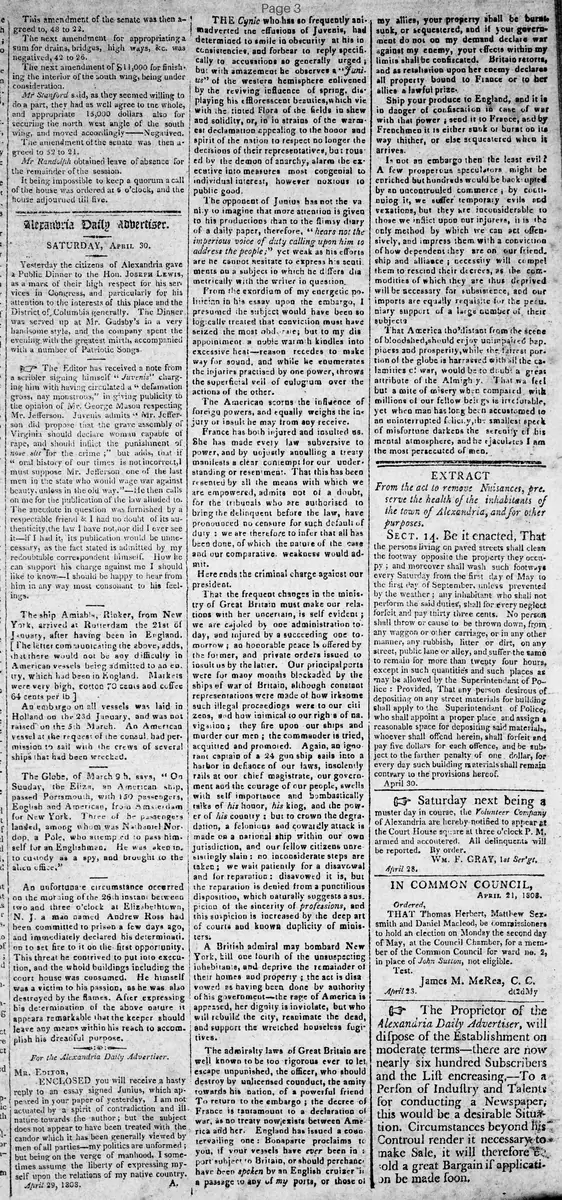
ENCLOSED you will receive a hasty reply to an essay signed Junius, which appeared in your paper of yesterday, I am not actuated by a spirit of contradiction and ill nature towards the author; but the subject does not appear to have been treated with the candor which it has been generally viewed by men of all parties—my politics are unformed; but being on the verge of manhood, I sometimes assume the liberty of expressing myself upon the relations of my native country.
The Junius who has so frequently animadverted in the effusions of Juvenis, had determined to smile in obscurity at his inconsistencies, and forbear to reply specifically to accusations so generally urged; but with amazement he observes a "Junius" of the western hemisphere enlivened by the reviving influence of spring, displaying his fluorescent beauties, which vie with the tinted Flora of the fields in shew and solidity, or, in other strains of the warmest declamation appealing to the honor and spirit of the nation to respect no longer the decisions of their representatives, but roused by the demon of anarchy, alarm the executive into measures most congenial to individual interest, however noxious to public good.
The opponent of Junius has not the vanity to imagine that more attention is given to his productions than to the flimsy diary of a daily paper, therefore, "hears not the imperious voice of duty calling upon him to address the people;" yet weak as his efforts are he cannot hesitate to express his sentiments on a subject in which he differs diametrically with the writer in question.
From the exordium of my energetic politician in his essay upon the embargo, I presumed the subject would have been so logically treated that conviction must have seized the most obdurate; but to my disappointment a noble warmth kindles into excessive heat—reason recedes to make way for sound, and while he enumerates the injuries practiced by one power, throws the superficial veil of eulogium over the actions of the other.
The American scorns the influence of foreign powers, and equally weighs the injury or insult he may from any receive. France has both injured and insulted us. She has made every law subversive to power, and by unjustly annulling a treaty manifests a clear contempt for our understanding or resentment. That this has been resented by all the means with which we are empowered, admit not of a doubt. For the tribunals who are authorized to bring the delinquent before the law, have pronounced no censure for such default of duty: we are therefore to infer that all has been done, of which the nature of the case and our comparative weakness would admit.
Here ends the criminal charge against our president.
That the frequent changes in the ministry of Great Britain must make our relations with her uncertain, is self evident; we are cajoled by one administration to day, and injured by a succeeding one to morrow; an honorable peace is offered by the former, and private orders issued to insult us by the latter. Our principal ports were for many months blockaded by the ships of war of Britain, although constant representations were made of how irksome such illegal proceedings were to our citizens, and how inimical to our rights of navigation; they fire upon our ships and murder our men: the commander is tried, acquitted and promoted. Again, an ignorant captain of a 24 gun ship sails into a harbor in defiance of our laws, insolently rails at our chief magistrate, our government and the courage of our people, swells with self importance and bombastically talks of his honor, his king, and the power of his country: but to crown the degradation, a felonious and cowardly attack is made on a national ship within our own jurisdiction, and our fellow citizens unresistingly slain: no inconsiderate steps are taken; we wait patiently for a disavowal and for reparation: disavowed it is, but the reparation is denied from a punctilious disposition, which naturally suggests a suspicion of the sincerity of professions, and this suspicion is increased by the deep art of courts and known duplicity of ministers:
A British admiral may bombard New York, till one fourth of the unsuspecting inhabitants, and deprive the remainder of their homes and property; the act is disavowed as having been done by authority of his government—the rage of America is appeased, her dignity is inviolate, but who will rebuild the city, reanimate the dead, and support the wretched houseless fugitives.'
The admiralty laws of Great Britain are well known to be too rigorous ever to let escape unpunished, the officer, who should destroy by unlicensed conduct, the amity towards his nation, of a powerful friend
To return to the embargo; the decree of France is tantamount to a declaration of War, as no treaty now exists between America and her. England has issued a countervailing one: Bonaparte proclaims to you, if your vessels have ever been in a port subject to Britain, or should perchance have been spoken by an English cruizer in a passage to any of my ports, or those of my allies, your property shall be burnt sunk, or sequestered, and if your government do not on my demand declare war against my enemy, your effects within my limits shall be confiscated. Britain retorts, and as retaliation upon her enemy declares all property bound to France or to her allies a lawful prize.
Ship your produce to England, and it is in danger of confiscation in case of war with that power; send it to France, and by Frenchmen it is either sunk or burnt on its way thither, or else sequestered when it arrives.
Is not an embargo then the least evil? A few prosperous speculators might be enriched but hundreds would be bankrupted by an uncontrolled commerce; by continuing it, we suffer temporary evils and vexations, but they are inconsiderable to those we inflict upon our injurers, in it is the only method by which we can act offensively, and impress them with a conviction of how dependent they are on our friendship and alliance: necessity will compel them to rescind their decrees, as the commodities of which they are thus deprived will be necessary for subsistence, and our imports are equally requisite for the pecuniary support of a large number of their subjects
That America tho' distant from the scene of bloodshed, should enjoy unimpaired happiness and prosperity, while the fairest portion of the globe is harassed with all the calamities of war, would be to doubt a great attribute of the Almighty. That we feel but a mite of misery when compared with millions of our fellow beings is irrefutable, yet when man has long been accustomed to an uninterrupted felicity, the smallest speck of misfortune darkens the serenity of his mental atmosphere, and he ejaculates I am the most persecuted of men,
MR. EDITOR,
ENCLOSED you will receive a hasty reply to an essay signed Junius, which appeared in your paper of yesterday, I am not actuated by a spirit of contradiction and ill nature towards the author; but the subject does not appear to have been treated with the candor which it has been generally viewed by men of all parties—my politics are unformed; but being on the verge of manhood, I sometimes assume the liberty of expressing myself upon the relations of my native country.
The Junius who has so frequently animadverted in the effusions of Juvenis, had determined to smile in obscurity at his inconsistencies, and forbear to reply specifically to accusations so generally urged; but with amazement he observes a "Junius" of the western hemisphere enlivened by the reviving influence of spring, displaying his fluorescent beauties, which vie with the tinted Flora of the fields in shew and solidity, or, in other strains of the warmest declamation appealing to the honor and spirit of the nation to respect no longer the decisions of their representatives, but roused by the demon of anarchy, alarm the executive into measures most congenial to individual interest, however noxious to public good.
The opponent of Junius has not the vanity to imagine that more attention is given to his productions than to the flimsy diary of a daily paper, therefore, "hears not the imperious voice of duty calling upon him to address the people;" yet weak as his efforts are he cannot hesitate to express his sentiments on a subject in which he differs diametrically with the writer in question.
From the exordium of my energetic politician in his essay upon the embargo, I presumed the subject would have been so logically treated that conviction must have seized the most obdurate; but to my disappointment a noble warmth kindles into excessive heat—reason recedes to make way for sound, and while he enumerates the injuries practiced by one power, throws the superficial veil of eulogium over the actions of the other.
The American scorns the influence of foreign powers, and equally weighs the injury or insult he may from any receive. France has both injured and insulted us. She has made every law subversive to power, and by unjustly annulling a treaty manifests a clear contempt for our understanding or resentment. That this has been resented by all the means with which we are empowered, admit not of a doubt. For the tribunals who are authorized to bring the delinquent before the law, have pronounced no censure for such default of duty: we are therefore to infer that all has been done, of which the nature of the case and our comparative weakness would admit.
Here ends the criminal charge against our president.
That the frequent changes in the ministry of Great Britain must make our relations with her uncertain, is self evident; we are cajoled by one administration to day, and injured by a succeeding one to morrow; an honorable peace is offered by the former, and private orders issued to insult us by the latter. Our principal ports were for many months blockaded by the ships of war of Britain, although constant representations were made of how irksome such illegal proceedings were to our citizens, and how inimical to our rights of navigation; they fire upon our ships and murder our men: the commander is tried, acquitted and promoted. Again, an ignorant captain of a 24 gun ship sails into a harbor in defiance of our laws, insolently rails at our chief magistrate, our government and the courage of our people, swells with self importance and bombastically talks of his honor, his king, and the power of his country: but to crown the degradation, a felonious and cowardly attack is made on a national ship within our own jurisdiction, and our fellow citizens unresistingly slain: no inconsiderate steps are taken; we wait patiently for a disavowal and for reparation: disavowed it is, but the reparation is denied from a punctilious disposition, which naturally suggests a suspicion of the sincerity of professions, and this suspicion is increased by the deep art of courts and known duplicity of ministers:
A British admiral may bombard New York, till one fourth of the unsuspecting inhabitants, and deprive the remainder of their homes and property; the act is disavowed as having been done by authority of his government—the rage of America is appeased, her dignity is inviolate, but who will rebuild the city, reanimate the dead, and support the wretched houseless fugitives.'
The admiralty laws of Great Britain are well known to be too rigorous ever to let escape unpunished, the officer, who should destroy by unlicensed conduct, the amity towards his nation, of a powerful friend
To return to the embargo; the decree of France is tantamount to a declaration of War, as no treaty now exists between America and her. England has issued a countervailing one: Bonaparte proclaims to you, if your vessels have ever been in a port subject to Britain, or should perchance have been spoken by an English cruizer in a passage to any of my ports, or those of my allies, your property shall be burnt sunk, or sequestered, and if your government do not on my demand declare war against my enemy, your effects within my limits shall be confiscated. Britain retorts, and as retaliation upon her enemy declares all property bound to France or to her allies a lawful prize.
Ship your produce to England, and it is in danger of confiscation in case of war with that power; send it to France, and by Frenchmen it is either sunk or burnt on its way thither, or else sequestered when it arrives.
Is not an embargo then the least evil? A few prosperous speculators might be enriched but hundreds would be bankrupted by an uncontrolled commerce; by continuing it, we suffer temporary evils and vexations, but they are inconsiderable to those we inflict upon our injurers, in it is the only method by which we can act offensively, and impress them with a conviction of how dependent they are on our friendship and alliance: necessity will compel them to rescind their decrees, as the commodities of which they are thus deprived will be necessary for subsistence, and our imports are equally requisite for the pecuniary support of a large number of their subjects
That America tho' distant from the scene of bloodshed, should enjoy unimpaired happiness and prosperity, while the fairest portion of the globe is harassed with all the calamities of war, would be to doubt a great attribute of the Almighty. That we feel but a mite of misery when compared with millions of our fellow beings is irrefutable, yet when man has long been accustomed to an uninterrupted felicity, the smallest speck of misfortune darkens the serenity of his mental atmosphere, and he ejaculates I am the most persecuted of men,
What sub-type of article is it?
Persuasive
Political
Informative
What themes does it cover?
Economic Policy
Politics
Commerce Trade
What keywords are associated?
Embargo Policy
British Insults
French Decrees
American Trade
Foreign Relations
Naval Aggression
Presidential Defense
What entities or persons were involved?
Mr. Editor
Letter to Editor Details
Recipient
Mr. Editor
Main Argument
the embargo is the least evil option for the us amid french and british trade aggressions and insults; the government has adequately responded to these violations without escalating to war.
Notable Details
Reply To Essay Signed Junius
Critique Of British Blockades And Attacks On Us Ships
French Decrees Annulling Treaty And Sequestering Property
Defense Of President's Actions